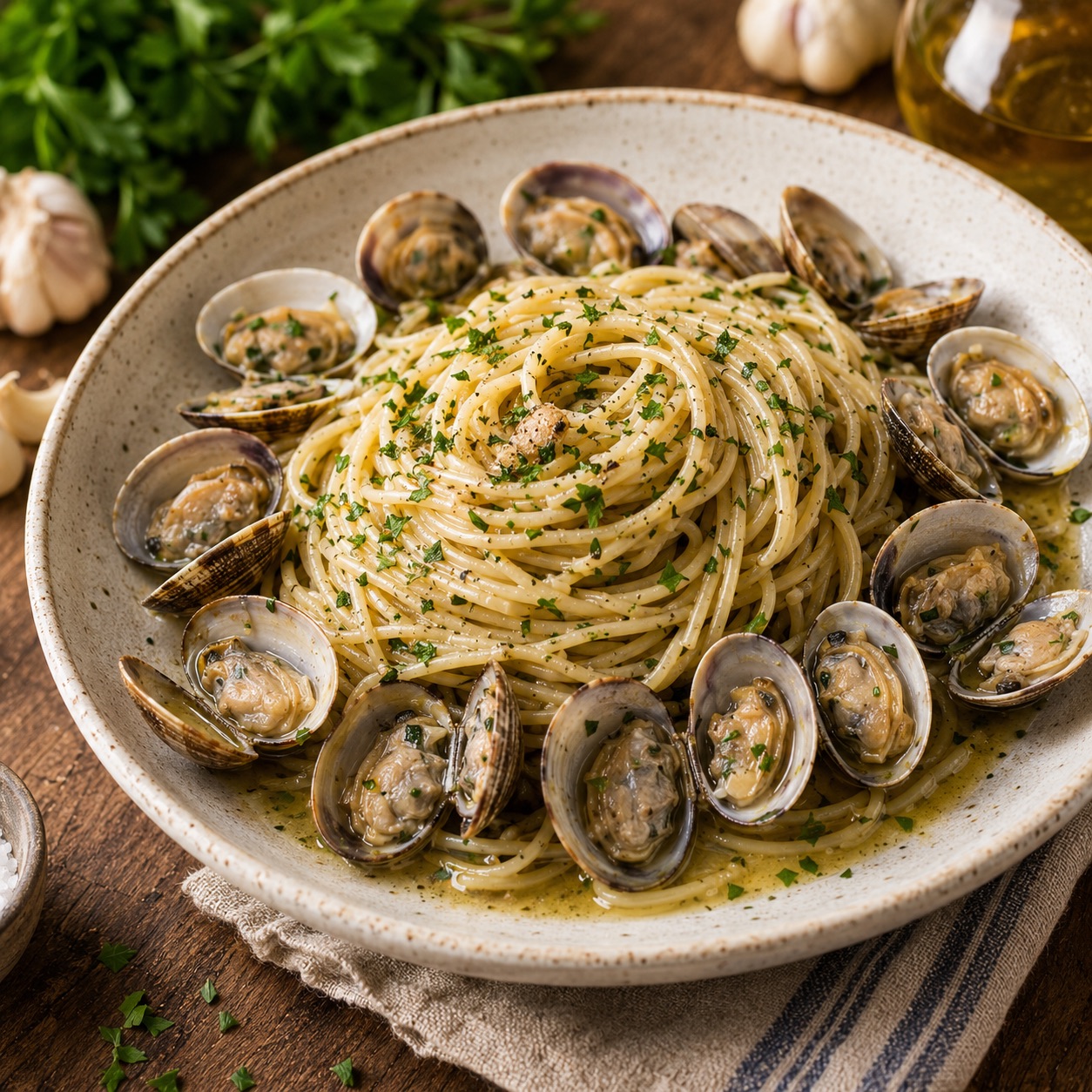
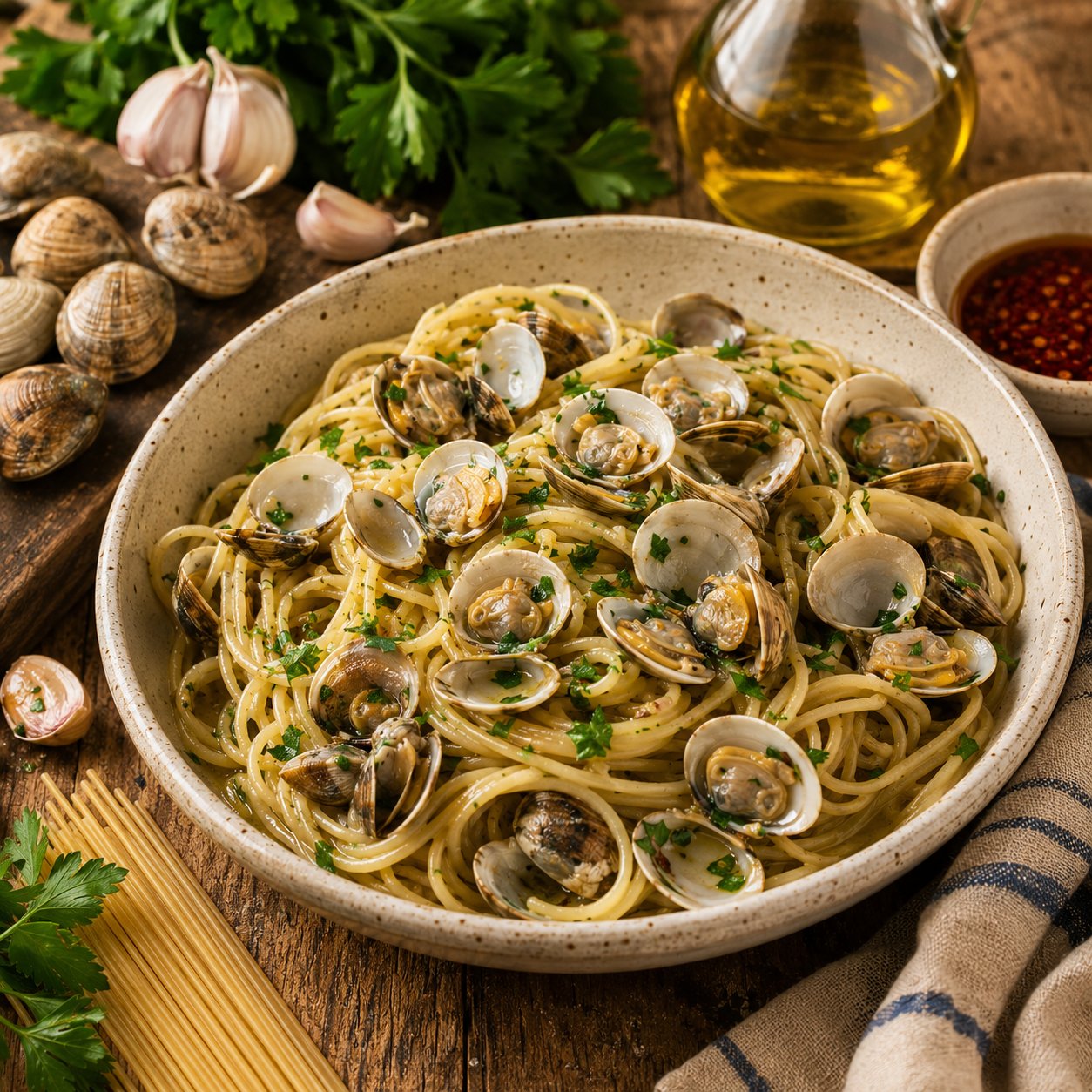
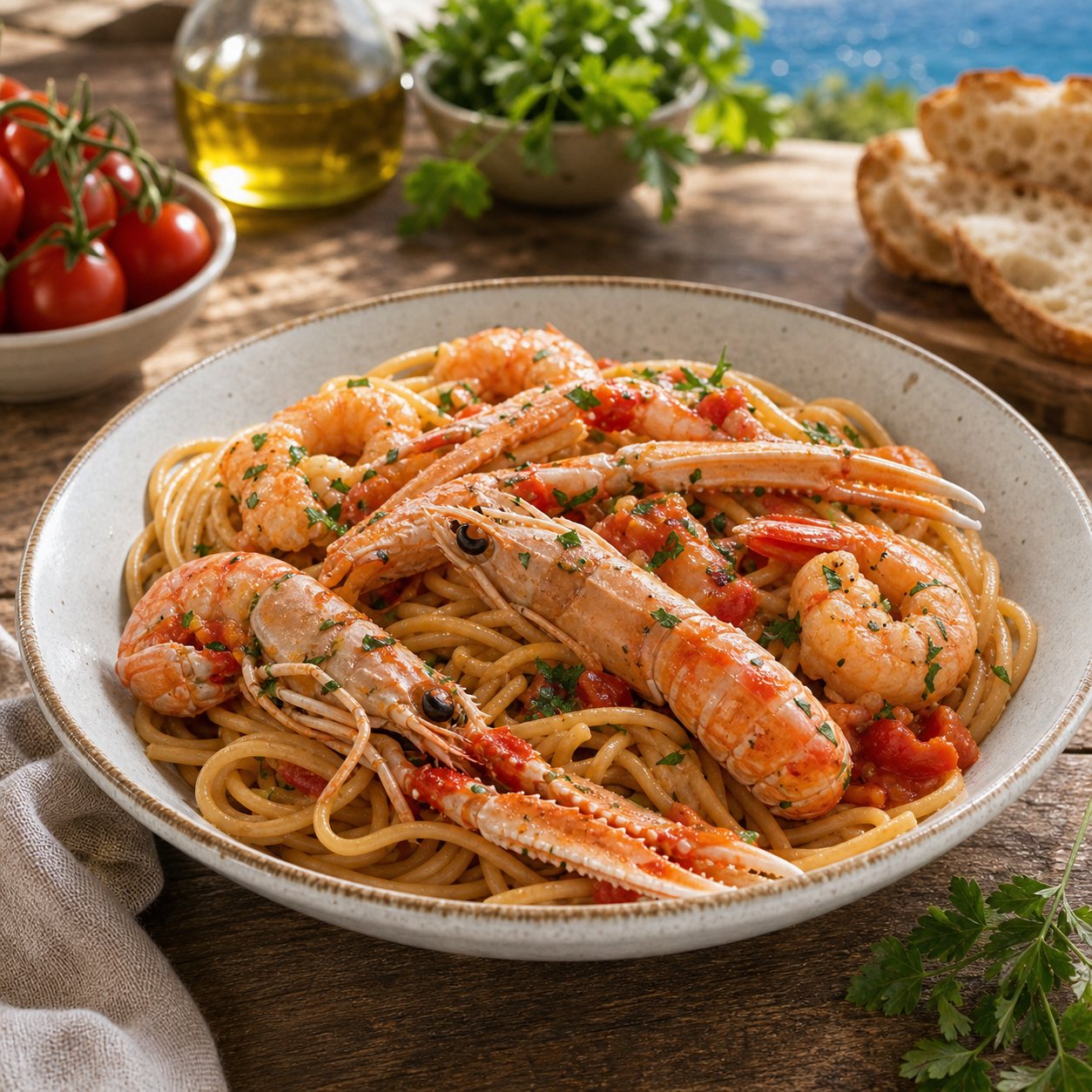
Spaghetti allo scoglio
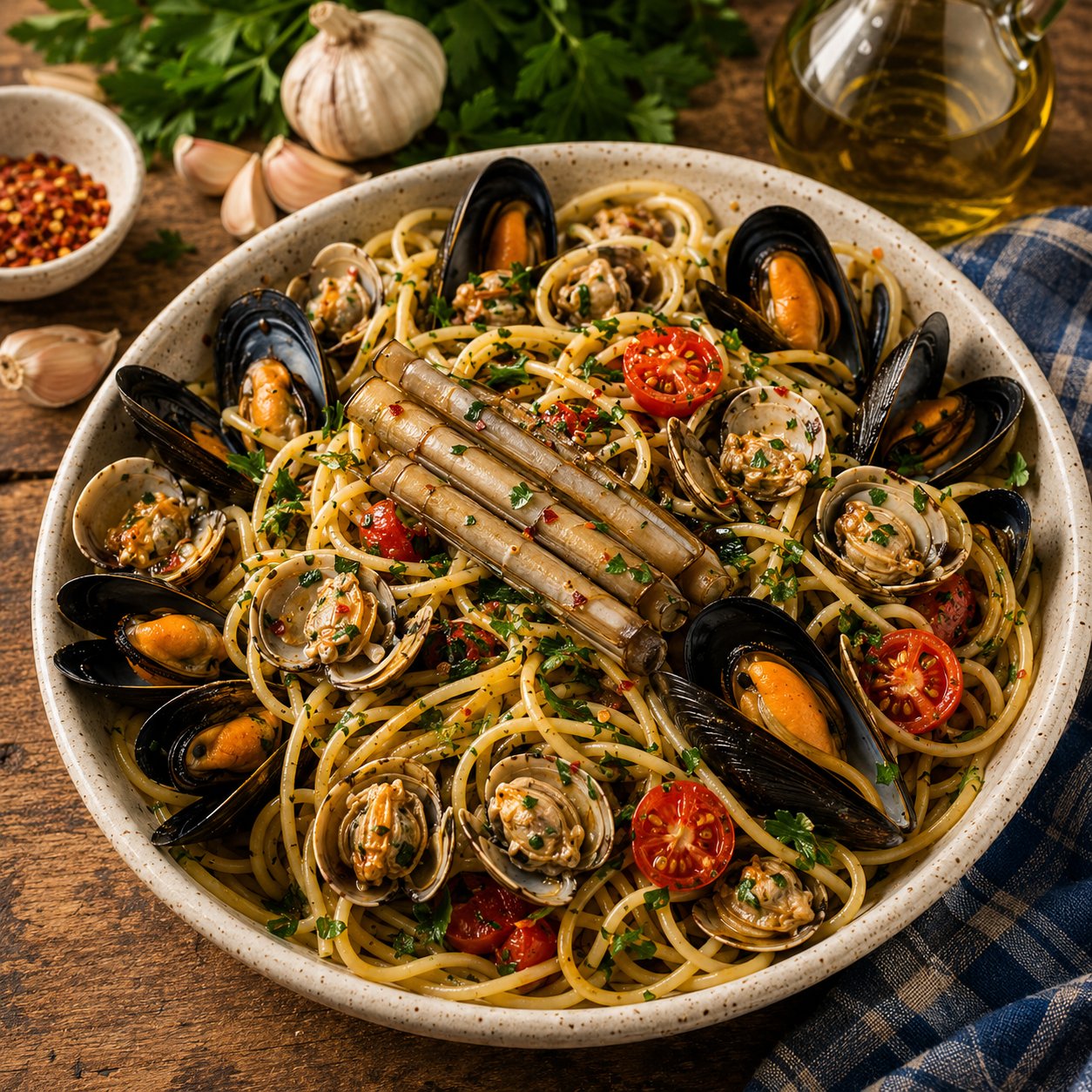
The feast version — four bivalves, one pan, one composite broth that none of them could produce alone. Cozze always, vongole or lupini always, cannolicchi and fasolari when the market had them. White wine, parsley at the end. The pasta of Christmas Eve, New Year's Eve, and the special Friday lunches that felt like an occasion.
On Christmas Eve the table was organized around fish. The cenone della Vigilia was a long meal — several courses, several hours, the family gathered in a way that only happened a few times a year. My father ate puttanesca, as he did on any night the table organized itself around the sea. The rest of us ate the scoglio, which was not an everyday pasta but a statement: this evening requires something more than a single shellfish.
The name means rocks — the rocks of the sea floor where these animals live, each one drawing its flavor from a slightly different depth and substrate. Cozze from the surface, where the water is warm and phytoplankton-rich. Vongole or lupini from the sandy bottom. Cannolicchi from deeper sand — the razor clams, long and narrow and open at both ends, named for the cut-throat razor they resemble, driving themselves vertically into the substrate with a muscular foot. Fasolari from coarser ground: the largest of the four, thick mahogany shells, firm crunchy meat, and a vivid red foot that you notice the moment you open them. Their guazzetto alone has a density and oceanic intensity that the smaller bivalves cannot match. When you open all four in the same pan, the combined liquid is layered in a way that no single species produces. The wine goes in to lift and unify it. The parsley goes in at the very end, because this is a Campanian kitchen and parsley always goes in at the very end.
The tomato question always came up. My mother's position was consistent: in bianco, so the shellfish speak without interruption. But on a feast day, when the table had candles and the occasion called for something visually festive, a few ripe cherry tomatoes in the base made the sauce look the way a Christmas Eve pasta should look — deep, slightly red, generous. She did not add much. She said too much tomato suppressed the real flavor of the clams, and she was right about that, so the few she used were a concession to the occasion rather than a culinary conviction.
Why mixed shellfish broth is more complex than the sum of its parts
Each bivalve species produces a distinct guazzetto reflecting its biology, diet, and habitat. Mussels (Mytilus galloprovincialis) release a broth dominated by branched-chain amino acids and sulfur-containing volatiles with a deep, mineral character. Clams (vongole or lupini) contribute higher concentrations of glycine and taurine — the amino acids responsible for marine sweetness — plus shorter-chain aldehydes from their phytoplankton diet. Cannolicchi (Solen marginatus) are razor clams — long, narrow, open at both ends, their muscular foot designed to drive them deep into sandy substrate. They live in coarser, deeper sediment than vongole and filter different organic matter; their liquid is lighter and sweeter, with more volatile esters and fewer sulfur compounds, which is why they cut through the mineral weight of the mussels in the finished broth. Fasolari (Callista chione) are among the largest and meatiest Mediterranean bivalves — thick-shelled, up to 9 cm, with a distinctively firm, crunchy texture and a vivid red foot that signals the glycogen density of their muscle tissue. Their guazzetto is concentrated and intensely oceanic, adding viscosity and body that the other three cannot replicate. When all four are opened in the same pan, these distinct flavor compounds interact: the sulfur volatiles from the mussels bind with ester compounds from the cannolicchi, the amino acids from the clams provide a sweet base that carries the whole mixture, and the fasolari liquid adds viscosity. The white wine contributes ethanol, which acts as a solvent for fat-soluble aromatic compounds that would not otherwise dissolve into the water-based broth — this is the chemical reason wine belongs in this dish in a way it is only optional in the single-species preparations. The result is a guazzetto more aromatic and more complex than any single shellfish produces alone. This is what the risottatura then drives into the pasta.
What goes in — and what the market decides
Cozze always
Fresh mussels — the mineral backbone of the combined broth. Their sulfur-rich guazzetto is the deepest note in the pan, the one that makes the whole thing smell unmistakably of the open sea. Scrubbed and debearded; open first as they release the most liquid.
Vongole or lupini always
Whichever was at the market. Their guazzetto is the sweet register — high in glycine and taurine, the amino acids that give shellfish broth its marine sweetness and keep the mussel depth from becoming heavy. Lupini give more intensity; vongole veraci more delicacy. Use one or the other, not both.
Cannolicchi when available
Razor clams (Solen marginatus) — long, narrow, straight-shelled, named after the cut-throat razor they resemble. Both ends permanently gape open; the muscular foot extends from one end and drives them deep into sand. 15–17 cm long. Sweet and delicate, the lightest of the four. Subject to seasonal harvest restrictions in Italy — genuinely hard to find some years. The pasta is different when they are in it.
Fasolari when available
Venus clams (Callista chione) — large, 5–9 cm, with a thick glossy shell in rich reddish-brown or mahogany with concentric rings. The interior is white, tinged purple. The meat is distinctive: a vivid red fleshy foot surrounded by firm, crunchy white meat — more substantial than any other bivalve in this dish. Intensely salty and oceanic. Their guazzetto adds body to the combined broth that the others cannot.
The tomato question — make your decision before you start
With tomato: a few ripe cherry tomatoes — no more than 150 g for four people — cooked down briefly in the garlic base before the shellfish liquids go in. The sauce takes on color and a faint sweetness that makes it look and feel more festive. Do not add more than a few. Too much tomato suppresses what you spent twenty minutes building.
The recipe — serves 4
Ingredients
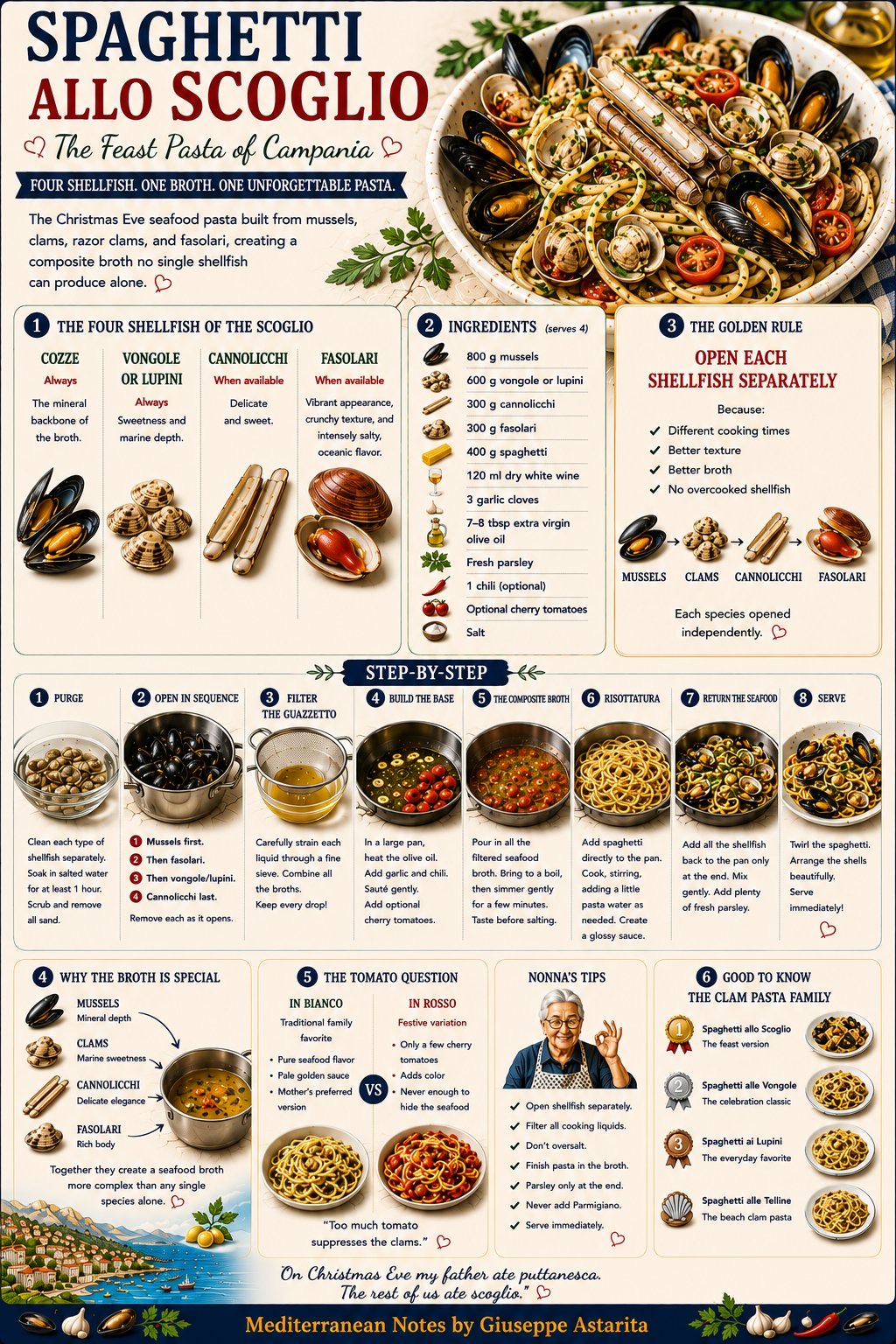
Method
Purge all the shellfish — start 2 hours before. Keep the species separate in different bowls of cold salted water (30 g per litre). They will expel sand at different rates and you will open them in different sequences. Tap each one; discard any that do not close. Rinse thoroughly just before cooking.
Cannolicchi purge quickly — 1 hour is usually enough. Fasolari and vongole benefit from the full 2 hours. Mussels need only a thorough scrub and debearding; they do not require the salted-water soak.
Open the shellfish in sequence — mussels first. In a large wide pot, heat 2 tbsp olive oil over high heat. Add a few parsley stems. Add the mussels, cover, cook over high heat 3–4 minutes shaking once. Remove mussels as they open. Strain the liquid through cheesecloth and reserve. Repeat the same process for the fasolari (3–4 min), then the vongole or lupini (1–2 min for lupini, 2–3 min for vongole), then the cannolicchi last (1–2 min — they are very fast). Strain and reserve each liquid separately or together. Discard any shellfish that do not open.
Opening in sequence means you control each species precisely. Cozze and fasolari can tolerate slightly more heat; lupini and cannolicchi overcook in seconds. Keep them separate until the final toss so nothing gets tough.
Shell half of each species. While the shellfish cool slightly, remove the meat from half the mussels, half the clams, half the cannolicchi, and half the fasolari. Leave the rest in shell. The shelled meat distributes through the pasta; the shells make the dish look right on the plate.
Build the base. In a large clean pan, heat 4 tbsp olive oil over low-medium heat. Add 2 crushed garlic cloves and the chili. Infuse gently until the garlic is golden — do not let it brown. Remove the garlic. If making in rosso: add the halved cherry tomatoes now and sauté over high heat for 3 minutes until they soften and concentrate. Then add the wine to deglaze, let it evaporate for 1 minute. If making in bianco: add the wine directly to the infused oil and let it evaporate for 1 minute.
Add the combined shellfish liquid. Pour all the filtered guazzetto into the pan. Bring to a gentle simmer and reduce for 3–4 minutes — the combined broth should taste deeply marine, slightly sweet from the fasolari, with the wine's acidity lifting the whole thing. Do not add salt; taste first. It is almost certainly salty enough already.
This is the moment to taste and decide whether you have enough broth. The pasta will absorb a significant amount during the risottatura. If the combined shellfish liquid seems thin or not very abundant, add a small ladleful of pasta water now.
The risottatura. Cook the spaghetti or linguine in lightly salted water until 2 minutes short of done. Drain and transfer directly into the pan with the shellfish broth. Turn the heat to high. Toss constantly, adding pasta water as needed, until the pasta finishes cooking in the broth and the sauce emulsifies into a glossy, lightly creamy consistency. This takes 2–3 minutes of active tossing.
Return all the shellfish and finish with parsley. In the last 30 seconds, add all the shelled meat and all the whole shellfish in shell. Toss once or twice — just to warm through, nothing more. Remove from heat. Add a very generous handful of freshly chopped parsley. A final drizzle of raw extra-virgin olive oil over the pan. Serve immediately.
Parsley at the very end, off the heat. Heat destroys the chlorophyll and the volatile aromatics that make fresh parsley what it is. It should be green and bright when it hits the plate, not wilted.
Plate and serve. Twirl into a nest with tongs. Arrange the whole shellfish — some mussels in shell, a few whole clams, cannolicchi if you have them — on and around the pasta so the composition shows what went into it. No Parmigiano. No bread to dip. A glass of cold Falanghina or Greco di Tufo. Eat while everything is still moving.
On Christmas Eve my father ate his puttanesca at one end of the table and the rest of us ate this. The cannolicchi, when the market had them, were the thing people reached for first — delicate and sweet against the mineral weight of the mussels, gone before the pasta was halfway finished. The fasolari held up longer, their flavor still present in the broth long after the last shell had been emptied. My mother poured the remaining broth from the pan over the pasta a second time if there was any left, which there usually was, and it was absorbed immediately. Nothing went back to the kitchen.
The note on cannolicchi is worth making once: in Italy, razor clam harvesting has been subject to increasing restrictions in recent years — seasonal bans, catch limits, regional closures — due to overfishing pressure on wild populations. Some years the market has them; some years it does not. This was already true when we were children, which is part of why the dish felt like a treat rather than a routine. If you cannot find them, the scoglio without cannolicchi is still worth making. If you can find them, they change the character of the combined broth in a way that is hard to describe and easy to taste.
Buon Natale — e che il guazzetto sia abbondante.
The clam pasta family
This is the feast version — all four bivalves, combined broth, the occasion pasta. For the single-species preparations: