Spaghetti con peperoni alla napoletana: summer in a bowl
Bell peppers contain all the heat and flavor of the summer months — the concentrated sweetness of something that has spent weeks in the Campanian sun. In summer we used to blend ingredients together — fresh herbs, fresh tomatoes, sometimes garlic and capers — to make quick sauces without heavy cooking. The bell pepper belongs to the same impulse. Cook it slowly until it is completely itself, then let the blender do the rest.
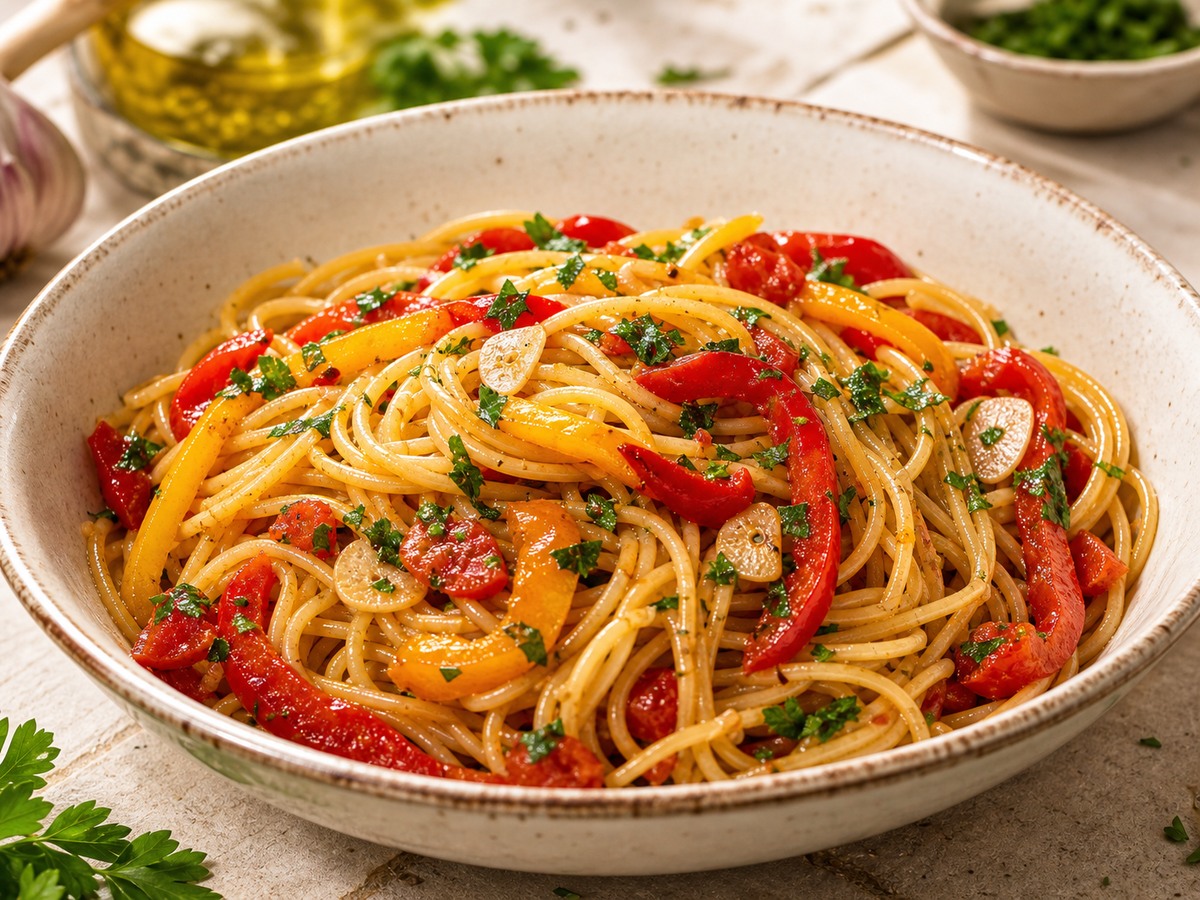
The bell pepper appears throughout the Italian summer kitchen in preparations that track the range of ways a single vegetable can be treated. Roasted and peeled, it becomes sweet and smoky — the peperoni arrosto elsewhere in this collection. Sautéed quickly, it keeps its texture and a little bite. Stewed slowly — which is the technique here — it gives up its structure entirely and becomes soft, almost creamy, concentrated to a sweetness that has little to do with the rawness of the original. The same pepper, three completely different results depending on the heat and the time you give it.
The Neapolitan pasta version applies a technique that connects it directly to the summer blending tradition: half the slow-stewed peppers are removed from the pan and blended with basil and raw olive oil until smooth, then returned and combined with the remaining whole pepper pieces. The result is simultaneously creamy and textured — the blended half coating the pasta, the unblended half providing resistance and color. No cream, no flour, no reduction. The creaminess comes entirely from the pepper itself, which after 15–20 minutes of slow stewing contains enough soft pulp and natural sugars to blend into something that coats the back of a spoon.
The Gaeta olives and capers are not decoration. The Gaeta olive — small, dark, slightly bitter, cured in brine — is one of the defining flavors of Neapolitan cooking: it appears in the puttanesca, in the acqua pazza, wherever the kitchen needs a clean mineral-salty counterpoint to sweetness. The capers (rinsed from salt) add acidity and a sharp floral bitterness. Without them the sauce is pleasant. With them it has the structure that makes it Neapolitan rather than just sweet.
One red and one yellow pepper. The red is riper and sweeter; the yellow slightly more delicate. Together they produce the characteristic orange-gold color and a flavor more complex than either alone. Green peppers are a different vegetable with a different flavor and do not belong in this preparation. Use red and yellow when they are good and in season. This is a July and August dish.
Red peppers, vitamin C, and why they outperform an orange by a factor of two
The red bell pepper is one of the richest dietary sources of vitamin C available — a single pepper of approximately 150 g provides roughly 150–200% of the adult daily requirement of ascorbic acid, far exceeding citrus fruit gram for gram. Yellow peppers provide slightly less; green (unripe) peppers approximately half as much, which is the nutritional case for using ripe peppers beyond the flavor argument. The red and yellow color comes from capsanthin and capsorubin, carotenoids specific to the Capsicum genus. These are fat-soluble and their absorption is enhanced significantly by cooking in olive oil — the same mechanism noted for lycopene in tomatoes and carotenoids in the summer vegetable posts. Slow stewing in olive oil increases the bioavailability of these carotenoids relative to eating the raw pepper, while vitamin C, being water-soluble and heat-sensitive, partially degrades during cooking — a trade-off inherent in any heat treatment of this vegetable. The blending step has an additional effect: cell disruption during blending releases intracellular carotenoids into the olive oil more completely than cooking alone, producing a more fully emulsified and bioavailable fat-soluble carotenoid source. The Gaeta olives contribute oleic acid and polyphenols specific to Campanian cultivars (oleuropein, hydroxytyrosol). The capers — among the highest known dietary sources of quercetin — also provide kaempferol, two flavonoids with documented anti-inflammatory activity at dietary concentrations. The combination of bell pepper carotenoids, olive oil phenolics, and caper flavonoids in a single sauce produces an anti-inflammatory phytochemical profile that is a reasonable illustration of why the Mediterranean summer diet generates the health outcomes it has in epidemiological research. This is not a health food constructed to be healthy. It is a summer dish that happens to be exactly what summer eating should be.
The recipe
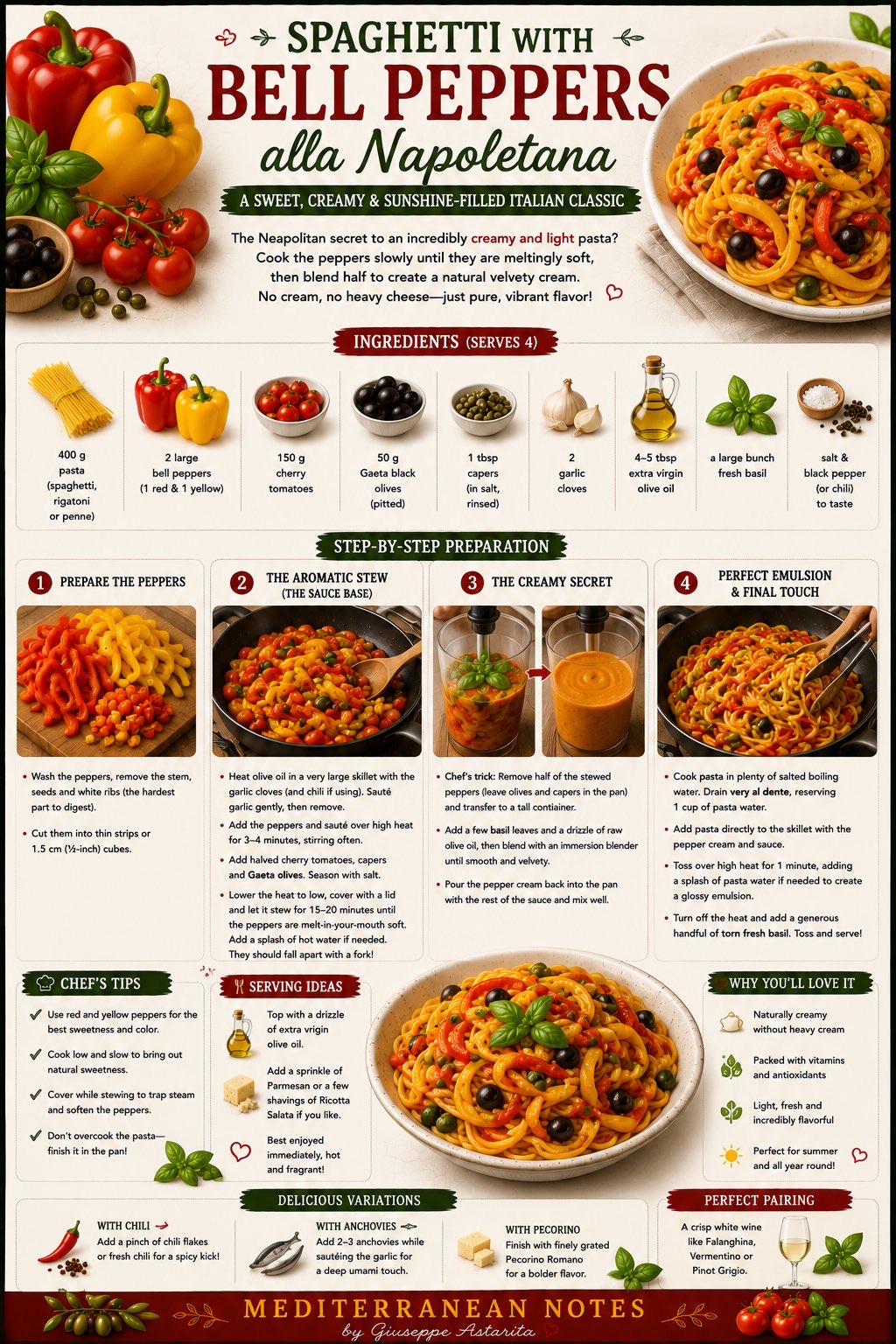
Ingredients · serves 4
Method
Prepare the peppers. Wash, remove the stem, seeds, and white inner ribs completely — the ribs are the most difficult part to digest and add bitterness. Cut into thin strips or 1.5 cm cubes.
Build the sauce. In a large skillet, heat the olive oil over medium heat. Add the garlic and sauté until golden, then remove. Raise to high heat and add the peppers — sauté 3–4 minutes until they begin to soften. Add the halved cherry tomatoes, Gaeta olives, and rinsed capers. Season with salt. Lower to minimum heat, cover, and stew for 15–20 minutes, adding a splash of hot water if needed. The peppers should fall apart at the touch of a fork.
Low and slow is the whole point. High heat produces browned peppers with bite; low covered heat produces the collapsed, caramelized sweetness the sauce requires.
The blending step — the creamy secret. Remove half the stewed peppers from the pan, leaving the olives and capers in. Transfer to a blender with a few basil leaves and a drizzle of raw olive oil. Blend until completely smooth and velvety. Pour the pepper cream back into the pan and stir to combine. The sauce is now creamy and whole at the same time.
Toss with the pasta. Cook the pasta until very al dente, reserving 1 cup of pasta water. Drain and add to the skillet. Toss over high heat for 1 minute, adding pasta water to create a glossy emulsion. Turn off the heat, tear in the remaining basil by hand, toss once more. Serve immediately with a drizzle of raw olive oil.
Optionally finish with a few shavings of Ricotta Salata or grated Pecorino Romano. The sauce is complete without it, but the cheese adds a pleasant sharpness.
Variations
Con le acciughe
Add 2–3 anchovy fillets to the oil with the garlic before the peppers arrive. They dissolve and become invisible but add a deep umami note that sharpens the sweetness of the pepper. The same technique as in the orecchiette con cime di rapa.
Con il peperoncino
Add fresh chili or chili flakes with the garlic at the start. Heat against the pepper's sweetness is a recurring Neapolitan flavor combination. Use fresh chili for a cleaner, more immediate warmth.
Con il Pecorino
Finish off the heat with finely grated Pecorino Romano for a bolder, saltier result — the version closest to the traditional Neapolitan table. Season carefully since the capers and olives already contribute significant salt.
The summer blending tradition in Campania — herbs, fresh tomatoes, sometimes almonds or garlic — finds its most satisfying pasta application in the bell pepper. Unlike fresh herb sauces that require speed and no heat, the pepper demands patience and time first. Then the blender. Then the color that arrives in the bowl looking exactly like the month of August looks from inside a Campanian kitchen.
Buon appetito — e buona estate.