Pasta con fave, guanciale e Pecorino: once or twice a year, in season, and worth every shell
In Campania in April and May, when fresh fava beans are abundant and inexpensive, this pasta appeared on the table. Once or twice a year at most. Everyone appreciated it — the sweet tenderness of the fava beans against the salty crispiness of the guanciale, the Pecorino emulsified into a creamy sauce with the pasta water. Spring in a bowl, available for a few weeks and then gone.
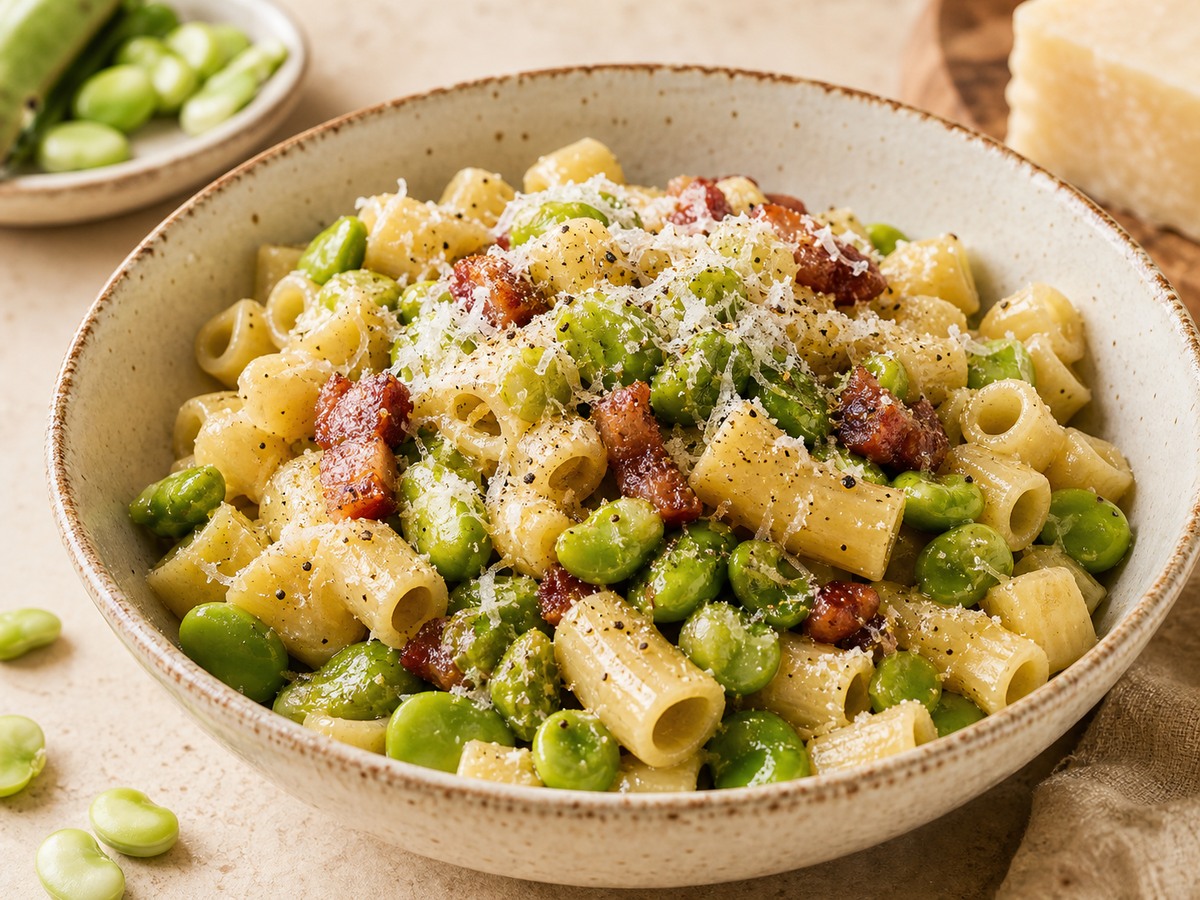
This pasta is the cooked expression of the same spring ritual described in the fava beans and Pecorino post — where the raw beans are eaten by hand with shavings of cheese as a snack or at a picnic. The pasta version takes those same two elements — fava beans and Pecorino — adds the guanciale that makes it a meal, and applies the Roman gricia technique (guanciale, Pecorino, pasta water, black pepper, emulsified off the heat) to what is essentially a spring ingredient substitution. The result is richer than the raw version and more substantial, and it carries the same seasonal character: make it in April and May when fresh favas are available, and not otherwise.
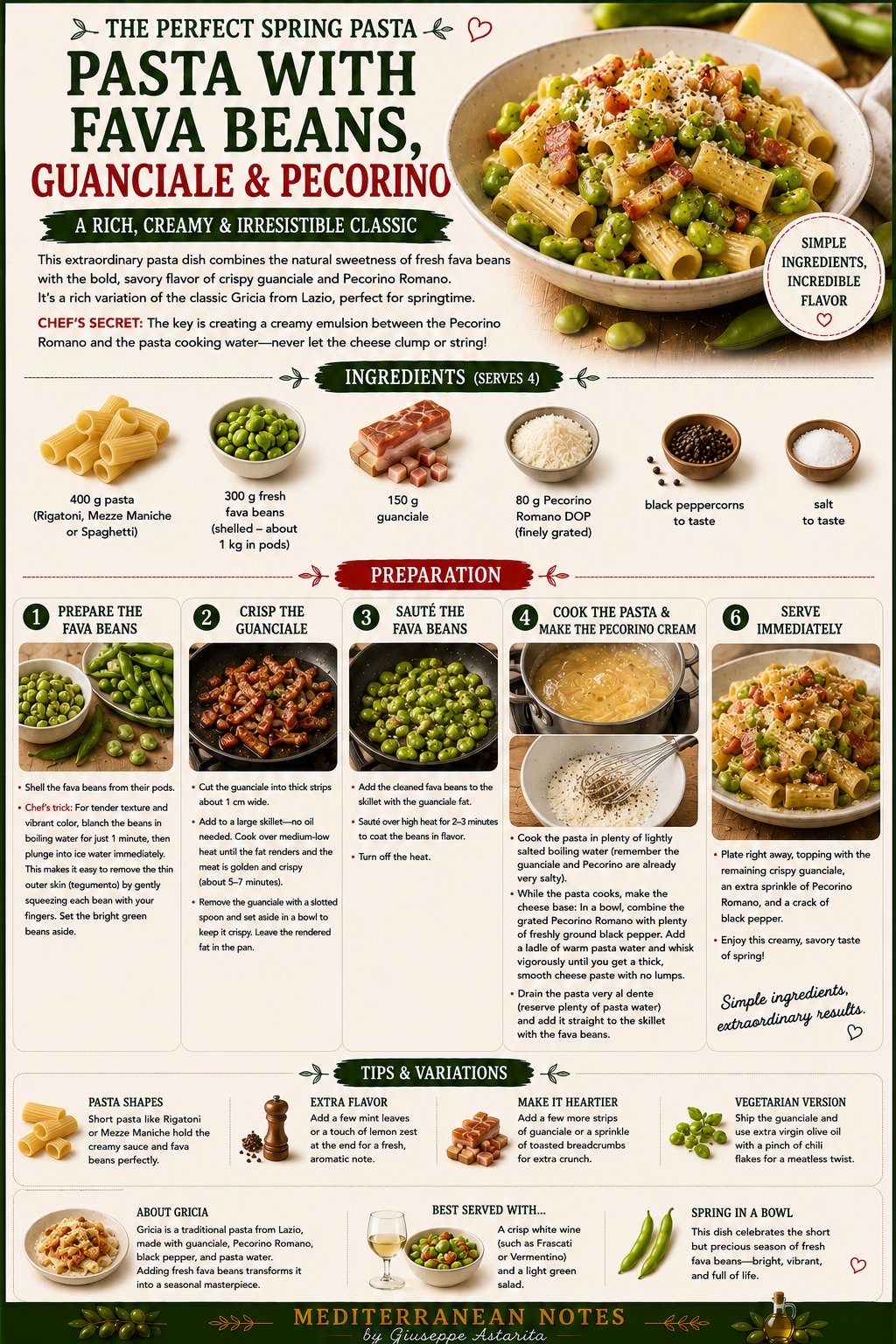
The connection to the gricia is explicit — the infographic notes it directly, calling this a seasonal variation on the Lazio classic. The gricia itself is the ancestor of both the carbonara (add egg) and the amatriciana (add tomato), and this spring pasta is the gricia with fava beans added: guanciale rendered crispy, Pecorino Romano emulsified with pasta water into a creamy sauce, black pepper, and then the favas providing sweetness and color and the specific flavor that only the fresh spring bean carries. It is a pasta that makes sense as part of a family — the same guanciale, the same Pecorino, the same technique, different season, different character.
The fava bean preparation for pasta is slightly different from the raw eating preparation. The pods are shelled, and then the inner skin of each bean is removed — either by blanching briefly in boiling water and then plunging into ice water (the method that produces a vivid green color and makes the skin easier to remove) or by squeezing each bean from its skin raw. The blanched beans are softer and more evenly colored; the raw-peeled ones have a slightly firmer texture and a more pronounced flavor. For pasta, where the beans will be sautéed briefly in the guanciale fat, either method works. The important thing is to use the beans when they are small and sweet — a kilogram of pods will yield roughly 250–300 grams of shelled and peeled beans, which is the right quantity for four portions of pasta.
Fava beans, guanciale fat, and why this pasta is a complete protein bowl
This pasta brings together three of the most nutritionally distinct ingredients in this blog's collection in a single bowl. The fava beans (discussed in detail in the adjacent post) provide complete protein with high lysine content, L-DOPA, folate at approximately 35–45% of the adult daily requirement per serving, iron, and prebiotic inulin. The guanciale provides predominantly monounsaturated oleic acid and saturated palmitic acid, along with the rendered fat that functions as the cooking medium for the fava beans and as the primary fat phase in the Pecorino-pasta water emulsion. The Pecorino Romano provides calcium, glutamate (the umami compound that makes the creamy sauce taste more complex than its two ingredients would suggest), conjugated linoleic acid from sheep's milk, and fat-soluble vitamins. The pasta water is the emulsification medium: its dissolved starch prevents the Pecorino fat from separating when the cheese is added off the heat, producing the creamy sauce rather than a greasy or clumped one — the same mechanism as cacio e pepe, gricia, and carbonara. The brief blanching of the fava beans before adding to the guanciale fat serves a dual function: it partially inactivates vicine and convicine (the compounds associated with favism in G6PD-deficient individuals), and it fixes the chlorophyll in the outer skin of the bean in its bright green state — a process called blanching fixation, where brief heat followed by cold water arrest the enzymatic browning of chlorophyll before it can proceed. The result is the vivid green color of the blanched and peeled bean in the finished pasta. From a meal-composition standpoint, this pasta provides complete protein (from both the beans and the guanciale), complex carbohydrate, dietary fiber (from the beans), and a broad spectrum of micronutrients — one of the more complete single-bowl meals in the spring collection, and available for approximately six weeks per year.
The recipe
Ingredients · serves 4
Method
Prepare the fava beans. Shell from the pods. To peel the inner skin: bring a small pot of water to a boil, add the beans for 1 minute, then drain and plunge immediately into ice water. The skins will loosen — squeeze each bean gently from its skin. The inner bean is a vivid, saturated green. Set aside. Alternatively, squeeze each bean raw from its skin with a fingernail nick — firmer texture, slightly more pronounced flavor.
Small, young favas — early season — can be used without peeling if the skin is still thin and tender. Larger, more mature beans should always be peeled for this dish.
Crisp the guanciale. Place the guanciale strips in a large, cold, dry skillet. Render over medium-low heat — no oil needed — until the fat is translucent and the meat is golden and crispy at the edges, about 5–7 minutes. Remove the crispy guanciale with a slotted spoon and set aside in a warm bowl, leaving all the rendered fat in the pan.
Sauté the fava beans. Add the peeled fava beans to the skillet with the warm guanciale fat. Sauté over high heat for 2–3 minutes — enough to coat them in the fat and develop slight color at the edges without making them mushy. Turn off the heat and set aside.
Make the Pecorino cream. In a bowl, combine the finely grated Pecorino with a generous amount of freshly ground black pepper. Add 1–2 ladles of warm pasta water and whisk vigorously until you have a thick, smooth, lump-free paste. This is the carbocrema of the gricia — the Pecorino dissolved into pasta water, ready to emulsify.
The pasta water must be warm, not boiling — boiling water can cause the Pecorino to seize. Whisk immediately and thoroughly until completely smooth before adding to the pasta.
Combine and serve. Cook the pasta in lightly salted water (the guanciale and Pecorino provide most of the salt) until very al dente — 2 minutes before the package time. Reserve a generous cup of pasta water. Drain and add directly to the skillet with the fava beans. Return the crispy guanciale pieces. Toss over medium heat for 1 minute. Take the pan completely off the heat. Pour the Pecorino cream over and toss vigorously, adding small splashes of pasta water until the sauce is creamy and coats every piece of pasta and every fava bean. Serve immediately with an extra dusting of Pecorino and a final crack of black pepper.
This pasta is available for approximately six weeks in a good year — from the moment the fava beans appear in the spring markets until they become too large and starchy to eat with pleasure. Within that window, it is worth making more than once. Between years it is worth anticipating. The specific pleasure of a food that is only available for a short time and that you know will disappear again is one of the things that seasonal cooking does that year-round eating cannot replicate. You notice the fava beans differently when you know the window is closing.
The fava beans and Pecorino post describes eating them raw, which is the simpler and perhaps purer version of this spring combination. This pasta is the same ingredients assembled into a full meal, with the guanciale providing the richness and the gricia technique providing the sauce. Both belong to the same few weeks of the year. Both are worth the shells.
Buon appetito — e buona primavera.