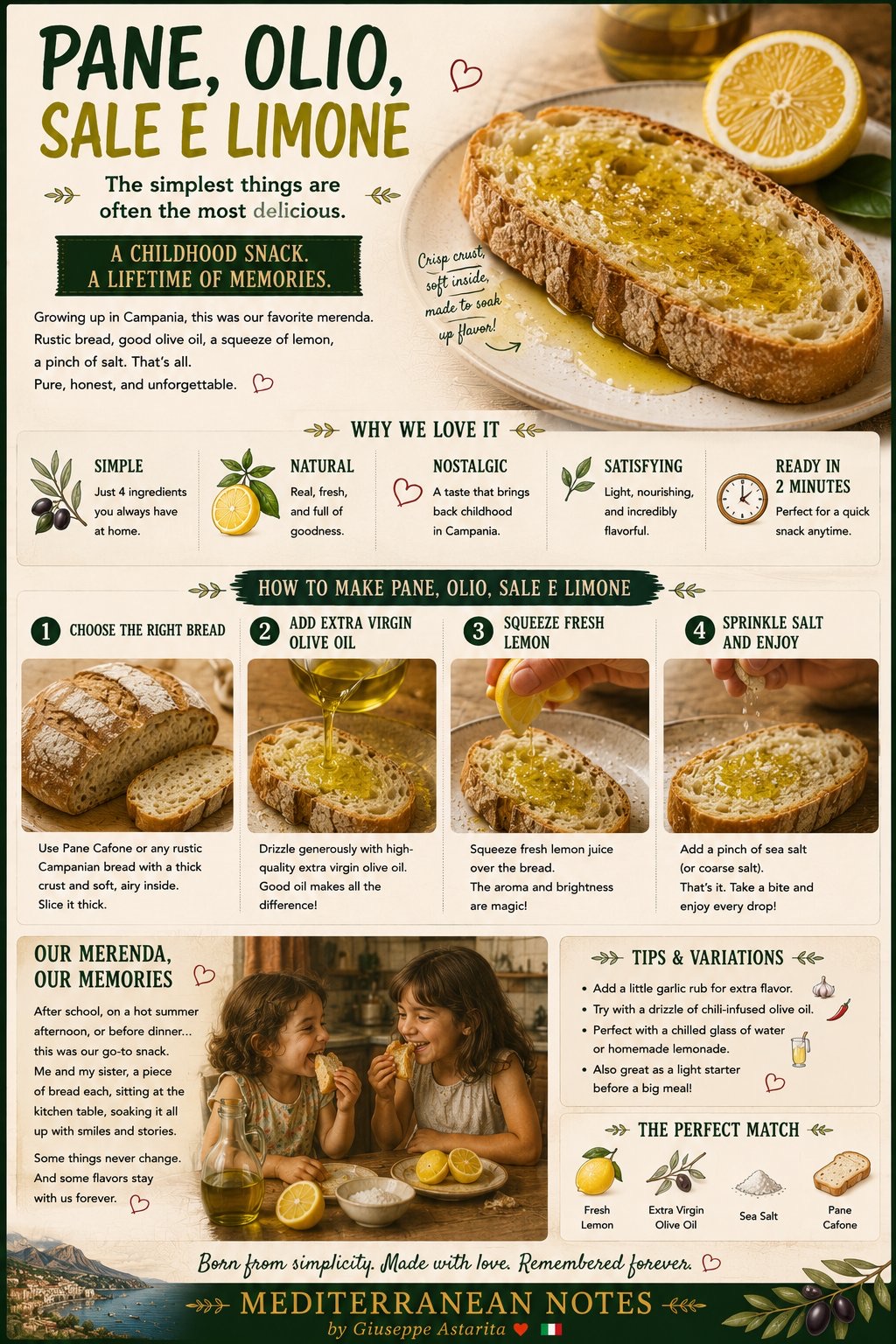
Pane, Olio, Sale e Limone
A Childhood Snack. A Lifetime of Memories.
Growing up in Campania, this was our merenda. Me and my sister in the afternoon — between lunch at one or two and dinner at eight or nine — a piece of bread each, sitting at the kitchen table. Rustic bread, good olive oil, a squeeze of lemon, a pinch of salt. That's all. We couldn't stop eating it. I still make it with my kids now.
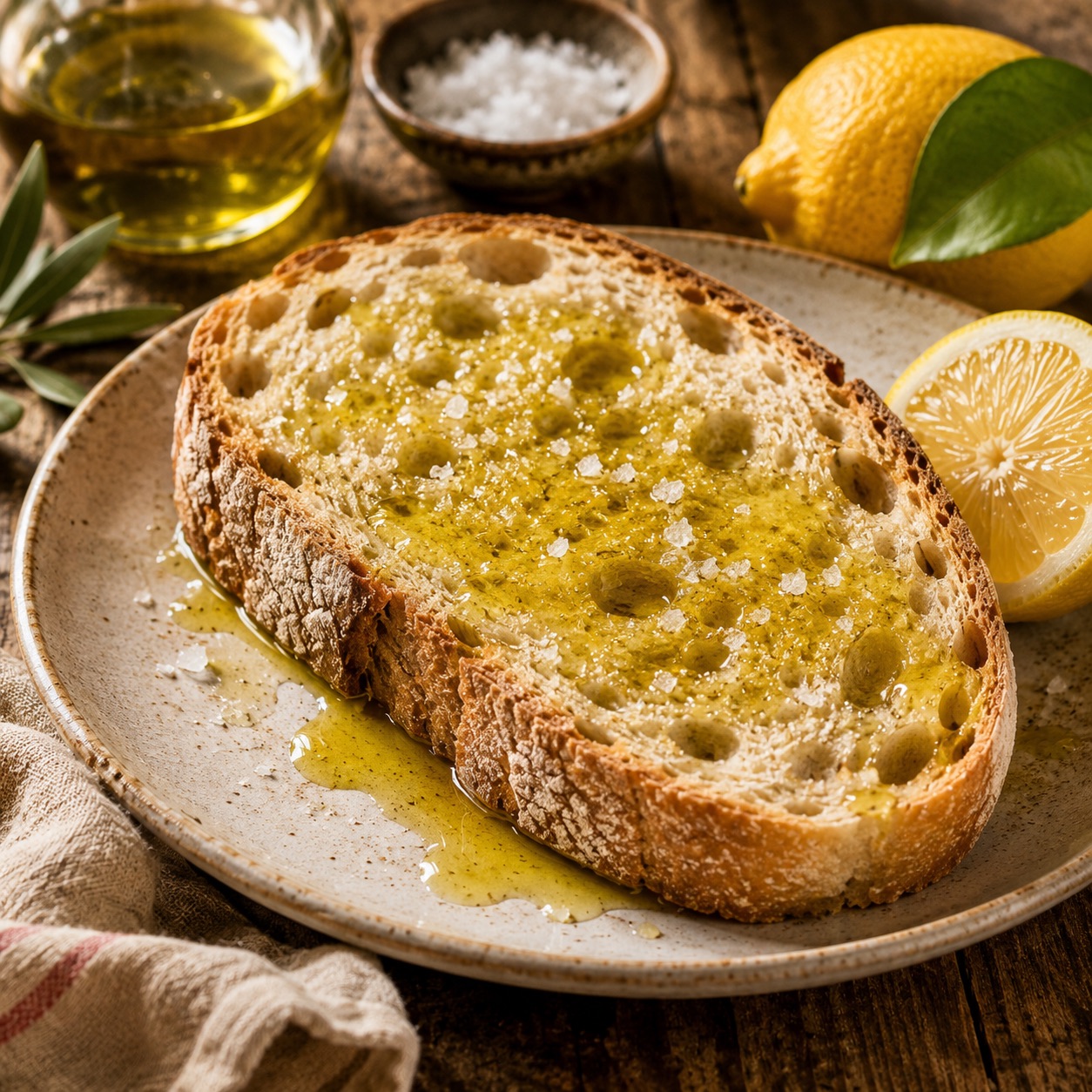
Some things never change. And some flavors stay with us forever. I make this for my daughters now, in Massachusetts, with the same four ingredients. The bread is different — it is what is available here, not the pane cafone of Campania — but the olive oil is Campanian when I can find it, and the lemon is always fresh, and the salt is always added last, and the taste is close enough to carry the memory forward into the next generation.
The merenda — the Italian afternoon snack, taken between the midday meal and dinner — is a structured institution of Italian childhood that has no direct equivalent in American culture. Italian lunch is the main meal of the day, substantial and multi-course, taken between 1 and 2 in the afternoon. Italian dinner is late — 8 or 9 in the evening — and lighter. The gap between them is six or seven hours. The merenda is what bridges them: small, not a meal, but more deliberate than a casual snack. In the 1980s Campanian kitchen, the merenda was bread with something — oil and lemon, or jam, or a piece of cheese, or just the bread itself. Nothing elaborate. The elaborateness was for the meals.
The combination of extra-virgin olive oil and fresh lemon juice produces a flavor greater than either alone because of two interacting mechanisms. First, the fat-soluble flavor compounds in the olive oil — the polyphenols, tocopherols, and volatile esters that give good extra-virgin oil its distinctive peppery, grassy, or fruity character — are rendered more bioavailable and perceptible when emulsified with the aqueous lemon juice. The lemon's citric acid also acts as a mild acidulant that brightens the fat-soluble compounds, making the oil taste more vivid on the palate. Second, the citral and limonene in the lemon zest (if any zest contacts the juice) contribute top notes that sit above the heavier oil flavor and give the combination its characteristic freshness.
The reason quality matters for this preparation specifically — more than for preparations with many competing ingredients — is that there is nothing to hide behind. A simple tomato sauce can mask mediocre oil. A bread dipped in olive oil and lemon cannot. The polyphenol content of extra-virgin olive oil, which gives it its characteristic peppery bite and its health benefits, drops dramatically in lower-quality or older oils. The oil used for this merenda should be the best available, used generously, used fresh. The bread is a vehicle. The oil is the point.
This is the most minimal post in the collection — four ingredients, a two-minute preparation, no technique beyond pouring and squeezing. It belongs here because the collection is not only about elaborate preparations and historical recipes and family rituals requiring full days. It is also about this: the afternoon, the kitchen table, my sister and I with our pieces of bread, the Campanian olive oil and the fresh lemon, the gap before dinner being filled with something that required nothing and delivered everything. The simplicity is the point. Some of the most important food memories do not involve complex cooking.
My daughters eat this now. Not every afternoon, not as a daily ritual in the way it was in Campania — the structure of American childhood is different and the gap between meals falls differently — but when I make it for them they eat it without negotiation, which in this collection is always the measure of success. The olive oil on the bread, the lemon, the salt. They do not know yet that this is a memory being passed forward. They just know it tastes good.
Sempre il pane con l'olio e il limone —
some things never change.