Le Insalate Verdi
Typical Green Salads from Campania
Huge bowls of lattuga that my sister ate in extraordinary quantities. Wild arugula that my parents used to forage from the roadside and from the hills around Caserta — and sometimes I went with them to find it. Scarola riccia with lemon, especially alongside potato dishes. Always at the end of the meal. Always simple. Salt, olive oil, lemon or vinegar. That was enough.
The salad came at the end. Not as a starter, not alongside the primo, not as a separate course with its own logic. After the secondo — after the meat or fish — a bowl of dressed greens arrived at the table to rinse the mouth of the richness of what had just been eaten and to help the digestion before the fruit or dessert closed the meal. This was the function and it was understood without discussion. The
other salad post covers the more elaborate Neapolitan preparations — caprese, insalata russa, scarola agrodolce. This post is about the simple green ones: the bowl of leaves, the olive oil, the lemon or the vinegar, the salt. The daily ones. The ones that were always there.
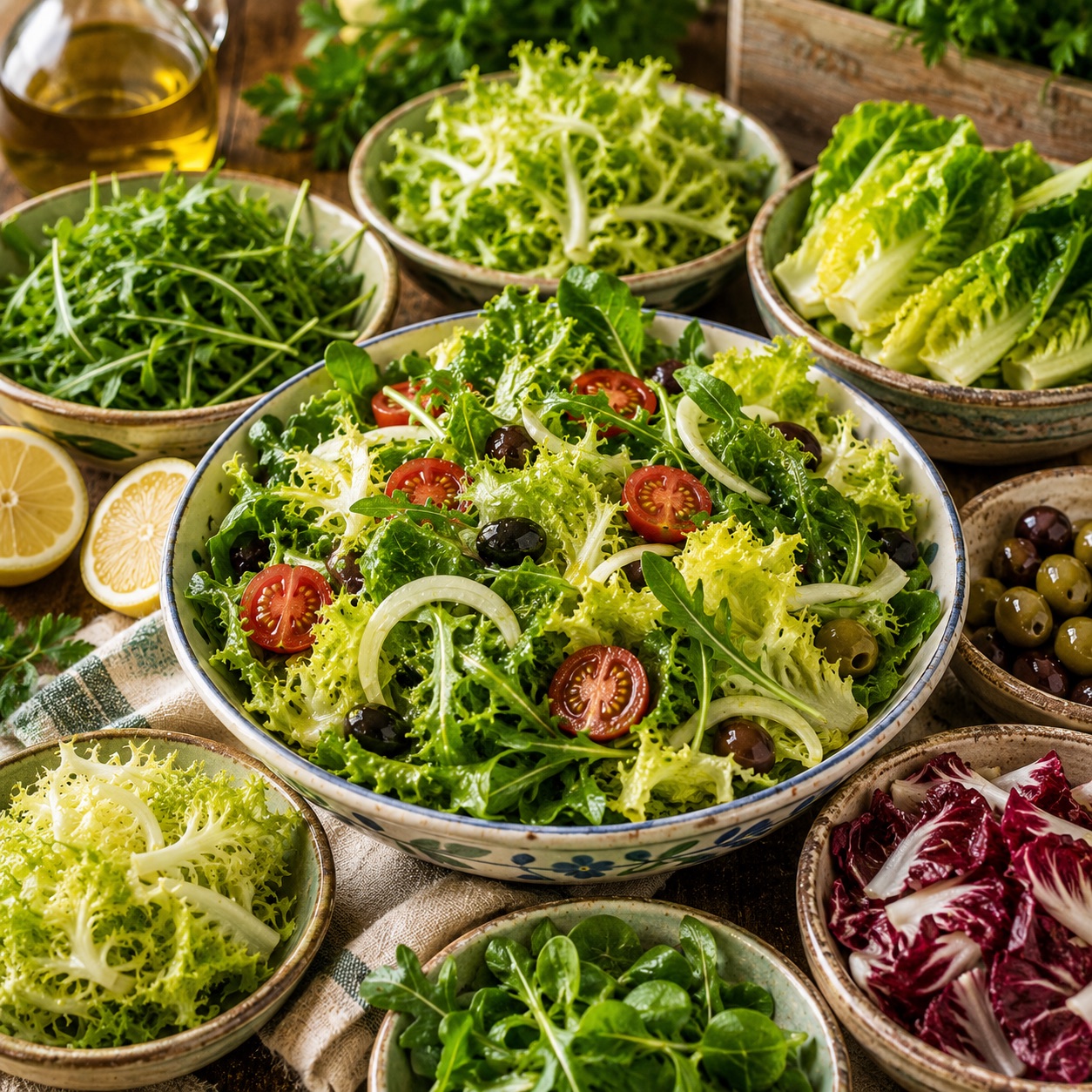
The green salad at the end of a Campanian meal was not a composed preparation with an argued dressing — it was a bowl of whatever green leaves were in season, washed and torn by hand, dressed at the table with salt, olive oil, and either lemon juice or a little vinegar. The leaves mattered. The dressing was always the same. What changed was which plant was in the bowl, which depended on the season and, in the case of the wild arugula, on what had been found on the walk.
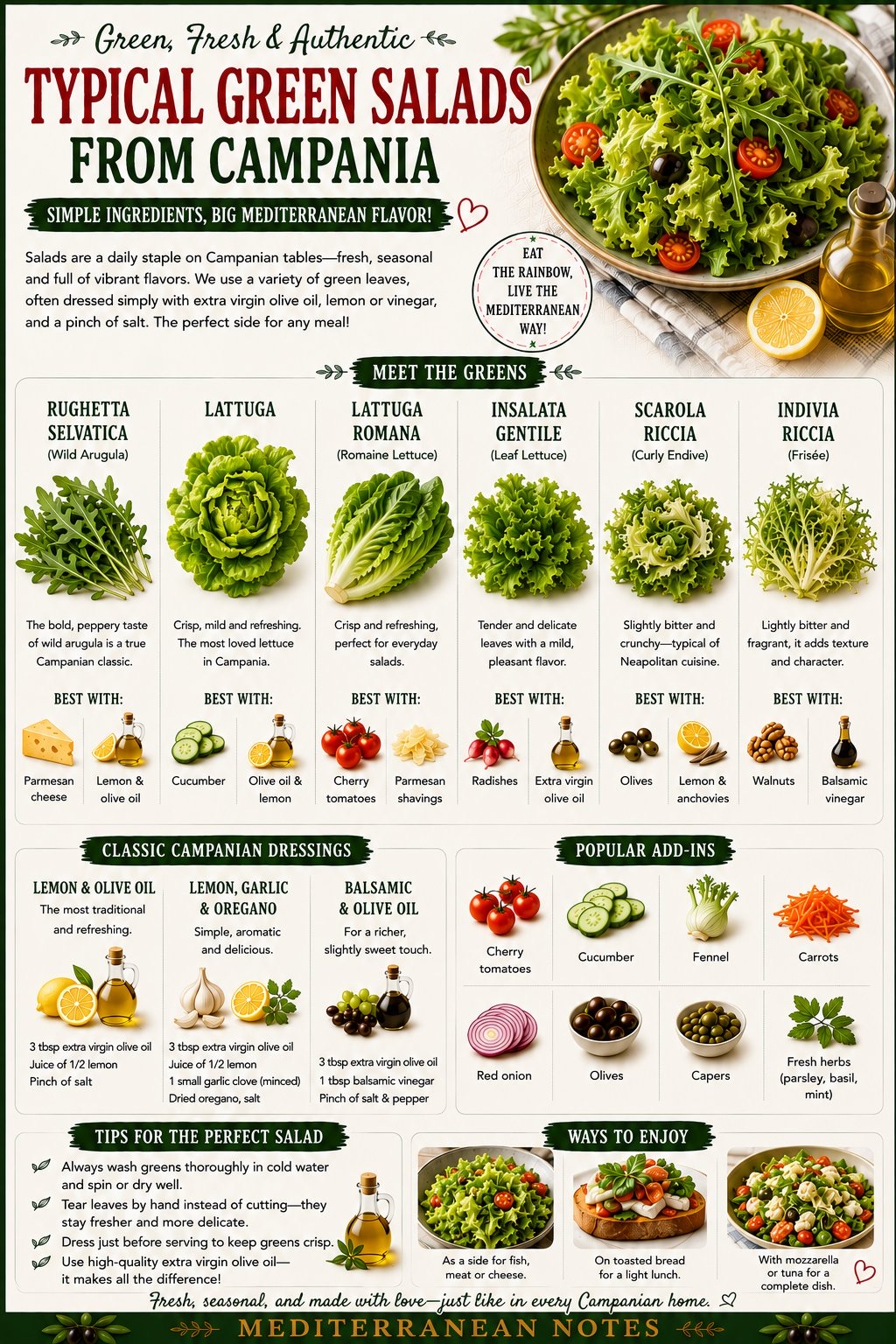
Insalate verdi della Campania — fresche, stagionali, fatte con amore. Click to enlarge.
The three greens I remember
Romaine or leaf lettuce — lattuga romana or insalata gentile
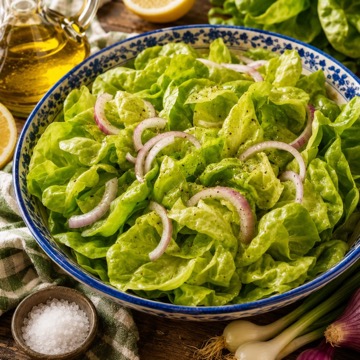
My sister ate this in quantities that I remember as extraordinary — huge bowls of lattuga at the end of lunch, dressed simply with olive oil and lemon, sometimes with the addition of cipolline fresche — the fresh spring onions with the long green stalks, sliced thin across the white bulb and scattered through the leaves. She loved it in a way that nobody else at the table quite matched. The bowl was large. She finished it.
The cipolline fresche are specific: not the dried yellow onions of the soffritto, but the young spring onions pulled early, mild and slightly sweet, their white part barely formed and their green tops still bright. Sliced across, they add a crunch and a mild sharpness that the lettuce alone does not have. This was the customization my sister made that I have always associated with her bowl of lattuga.
Dressing: Salt, extra-virgin olive oil, lemon juice. Sometimes with sliced fresh spring onions (cipolline) through the leaves. Tear the leaves by hand — never cut, which bruises them. Dress just before serving.
Wild arugula — rughetta selvatica, rucola di campo
My parents used to harvest wild arugula from the roadside and from the hills around Caserta. This was not a choice made from necessity — it was a practice, a knowledge of where the plant grew in the fields and along the paths that my parents carried from an older way of relating to the land around them. The wild arugula that grows freely in the Campanian countryside is a different plant from the cultivated arugula sold in supermarkets: smaller leaves, much more peppery, with a bitterness and intensity that the cultivated version does not have. You needed less of it and you tasted it more.
Sometimes I went with them to find it — walking the paths above the city, looking along the edges of fields and roads where the plant establishes itself in disturbed soil. I remember the smell when the leaves were picked, sharper and more herbal than the cultivated version, and the specific pleasure of eating something you had gathered yourself from a place you knew. This is a different kind of cooking knowledge from recipe knowledge — it is landscape knowledge, and it is becoming rarer.
For some reason I only remember eating the wild arugula with vinegar rather than lemon — a preference that established itself at some point and that I cannot fully explain. The vinegar's sharper acidity seemed to suit the already-sharp leaves better than the softer acid of the lemon. Both are correct. My memory says vinegar.
Dressing: Salt, extra-virgin olive oil, red wine vinegar (not lemon — or at least not in my memory). Sometimes with shaved Parmigiano alongside. Nothing else. The wild arugula is the point; the dressing only supports it.
Curly endive — scarola riccia, indivia riccia
The scarola riccia was the winter salad — slightly bitter, slightly crunchy, with the curly frisée leaves that hold dressing in their folds and give each forkful more flavor than a flat leaf would. I loved it with lemon specifically, and I remember it as a pairing with potato-based dishes — particularly alongside something like a
gattò di patate, where the richness of the potato and cheese filling needed something bitter and acidic to balance against it. The scarola with lemon was that balance. You finished a slice of the gattò and then reached for a forkful of the dressed scarola and the two things worked together without needing to be explained.
The bitter compounds in the scarola riccia — the same lactucin and lactucopicrin that appear in the cooked escarole of the
pizza di scarola — are more pronounced in the raw leaf than in the cooked one. The bitterness of the raw salad at the end of the meal is not incidental: it stimulates bile secretion and gastric acid production, both of which support digestion after a substantial meal. My mother would have explained this as
fa bene alla digestione — it helps the digestion — and she would have been correct.
Dressing: Salt, extra-virgin olive oil, lemon juice. The lemon is important here — its acidity balances the bitterness of the leaf in a way that vinegar does not. Best served as a side to rich dishes: gattò di patate, baked pasta, braised meats.
The three Campanian dressings
Lemon and olive oil
3 tbsp extra-virgin olive oil · juice of ½ lemon · pinch of salt
The most traditional. Works with all three greens but is especially right for scarola and lattuga. Dress at the last moment.
Vinegar and olive oil
3 tbsp extra-virgin olive oil · 1 tbsp red wine vinegar · pinch of salt
Sharper, more assertive. The correct dressing for wild arugula, in my memory at least. Also good with scarola and frisée. Never both vinegar and lemon.
Lemon, garlic, oregano
3 tbsp olive oil · juice of ½ lemon · 1 small garlic clove minced · dried oregano · salt
For a more aromatic result. Good alongside grilled meat or fish when the salad needs to hold its own against strong flavors.
Why salad at the end of the meal — the digestive function confirmed
The Campanian practice of serving the green salad after the secondo and before the fruit — explained by every grandmother as fa bene alla digestione and sciacqua la bocca (rinses the mouth) — is physiologically accurate on both counts. The bitter compounds in salad greens, particularly the sesquiterpene lactones present in the endive family (lactucin, lactucopicrin) and the glucosinolates in arugula, stimulate bile secretion from the gallbladder when detected on the tongue and in the upper digestive tract. Bile is the emulsifying agent for dietary fat — a meal that included meat, cheese, or cooked oil produces a fat load that requires bile for proper absorption, and the bitter salad consumed immediately after stimulates exactly the bile response that improves this absorption.
The insoluble fiber in raw leaves also accelerates gastric motility — moving the contents of the stomach through the digestive tract more efficiently — and the lemon juice or vinegar in the dressing adds organic acids (citric, acetic) that support the stomach's acidic environment and may assist protein digestion from the preceding meat course. The sciacqua la bocca function — the palate-cleansing role — is real as well: the fresh acid of the dressing and the slight bitterness of the raw leaf clear the fatty residue of the meat course from the palate and prepare it for the clean sweetness of fruit. This is meal sequencing as practical physiology. Generations of Campanian grandmothers had it right.
Wild arugula from the hills above Caserta. My parents knew where it grew — along the paths, at the edges of fields, in the disturbed soil where it establishes itself. Sometimes I went with them. That knowledge of where a plant grows in a specific landscape is a different kind of knowledge from recipe knowledge, and it is disappearing faster.
My father preferred vinegar on his salad. We — the rest of the family — tended toward lemon. This was a small domestic disagreement that was never resolved and never needed to be: the salad arrived at the table undressed, and the olive oil, the salt, the lemon, and the bottle of vinegar were all on the table, and everyone dressed their own portion. No bottled dressings of any kind. No Italian dressing from a bottle, no creamy ranch, no balsamic glaze product. Those things did not exist in our kitchen and their absence was not felt. The combination of good olive oil, salt, and either lemon juice or a little wine vinegar is sufficient for any green leaf, and the notion that a salad requires a complicated dressing is an idea that the Campanian kitchen never entertained.
The olive oil was used generously — very generously, in large quantities, more than a cautious modern approach would suggest. The salad was almost a vehicle for the olive oil as much as the olive oil was a dressing for the salad. And when you finished the leaves and looked down at the bowl, there was a small pool of liquid at the bottom: olive oil, lemon juice or vinegar, the water released from the leaves, the salt dissolved into it. This was the sauce. You took a piece of bread and you dragged it around the bowl and you ate it. La scarpetta dell'insalata — the salad scarpetta — was not less satisfying than the one at the end of a plate of ragù. In some ways it was more surprising, because the combination of good oil and lemon and the residue of bitter leaf produced something lighter and brighter and very specific to that moment at the end of the meal.
The wild arugula my parents foraged is not available in American supermarkets in the same form. What is sold as "arugula" in the United States is almost always the cultivated variety — Eruca vesicaria, larger-leafed, milder, bred for consistent flavor and long shelf life. The true wild arugula — Diplotaxis tenuifolia, the perennial wall rocket — has smaller, more divided leaves, a much sharper peppery flavor, and a bitterness that the cultivated version lacks. If you have a garden in a climate that allows it, it grows easily and perennially from seed. At a farmers market in spring and autumn you may occasionally find it. It is worth distinguishing from the cultivated variety when you do, because it is a different ingredient.
The green salad at the end of the meal was not a considered dietary choice — it was simply how meals ended. The pasta, the secondo, and then the bowl of dressed leaves before the fruit. This sequence has a logic that the research confirms and that the tradition carried without needing confirmation. The meal was built correctly. The salad at the end was part of why.
Buon appetito — e sempre l'insalata verde alla fine.