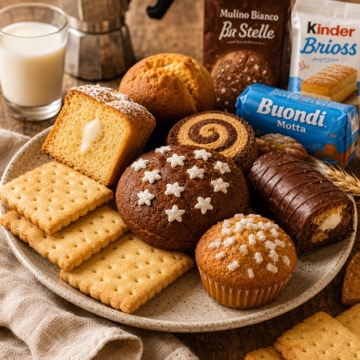
I Gelati Confezionati
Cornetto, Fior di Fragola, Coppa del Nonno — and the bar at the beach
Campania has some of the best fresh gelato in the world. Gelaterie on every street, granite in the morning, semifreddi in the afternoon. And yet all summer, whenever we were at the beach or away from a proper gelateria, we bought from the bar — packaged, from the freezer — and it was exactly right for the occasion.
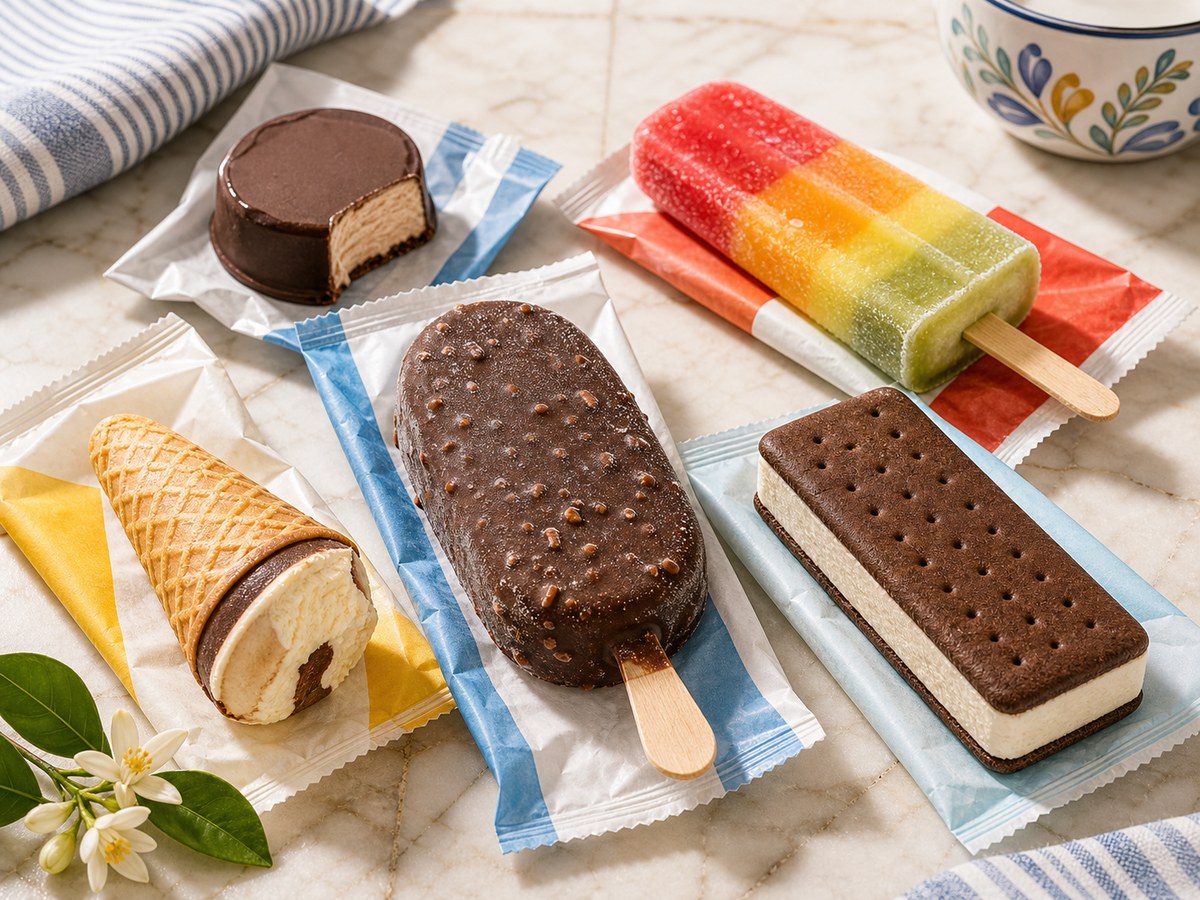
The bar at the beach was a specific institution. Not a gelateria — a bar, which in Italy means coffee, cold drinks, a pastry case, and a glass-front freezer chest stocked with packaged gelati in their individual wrappers. You ordered at the counter or you opened the lid of the chest yourself and chose. The condensation on the outside of the wrapper, the brief resistance before the wrapper tore open, the first bite taken immediately because the sun was already working on it — this was un gelato al volo, the phrase Italians use for the quick gelato taken on the go, eaten standing or walking or with your feet still in the sand. No cup, no spoon, no sitting down. The packaging was part of the experience.
Caserta is fifteen miles from the coast. In summer we went to the beach at Baia Domizia or Castel Volturno, sometimes further north toward Minturno or Gaeta, or anywhere else really — the destination mattered less than the fact of going. Sometimes we stopped at a bar on the way home. Sometimes there was a bar right on the beach, a structure of concrete and corrugated metal and plastic chairs that sold cold drinks and panini and had the freezer chest near the entrance. The Cornetto was the standard choice, but the choice itself was a small event — you looked at what was available, you considered your options, you decided. As a child this felt like a significant decision. Looking back it was not, but the quality of the attention you gave it was real.
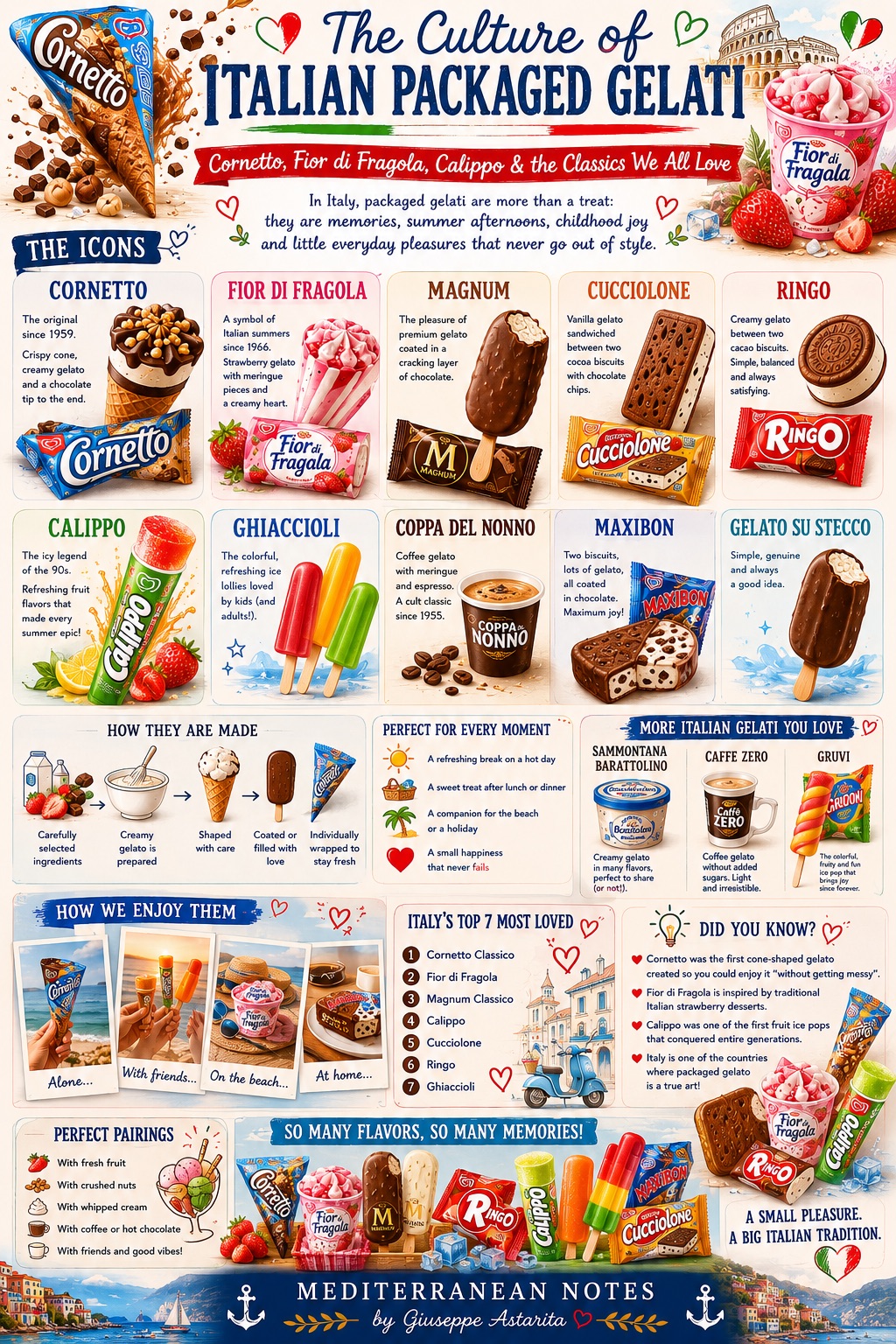
The Cornetto has been produced since 1959 and is the most recognized Italian packaged gelato. The design is specific and has not changed in any meaningful way since I was a child: crispy waffle cone, creamy gelato filling, a layer of chocolate on the inside of the cone to prevent sogginess, and the chocolate tip at the pointed end which was always eaten last and which was the best bite. The Cornetto was designed, according to the company, specifically to be eaten without getting messy — a practical engineering problem solved by the chocolate lining and the gradual taper of the cone that kept the gelato from escaping. It works. In thirty years of eating Cornetti I do not remember one structural failure.
The Fior di Fragola occupied a different category — it was not a cone but a cup, strawberry gelato with a creamy heart and pieces of crunchy meringue folded through it. The meringue pieces are what distinguish it: they provide a textural contrast that no other packaged gelato replicates, and the inspiration comes from the Italian pastry tradition of incorporating meringue into semifreddi and frozen desserts. It has been produced since 1966, which means it was already twenty years old when I was eating it as a child, already part of the established order of things. In summer the Fior di Fragola was what you chose when you wanted something that felt slightly more considered than the Cornetto — lighter, fresher, the strawberry flavor doing most of the work.
The Cucciolone was the children's gelato in the way that the Coppa del Nonno was the adults' gelato, though both categories were porous. The Cucciolone — vanilla gelato sandwiched between two cocoa biscuits with chocolate chips — was sweet and substantial, something you ate slowly, the biscuit softening slightly as you went. It has been around since the 1980s, which means it was new when I was a child. The Ringo, by contrast, was already old: born in the 1960s, gelato sandwiched between two round cacao biscuits, simpler and more restrained than the Cucciolone. Both occupied the biscuit-sandwich category that made gelato slightly more like a cookie, which appealed to children and adults who wanted something to chew as well as something cold.
The Maxibon was its own category entirely: two biscuits on one end, chocolate coating on the other, a large quantity of gelato filling the space between. Maximum everything, which is what the name promises. It was the choice when you were genuinely hungry rather than just wanting something cold, the gelato that also served as an afternoon snack. You needed both hands. This was acceptable at the beach and unusual anywhere else.
The Calippo and the ghiaccioli deserve a separate note because they occupied a different physical category from the rest. The Calippo — a fruit ice in a tube, pushed up from the bottom as you ate — was the 1990s product that every child of that decade remembers with specific clarity. The push-up mechanism was half the appeal: lemon or orange ice that you advanced incrementally, managing the pace yourself. One of the first fruit ice pops to genuinely conquer an entire generation across Italy. The ghiaccioli — the simple colored ice lollies on a stick — were the other option in the freezer chest when you wanted something cold but not creamy, fruit-flavored rather than dairy, lighter after an afternoon in the sun. Adults ate them too and did not always acknowledge this.
Packaged industrial gelato differs from artisanal gelateria gelato primarily in two ways: overrun (the amount of air incorporated during freezing) and stabilizers. Artisanal gelato is typically churned at lower overrun — around 20–30% — producing a denser, richer product that must be kept at a specific temperature range and consumed within hours or days. Industrial packaged gelato uses higher overrun (40–60% or more in some products) and a combination of stabilizers — typically locust bean gum, guar gum, and carrageenan — that maintain a smooth texture across a wide range of temperatures and during freeze-thaw cycles in transport and storage. The emulsifiers (lecithin, mono- and diglycerides) prevent fat separation and ice crystal growth over time, which is what keeps the texture creamy rather than icy after weeks in a freezer chest. The chocolate lining of the Cornetto cone solves a specific structural problem: waffle cones become soggy very quickly when in contact with a water-based frozen product due to moisture migration through the cone wall. The thin layer of tempered chocolate applied to the inside of the cone acts as a moisture barrier — chocolate contains negligible water and its fat phase does not absorb water from the gelato — keeping the cone crisp from production through consumption. The same principle is used in the chocolate tip at the bottom: it seals the apex of the cone, which would otherwise be the first point of structural failure when the gelato softens near the end of eating.
Le icone — una alla volta
The Barattolino Sammontana deserves a mention for a different reason: it was the packaged gelato that entered the house rather than the beach bar. A tub of creamy gelato in multiple flavors — stracciatella, fior di latte, nocciola — bought at the supermarket, kept in the home freezer, served at the table after dinner with a proper spoon. This was the domestic version of the same impulse: when there was no time or inclination to go to the gelateria, the Barattolino was the reasonable and satisfying alternative. It is still sold. I have one in my freezer in Massachusetts.
I should say that none of this replaced the gelateria. A properly made gelato from a good gelateria in Naples or Caserta is a categorically superior product — denser, fresher, with a flavor that the industrial versions do not approach. The packaged gelati did not compete with that. They occupied a different occasion: the beach bar, the roadside stop, the supermarket freezer, the moment when the gelateria was not there or not convenient. Un gelato al volo is a specific thing. It has its own quality and its own memories attached to it, and those are not inferior to the memories attached to the gelateria — they are just different. My daughters eat Cornetti in summer when we can find them, and the chocolate tip is still the best bite.
Buona estate — e tieni il Cornetto in verticale.