Merendine e Crackers
The generation that grew up on packaged cakes and saltines
At 10am at school, the teacher would say it was time for merenda. In the afternoon around four, my mother would ask: cosa vuoi per la merenda? The answer was almost always one of a small set of packaged options that I had completely forgotten about until I started writing this.
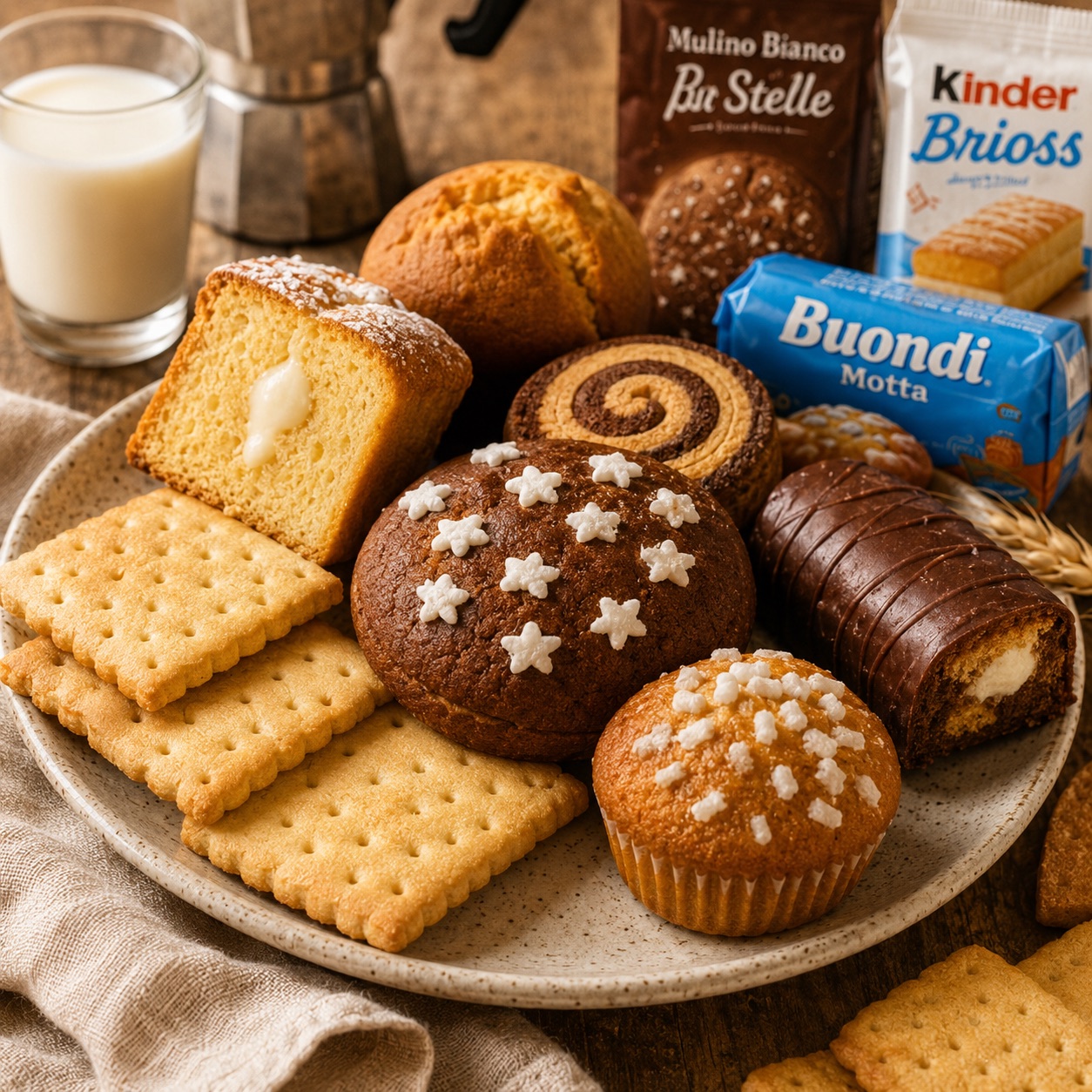
The word merenda is difficult to translate precisely. It is the Italian afternoon snack, specifically the one eaten by children between lunch and dinner, usually between four and five in the afternoon, sometimes with a glass of cold milk. It is also, in Campania and much of the south, the brief break in the school morning around ten o'clock — not exactly a snack break, more of a pause in which you ate whatever you had brought from home. Both of these were merendine occasions. And both, in the 1980s, were dominated almost entirely by packaged industrial products: small cakes, rolls, chocolate-filled things, salty crackers. I grew up entirely within this system and did not think of it as unusual until I moved to the United States and realized that no exact equivalent existed here.
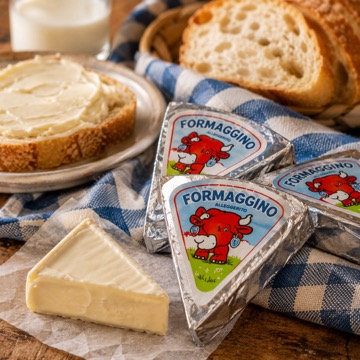
The crackers — which in the United States are called saltines and are a slightly different product — were the savory half of the merenda world. Packed in the little sealed sleeves inside a blue and white box, slightly salty, dry but not too dry, breakable into halves with a satisfying snap along the perforation. My mother bought them by the box. We ate them with milk in the afternoon, or sometimes with a thin slice of ham or a formaggino spread on top. They were the neutral option, the one that worked with almost anything. In Campania, the crackers were sometimes eaten dipped in cold milk the way you might dip a biscuit, which produced a texture that sounds unpleasant to anyone who has not tried it but which is, in fact, the only correct way to eat crackers at age eight.
The merendine — the sweet packaged cakes — were a different category entirely, and the variety available in Italy in the 1980s was remarkable. Writing this, I found myself remembering them one by one as if opening a pantry that had been closed for thirty years. The Girella: a small rolled cake, sponge and chocolate cream, individually wrapped in cellophane, perhaps the most recognized of the whole category. The Plumcake: a single-serve rectangular sponge cake, plain or with yogurt, soft and slightly dense. The Fiesta: a sponge roll with chocolate and hazelnuts, Ferrero, always slightly more elegant than the others. The Buondi Motta: a small soft bread roll with a slightly sweet crumb, filled with cream, in a yellow wrapper. The Kinder Brioss — or Kinder Brioche — a small brioche-style roll with a white milk cream filling, which came in packs of three and which was considered the premium option, the one you were happy to find in your school bag.
There were also the Pan di Stelle, technically a biscuit rather than a merendina but occupying the same afternoon drawer. Small round cookies with a pattern of stars on the surface, made by Mulino Bianco, which was the Barilla brand for sweet baked goods. Mulino Bianco products had a specific aesthetic — the old stone mill on the package, the suggestion of pastoral simplicity, the names that referred to nature and tradition — which was very effective advertising for an industrial product eaten by a generation that was simultaneously watching a great deal of television. I did not think about any of this at the time. I thought about whether there were any Pan di Stelle left in the box.
The merenda culture was not opposed to food culture. My mother cooked seriously — the Genovese, the ragù that started at five in the morning at my grandmother's, the seasonal vegetables done correctly. Crackers and Kinder Brioss at four in the afternoon were not in contradiction with any of this. They were a different register, a practical solution to a practical problem: children are hungry at four, school is over, dinner is at eight, something is needed. The something was a merendina and it was fine.
Industrial merendine stay soft and shelf-stable for weeks because of several specific interventions that are difficult or impossible to replicate at home. The first is the use of emulsifiers — compounds like lecithin, mono- and diglycerides, and DATEM — that keep fat and water distributed evenly through the crumb and prevent the fat from migrating to the surface or separating from the starch. This prevents the staling process that makes home-baked cakes dry within two days. The second is modified starch or pre-gelatinized starch in the formulation, which absorbs water at room temperature and holds it in the crumb structure without needing refrigeration. The third is modified atmosphere packaging — the bag is flushed with nitrogen, which displaces oxygen and stops the oxidative rancidity of the fat that would otherwise make the cake taste stale. The result is a product that tastes and feels like fresh-baked cake after three weeks on a shelf, which is technologically impressive and nutritionally irrelevant to an eight-year-old who wants a Girella at four in the afternoon. The flavor profile — sweet, slightly vanilla, with the specific chocolate cream of a Fiesta or the hazelnut of a Kinder Brioss — is partly the product ingredients and partly the fact that you ate them at a specific age, in a specific setting, which is the component no food science can replicate.
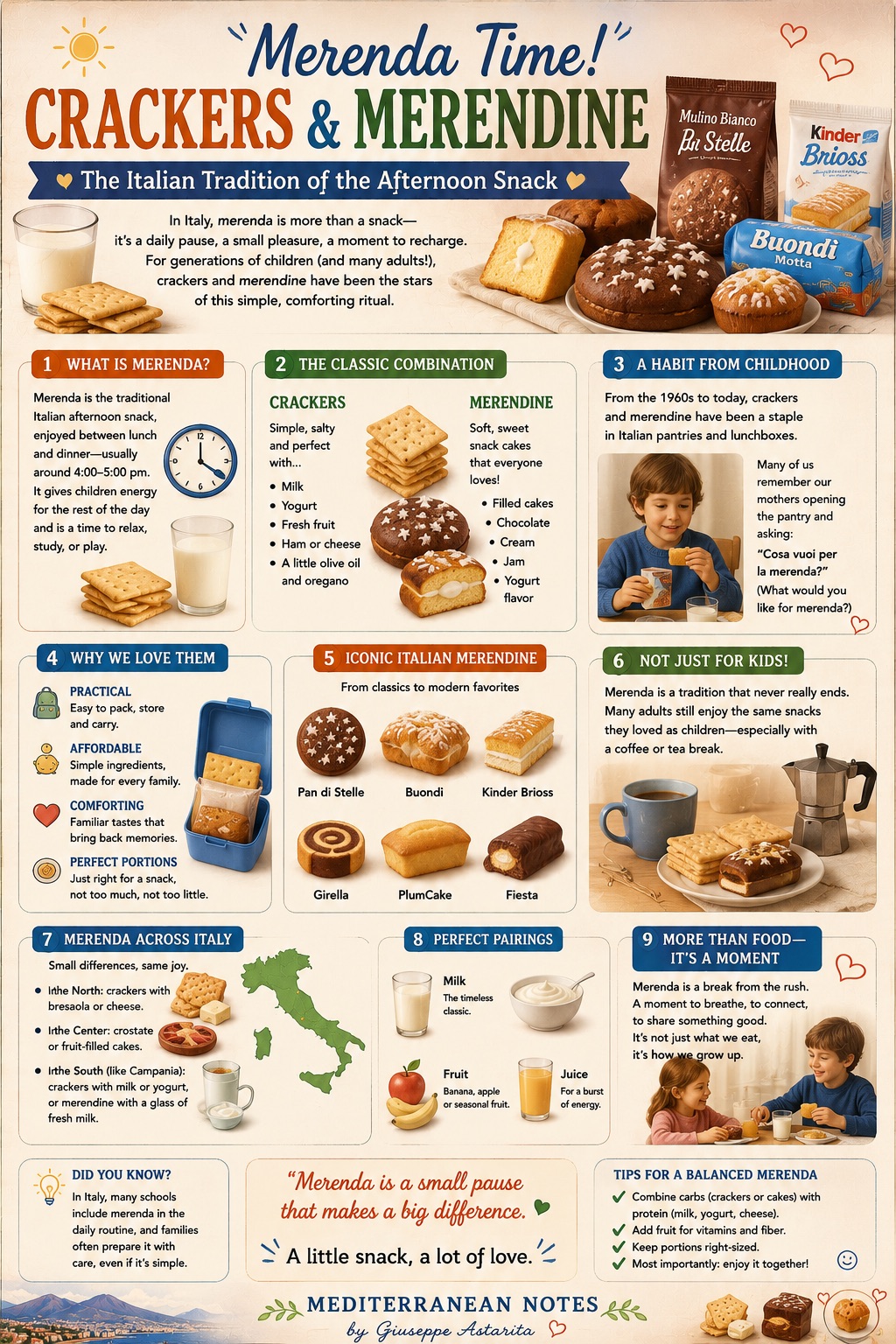
The canonical merendine
I buy Pan di Stelle for my daughters when I find them at the Italian grocery. They eat them the same way I did, sometimes dipped in milk. Anna asked me recently why the cookies have stars on them. I told her I did not know but that they had always been that way. Some things you accept without explanation and they are still correct.
Buona merenda — alle quattro, come si deve.