Il Formaggino
The small foil-wrapped cheese that was always in the refrigerator
Soft, mild, spreadable, individually portioned in foil. It was not considered a luxury or a treat. It was just there, as reliably as milk and eggs, and we ate it in every possible way.
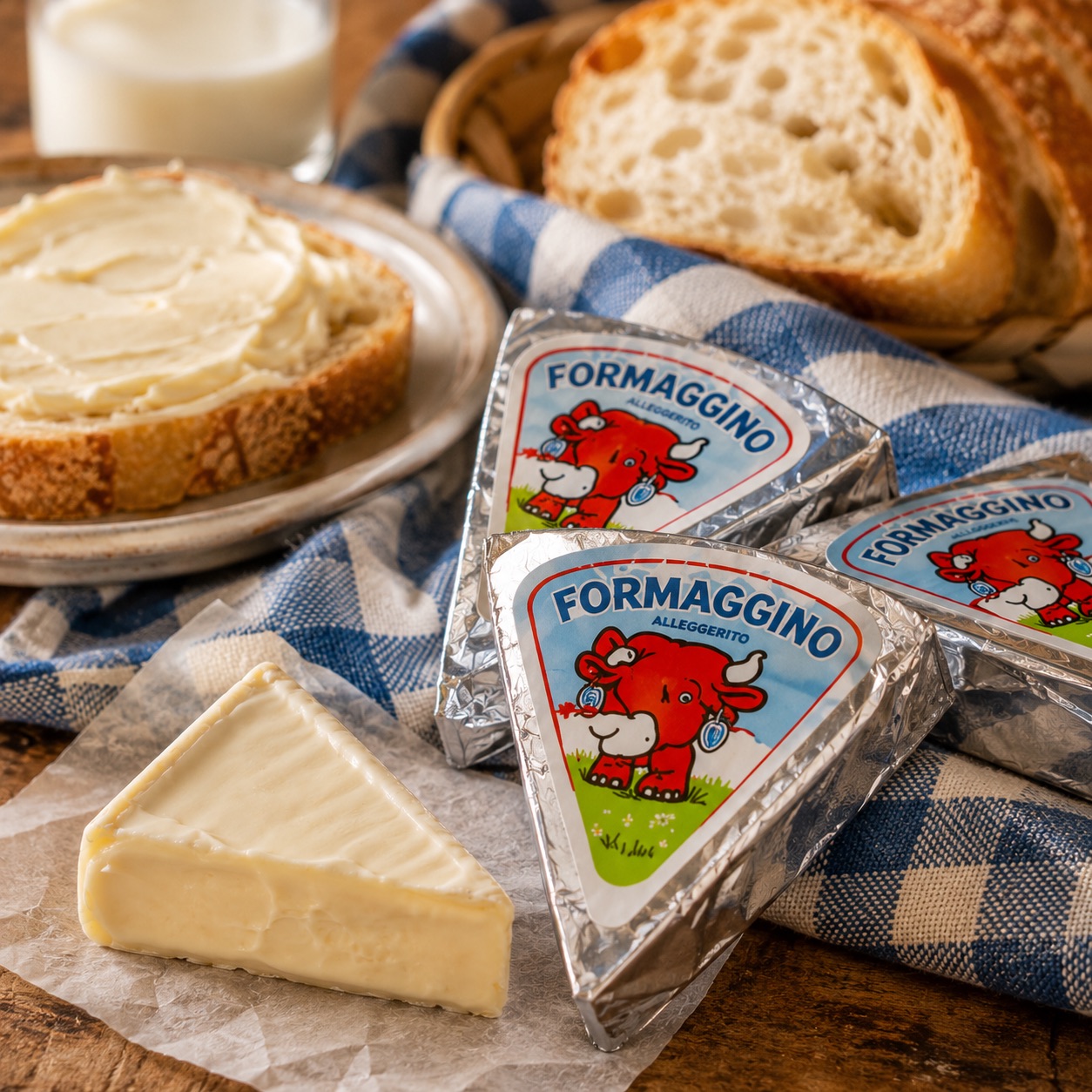
There is a specific pleasure in peeling the foil off a formaggino that has nothing to do with the cheese itself and everything to do with the precision of the package. The foil comes off in a single piece if you do it correctly — you find the tab at the corner, you peel back slowly, and the little triangular or square cheese sits there intact, slightly cool from the refrigerator, smooth and pale. This was something we did at the kitchen counter before school, sometimes at the end of dinner when there was nothing else, and in the afternoon with bread as merenda. The formaggino was not a special food. It was the food that was always available.
In Naples and Caserta in the 1970s and 1980s, the formaggino was as standard a refrigerator item as butter or leftover pasta. The brand that everyone had was the one with the small red cow on the label — Formaggino Mio, or the Kraft triangles, depending on the season and what was on sale at the negozio. My mother kept a stack of them in the door of the refrigerator and we went through them steadily. She spread them on bread for us in the morning sometimes, but more often we just took one ourselves, peeled the foil, and ate it as it was. Nobody thought of this as interesting. It was just what you did when you were hungry and it was not yet mealtime.
The merenda version was the most common. After school in the afternoon, around four or five, with a piece of bread — not always, sometimes just the cheese itself. Sometimes with a slice of prosciutto cotto laid on top of the spread. Sometimes with a few slices of fresh tomato if it was summer. The cheese itself has a quality that is difficult to describe to someone who did not grow up with it: very mild, almost neutral in flavor, slightly salty, with a creaminess that comes from the processing rather than from age or terroir. It is not trying to be anything other than what it is. In a world where cheese is increasingly about complexity and provenance, the formaggino is an honest product that makes no claims.
The dinner use is the one I remember most clearly because it was the least expected. It was the equivalent of reaching into the pantry when there was nothing planned — not a failure of preparation but a particular form of sufficiency. A piece of bread, a formaggino, maybe a slice of salame if there was one left. This was a complete end to dinner in our house, and it was perfectly fine. My father ate formaggino. He was selective about almost everything else, but the formaggino asked very little of anyone and he found that acceptable.
I have not seen the same product in the same form in Massachusetts, which is perhaps part of why I am thinking about it now. The American equivalent — individually wrapped processed cheese slices — is a different thing in texture and flavor, oriented toward the grilled cheese sandwich rather than toward bread-and-cheese as a standalone snack. The formaggino was its own category. It traveled well, required no knife if you did not want one, and satisfied a particular hunger that was neither a full meal nor nothing. I miss it in the way you miss something you did not think to miss until you could no longer find it.
The formaggino is a processed cheese product — made by combining natural cheese (usually mild young cheeses like young Gouda or mild Cheddar-type) with emulsifying salts, typically sodium citrate or sodium phosphate, along with milk, cream, and sometimes butter. The emulsifying salts break down the protein-fat matrix of the natural cheese and allow it to be reheated into a homogeneous, smooth mass that re-solidifies into a stable gel on cooling. This process eliminates the separation of fat from protein that you would get if you simply melted and re-cooled natural cheese. The result is a product with a very consistent texture — soft, spreadable at refrigerator temperature, not grainy — and a much longer shelf life than natural cheese, because the processing eliminates or controls most of the microbial and enzymatic activity responsible for aging. The flavor profile is intentionally mild: the emulsifying process neutralizes most of the sharp compounds that develop during aging (primarily short-chain fatty acids and certain amino acid breakdown products), which is exactly why children find it approachable. The fat content is typically 35–45%, which gives it the creamy texture without richness that would make it too heavy for a child's snack. It is not nutritionally equivalent to aged cheese, but it was never intended to be. It was designed for convenience, consistency, and mild flavor — and in those three things, it succeeds completely.
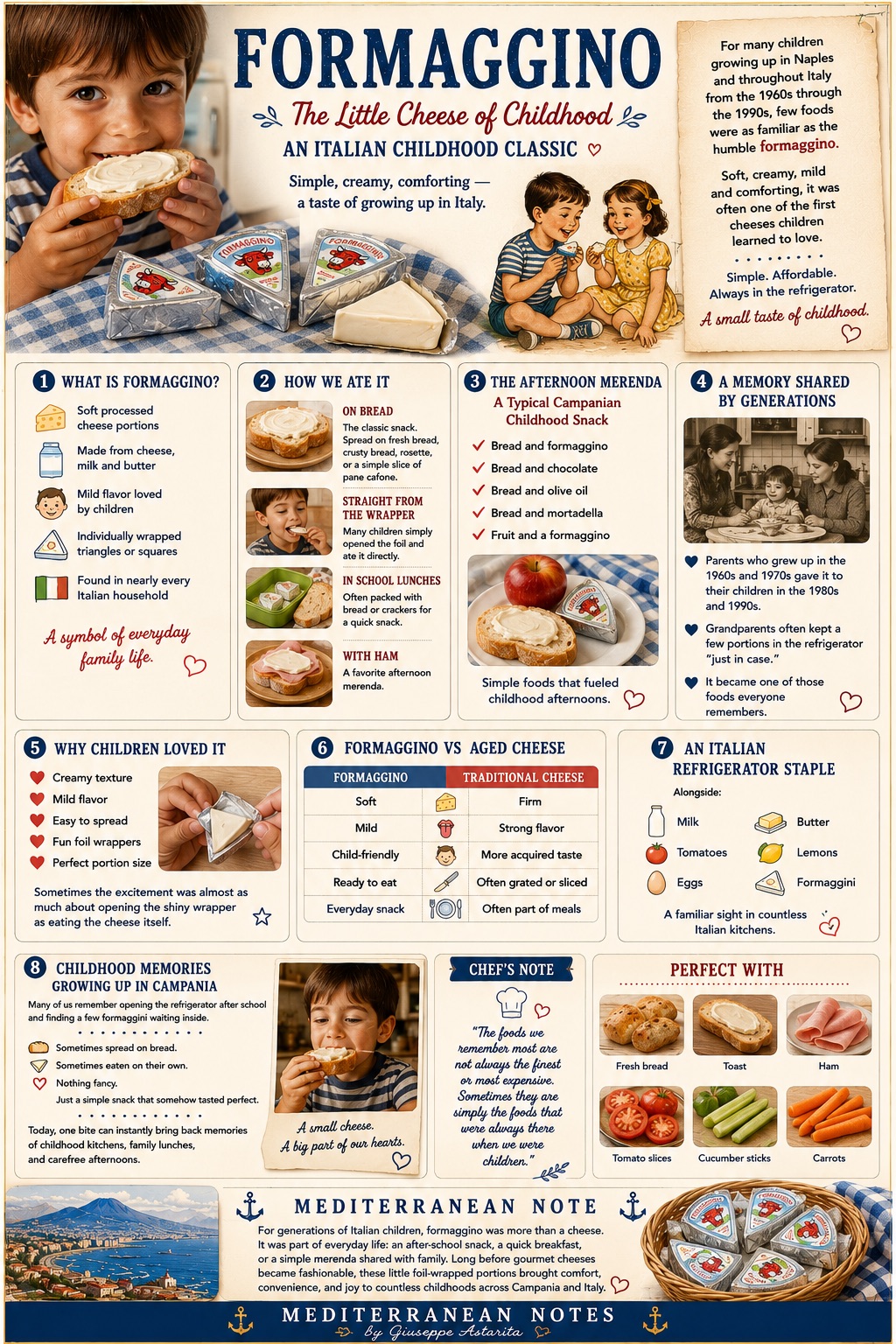
How we ate it
I buy formaggini for my daughters when I find them at the Italian grocery in Boston. They eat them the same way I did — on bread, sometimes just straight from the foil. Carolina, who is four, has figured out the foil-peeling independently, which I find pleasing. Some muscle memories transmit across generations without anyone teaching them directly.
Buon appetito — e sbuccia il foglio piano piano.