CoursesBasicsFirst CoursesSecond CoursesSides & VegetablesSoupsSaucesEggs & FrittatePizza & BreadBreakfastSnacksStreet FoodDesserts
DietVegetarianVegan
SeasonSpringSummerAutumnWinter
MainSeafoodMeatEggs
MoreCulture & TraditionsGlossaryAbout

Crespelle al Forno
Baked crêpes, Neapolitan style — one of the dishes I looked forward to most

My mother made these the same way she made cannelloni and lumaconi — the same filling logic, the same baking approach, just a different vessel. Ground beef, ricotta, smoked provola, tomato sauce. Or besciamella with mushrooms. Or spinach and ricotta in white. Soft and yielding straight from the oven, they were one of my favorites at Sunday lunch.
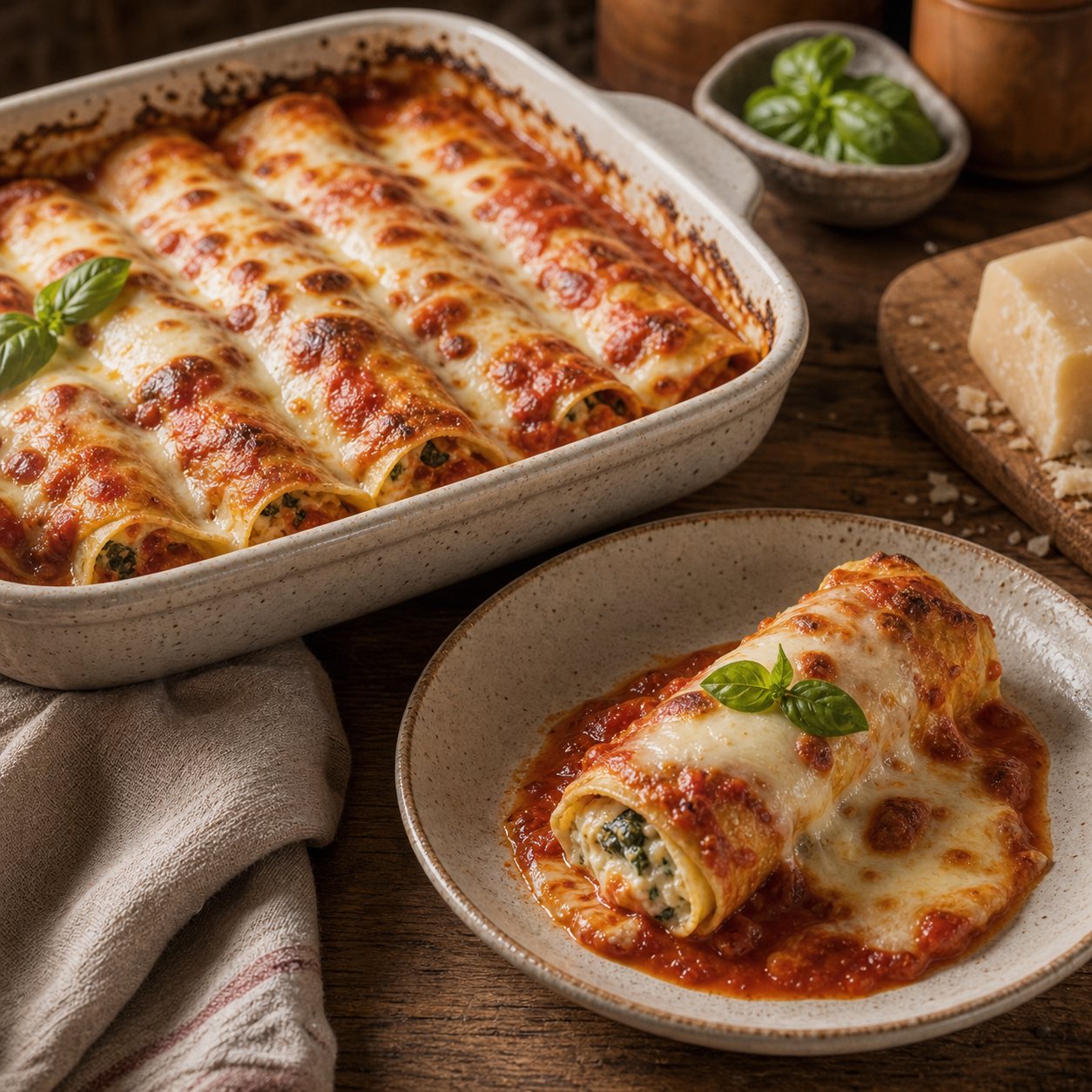
Crepes Napoletane

The crespella — a thin crêpe, cooked in a buttered pan, pliable enough to fold around a filling and hold its shape in the oven — is not a French import in the Neapolitan kitchen. It arrived there long enough ago that it became something else: a vehicle for the same fillings that go into cannelloni and lumaconi and large conchiglioni, baked in tomato sauce or besciamella under a crust of melted cheese. The French made crêpes into a delicate thing served with butter and sugar. The Neapolitans made them into Sunday lunch.

My mother's approach to all three formats — cannelloni, lumaconi, crespelle — was essentially the same. You started with the filling: browned ground beef, cooled and combined with ricotta, diced smoked provola, Parmigiano, black pepper. You made or bought the pasta or crêpes. You filled them, folded or rolled, laid them in a baking dish, covered them with tomato sauce, added more cheese, put them in the oven. The technical differences between a crêpe and a cannelloni tube are real — the crêpe is thinner, softer, absorbs the sauce differently, has no al dente resistance to negotiate — but the spirit of the dish is identical. It is the same gesture toward abundance dressed slightly differently each time.

What distinguished the crespelle was their texture. A well-made crêpe is thin enough to become almost translucent when held to the light, and after twenty minutes in the oven under tomato sauce it softens further into something that is barely distinguishable from the filling — not dissolved, but yielding, smooth, gentle in the mouth. The lasagna napoletana has structure and layers and resistance. The crespelle have none of these things. They are the more delicate option, which is why they felt like the more refined one, even though the filling was essentially the same.

The cannelloni and the lumaconi were for the days when she wanted the table to look substantial. The crespelle were for the days when she wanted it to look elegant. The filling was often the same.

The besciamella version was the one she made when she wanted something that felt lighter than the tomato version — which sounds counterintuitive, because besciamella is butter and flour and milk and is not light in any objective sense. But its whiteness, its neutral creaminess, reads differently at the table. Add mushrooms — sautéed with garlic and a little white wine, folded into the sauce along with the ricotta — and the result is a dish that belongs to autumn and winter in a way the tomato version does not. The spinach and ricotta version in white is the most restrained of the three: no meat, no tomato, just the sweetness of the spinach and the freshness of the ricotta held together by besciamella and a crust of Parmigiano. I found it the most elegant and also the easiest to eat three portions of without noticing.

Why crêpes work where pasta wouldn't — the gluten and the resting time

A crêpe batter is a suspension of flour in a liquid — eggs, milk, melted butter — with no kneading and minimal gluten development. The resting period of at least 30 minutes matters: it allows the flour particles to fully hydrate and the gluten strands that did form during mixing to relax. A batter cooked immediately after mixing produces tougher, less pliable crêpes that are more likely to tear when folded. A rested batter produces a more uniform, more extensible result because the gluten network has had time to loosen and the starch granules have absorbed the liquid more evenly.

The difference between a crêpe and a pasta sheet in baking is about moisture behavior. Fresh pasta is denser, with more structural integrity from the gluten network, and requires longer baking to soften fully. A crêpe, with its looser structure and higher egg-to-flour ratio, absorbs moisture from the sauce much more readily and softens faster — which is why crespelle baked in tomato sauce or besciamella reach the yielding, almost melting texture that defines the dish in about 20 minutes, versus the longer baking that a pasta-based cannelloni needs.

The smoked provola in the filling does something specific: its lower moisture content compared to fresh mozzarella means it melts without releasing significant water into the filling, keeping the interior of each crêpe compact rather than wet. This is why the Neapolitan tradition favors provola affumicata over fresh mozzarella in baked dishes — the result is firmer, more coherent, and the smoke contributes a background flavor that cuts through the richness of the ricotta.


The base
The crêpes
Same batter for all three fillings — make these first, let them cool

Makes 10–12 crêpes, enough for 4 people. Rest the batter for at least 30 minutes before cooking. The crêpes can be made a day ahead, stacked between sheets of parchment, and refrigerated.
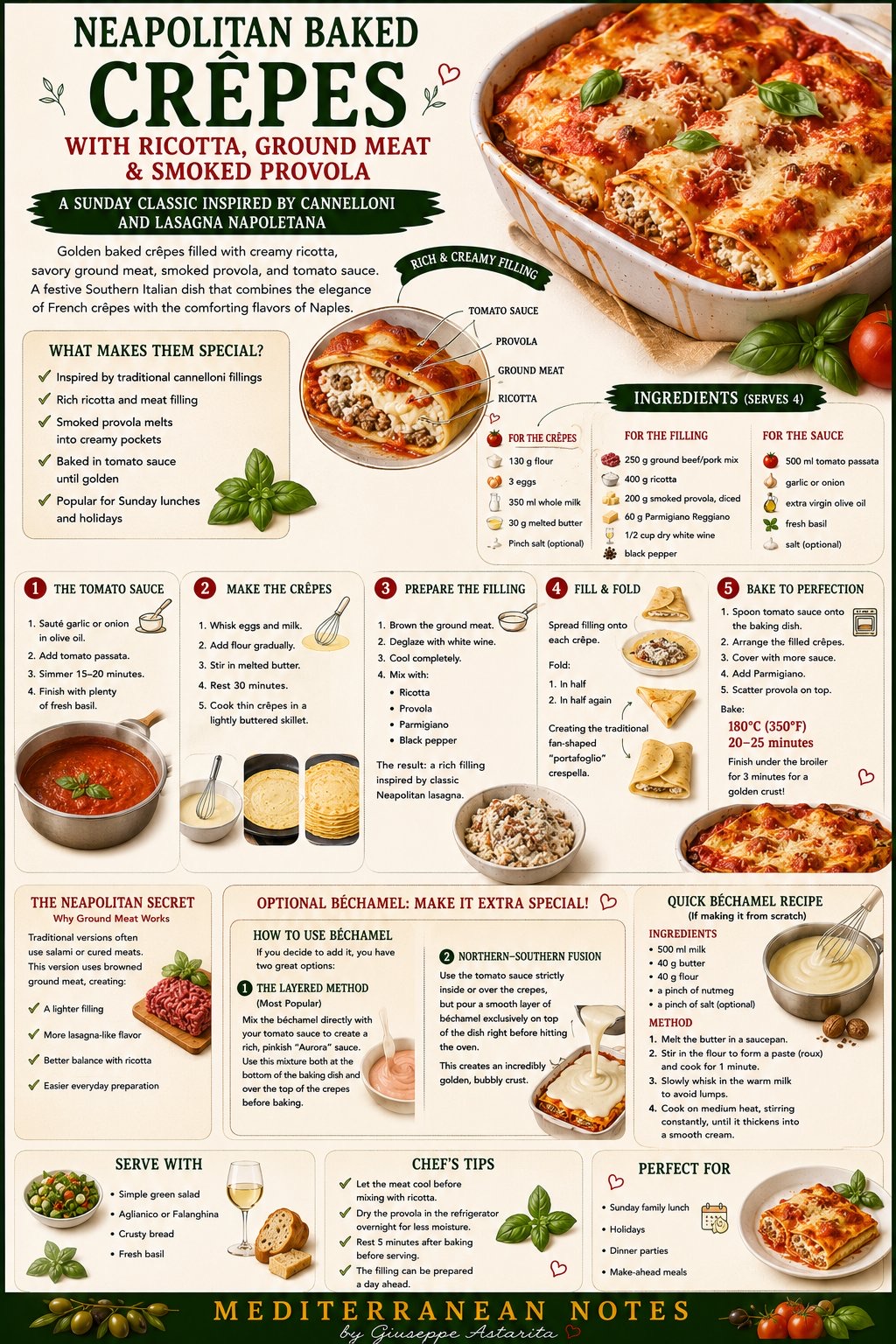
Crespelle al Forno Napoletane — infographic by Giuseppe Astarita
Crespelle al forno — thin crêpes, rich filling, tomato sauce or besciamella. Click to enlarge.
130 gAll-purpose flour
3 wholeEggs
350 mlWhole milk
30 g, meltedButter (plus more for the pan)
PinchSalt
1
Whisk the eggs and milk together. Add the flour gradually, whisking to avoid lumps. Stir in the melted butter and a pinch of salt. The batter should be smooth and fluid, about the consistency of single cream. Rest for at least 30 minutes at room temperature.
If lumps remain after whisking, pass the batter through a fine sieve. Starting with the liquid and adding flour gradually produces a smoother batter than the reverse.
2
Heat a small non-stick pan (20–22 cm) over medium heat. Melt a small amount of butter and swirl to coat. Pour in just enough batter to cover the base thinly — about 3–4 tablespoons — and tilt the pan immediately to spread it in a thin, even layer. Cook for about 1 minute until the edges lift and the surface is set. Flip and cook for 30 seconds on the other side. Stack on a plate.
The first crêpe is usually a test — it calibrates the heat and tells you if the batter is the right consistency. Discard it or eat it immediately. The rest will be better.

First filling — the classic
Ground beef, ricotta, and smoked provola with tomato sauce
The version my mother made most often — the same filling as her cannelloni

For the filling

250 gGround beef (or beef/pork mix)
400 gRicotta
200 g, diced smallSmoked provola
60 g, gratedParmigiano Reggiano
½ cupDry white wine
To tasteBlack pepper

For the tomato sauce

500 mlTomato passata
2 clovesGarlic (or half an onion)
3 tbspExtra virgin olive oil
Small bunchFresh basil
1
Make the tomato sauce: sauté the garlic in olive oil, add the passata, simmer 15–20 minutes with the basil. Season and set aside.
2
Brown the ground meat in a little oil, breaking it up well. Deglaze with the white wine and let it evaporate. Season with salt and pepper. Spread on a plate to cool completely — do not add it to the ricotta while hot or the cheese will weep.
3
Combine the cooled meat with the ricotta, diced provola, and half the Parmigiano. Mix well. Taste and adjust seasoning. The filling should be rich and cohesive — not too wet.
4
Spread a spoonful of filling across the lower third of each crêpe. Fold in half, then in half again to form a fan shape — the traditional portafoglio fold. Alternatively, roll them like cannelloni.
5
Spoon a layer of tomato sauce into a baking dish. Arrange the filled crêpes in the dish, slightly overlapping. Cover with more tomato sauce. Scatter the remaining Parmigiano and a few extra cubes of provola over the top. Bake at 180°C for 20–25 minutes until bubbling and golden at the edges. Finish under the broiler for 2–3 minutes for a slightly crisped top.
Rest for 5 minutes before serving — the filling settles and the crêpes hold their shape better when cut.

Second filling
Besciamella, mushrooms, and ricotta
The autumn and winter version — no tomato, no meat

The besciamella in this version does double duty: some goes into the filling with the mushrooms and ricotta, and the rest is poured over the assembled crêpes before baking. Mixed into the tomato sauce it becomes an aurora sauce — pink, slightly sweeter — but here it stands alone, and the result is quieter and more delicate than the red version.

For the besciamella

500 mlWhole milk
40 gButter
40 gAll-purpose flour
Pinch eachNutmeg and salt

For the filling

300 g, slicedMixed mushrooms (porcini, champignon, or cremini)
300 gRicotta
1 cloveGarlic
½ cupDry white wine
50 g, gratedParmigiano Reggiano
To tasteFresh parsley, black pepper
1
Make the besciamella: melt the butter over medium heat, add the flour and stir for one minute to cook out the raw flour taste. Gradually whisk in the warm milk, avoiding lumps. Cook, stirring constantly, until thickened to a smooth, creamy sauce — about 5 minutes. Season with nutmeg, salt, and pepper.
2
Sauté the mushrooms in olive oil with the garlic over high heat until they release their water and it evaporates — do not let them stew. Deglaze with white wine, let it evaporate. Season with salt, pepper, and parsley. Cool slightly.
High heat and patience are the two requirements for good sautéed mushrooms. Crowding the pan or keeping the heat too low produces steamed, soft mushrooms rather than browned, concentrated ones.
3
Combine the mushrooms with the ricotta, half the Parmigiano, and 3–4 tablespoons of the besciamella to bind. Fill and fold the crêpes as above. Arrange in a buttered baking dish, pour the remaining besciamella over the top, scatter with the remaining Parmigiano. Bake at 180°C for 20–25 minutes until the surface is golden and bubbling.

Third filling
Spinach and ricotta in white
The most restrained version — and the easiest to eat too much of

No meat, no tomato. The spinach and ricotta are a classic pairing that appears across the Neapolitan repertoire in ravioli, in timballi, in pasta al forno. Here it fills crêpes baked in besciamella with a crust of Parmigiano. The dish is white throughout and quieter than the other two, and it is the one I found hardest to stop eating.

500 g, cooked and squeezed very dryFresh spinach (or 300 g frozen)
400 gRicotta
1 eggEgg (to bind the filling)
70 g, gratedParmigiano Reggiano
PinchNutmeg
To tasteSalt and black pepper
Full quantityBesciamella (as above)
1
Cook the spinach, drain thoroughly, and squeeze out as much water as possible — more than you think necessary. Chop finely. Mix with the ricotta, egg, half the Parmigiano, a grating of nutmeg, salt, and pepper. The filling should hold its shape on a spoon.
Wet spinach is the single most common failure point in this dish. The water migrates into the filling and from there into the crêpe during baking, making everything soft and slightly watery. Squeeze the spinach in a clean cloth, wringing it out completely.
2
Fill and fold the crêpes. Arrange in a buttered baking dish. Cover with all the besciamella, scatter the remaining Parmigiano generously over the top. A few small knobs of butter dotted across the surface will help the top brown. Bake at 180°C for 20–25 minutes, then finish under the broiler for 2–3 minutes.

The fillings as a family

The three fillings described here represent a logic rather than a fixed list. The same approach — thin crêpe, rich filling, baked under sauce — accommodates many variations. My mother moved between them depending on the season and what was in the house: sausage and broccoli rabe in winter, zucchini and ricotta in summer, the baccalà-based version I never saw her make but which exists in old Neapolitan cookbooks for Lent. The crêpe is not the point; the filling is. The crêpe is the container that makes the occasion feel particular.

Sausage and broccoli rabe
Crumbled sausage, blanched and chopped friarielli, ricotta to bind. In red sauce. A winter version, assertive and deeply Neapolitan.
Aurora sauce
Mix the tomato passata and besciamella in roughly equal parts before baking — the result is a soft pink "aurora" sauce, slightly richer than either alone. Works with any filling.
Ham and mozzarella
Cooked ham, fresh mozzarella (squeezed dry), a little ricotta. Fast, mild, the one a child will eat without objection. Baked in besciamella or aurora sauce.

The cannelloni and the lumaconi are also worth making with any of these fillings — the technique changes slightly, the vessel changes, the spirit does not. All of them belong to the same tradition of baked filled pasta that runs through the Sunday kitchen of Campania from the simplest weeknight version to the full lasagna napoletana with its ragù and hard-boiled eggs and fried meatballs. The crespelle are where that tradition becomes lightest and most delicate.

Buon appetito — e buona domenica.
More from Primi al Forno
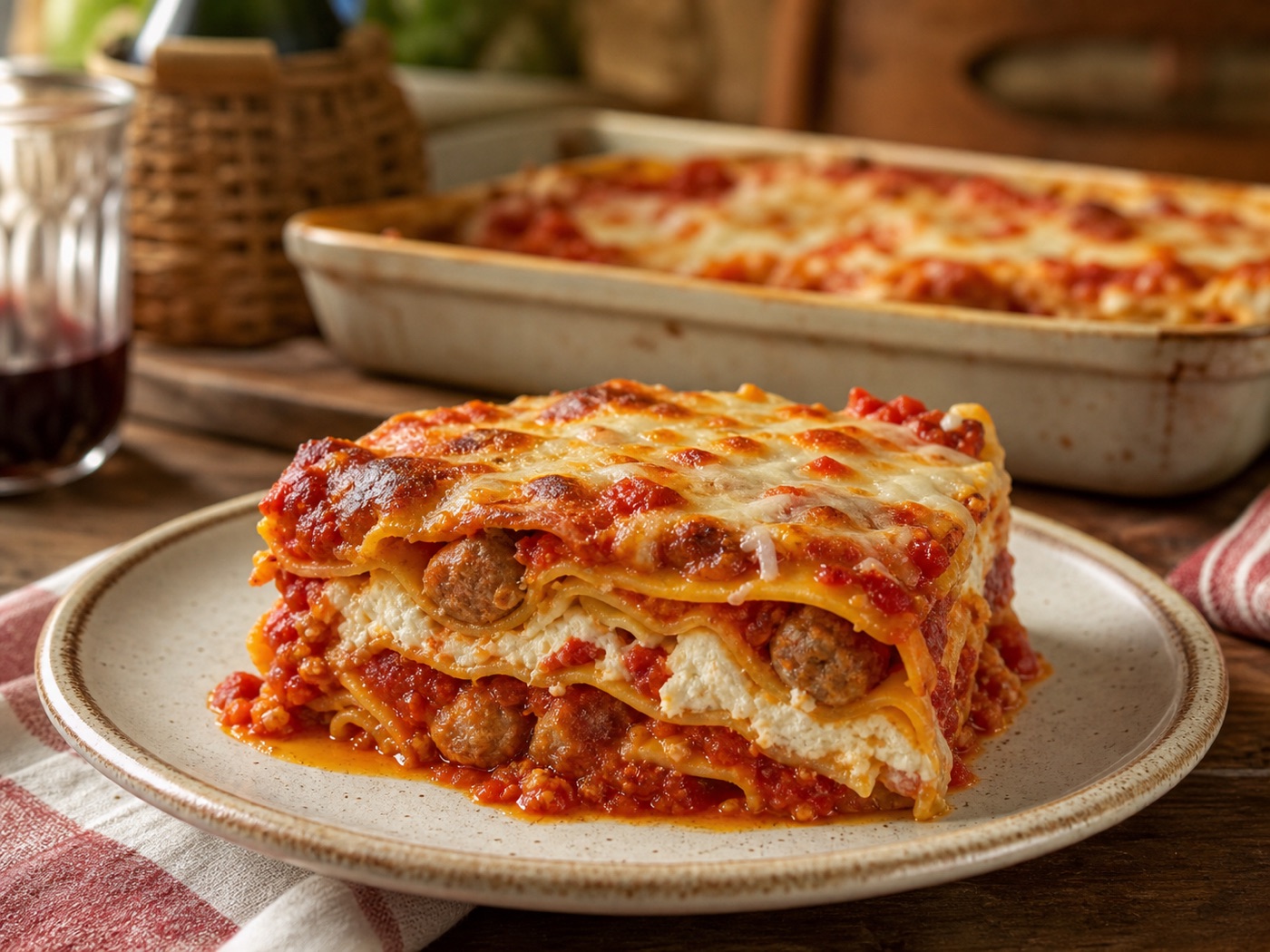
Lasagna Napoletana
Lasagna Napoletana
The full Sunday version — ragù, ricotta, hard-boiled eggs, fried meatballs, layers.
Timballo di melanzane e ziti
Timballo di melanzane con ziti
Fried eggplant, ziti, tomato, mozzarella — baked under pressure into a dense, satisfying whole.
Gnocchi alla Sorrentina
Potato gnocchi baked in tomato sauce with fior di latte — the lighter Sunday baked dish.