Gnocchi alla Sorrentina: the hardest choice at an Italian restaurant
If you go to an Italian restaurant in Campania and have to choose between a pizza and the gnocchi alla Sorrentina, it is genuinely hard to choose. Both are comforting, both are deeply Neapolitan, both arrive at the table and make every other option look like the wrong decision. This is one of the great baked pasta dishes of the region — and it is not pasta at all.
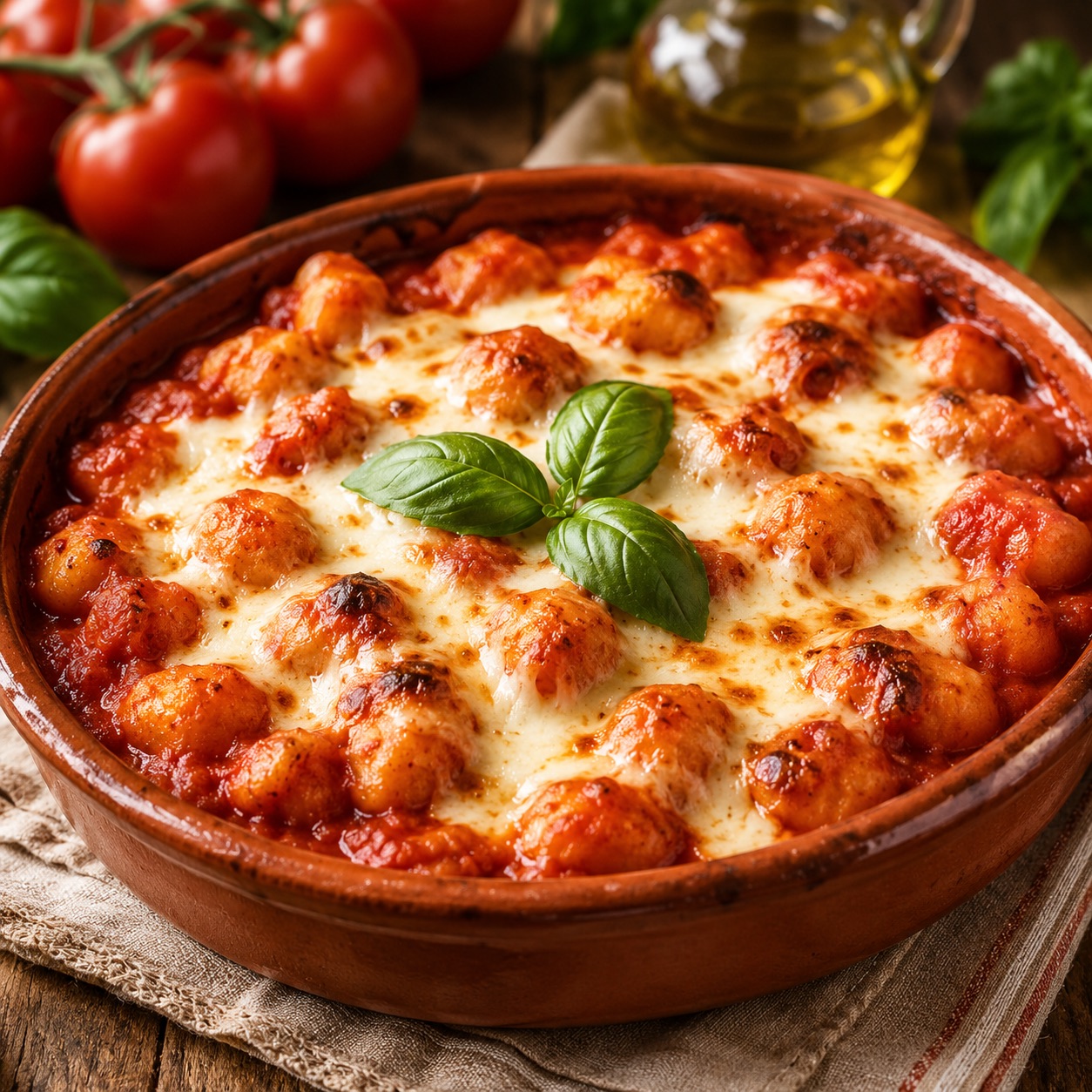
The gnocchi alla Sorrentina takes its name from Sorrento, the peninsula town above the Gulf of Naples — the same coastline that gave its name to the Nerano zucchini dish and the scialatielli, and that represents one of the most concentrated areas of culinary tradition in all of southern Italy. The dish is straightforwardly Campanian in character: good potato gnocchi, good tomato sauce (passata or San Marzano tomatoes, nothing more), fresh mozzarella or fior di latte drained of its water and cut into cubes, abundant Parmigiano, fresh basil, and a very hot oven for a very short time. The mozzarella melts into long stretchy threads without releasing liquid (because it has been properly drained), the tomato sauce reduces slightly, the top browns and bubbles, and the gnocchi — which were already cooked but are now receiving a second heat — become something slightly different from either boiled or fresh: a soft, yielding interior with a slight firmness on the surface where the sauce has set around them.
The connection to the previous post — the gnocchi di patate recipe — is direct: the alla Sorrentina is what you make when you have a batch of homemade gnocchi and want to do something with them that goes beyond a simple sauce. It is also perfectly good with good commercial fresh gnocchi, which are widely available and which, when treated well — properly boiled, not overcrowded, transferred immediately to the sauce — produce an excellent result. The baking step takes 10 minutes. The preparation of the tomato sauce takes 20. If the gnocchi are ready, this is a 30-minute dinner that tastes like more effort was involved.
The critical technical point is the mozzarella. Fresh mozzarella contains a significant amount of water — typically 50–60% moisture — and if added to a baking dish without prior draining, it releases this water during baking and makes the dish watery and diluted. The solution is simple and cannot be skipped: cut the mozzarella into cubes, place in a fine-mesh sieve, and let drain for at least 30 minutes before using. What emerges from the oven should have the mozzarella forming golden-edged, stretchy threads — not a pool of white liquid. The draining is the step that makes the difference between a good dish and a disappointing one.
The recipe
Ingredients · serves 4
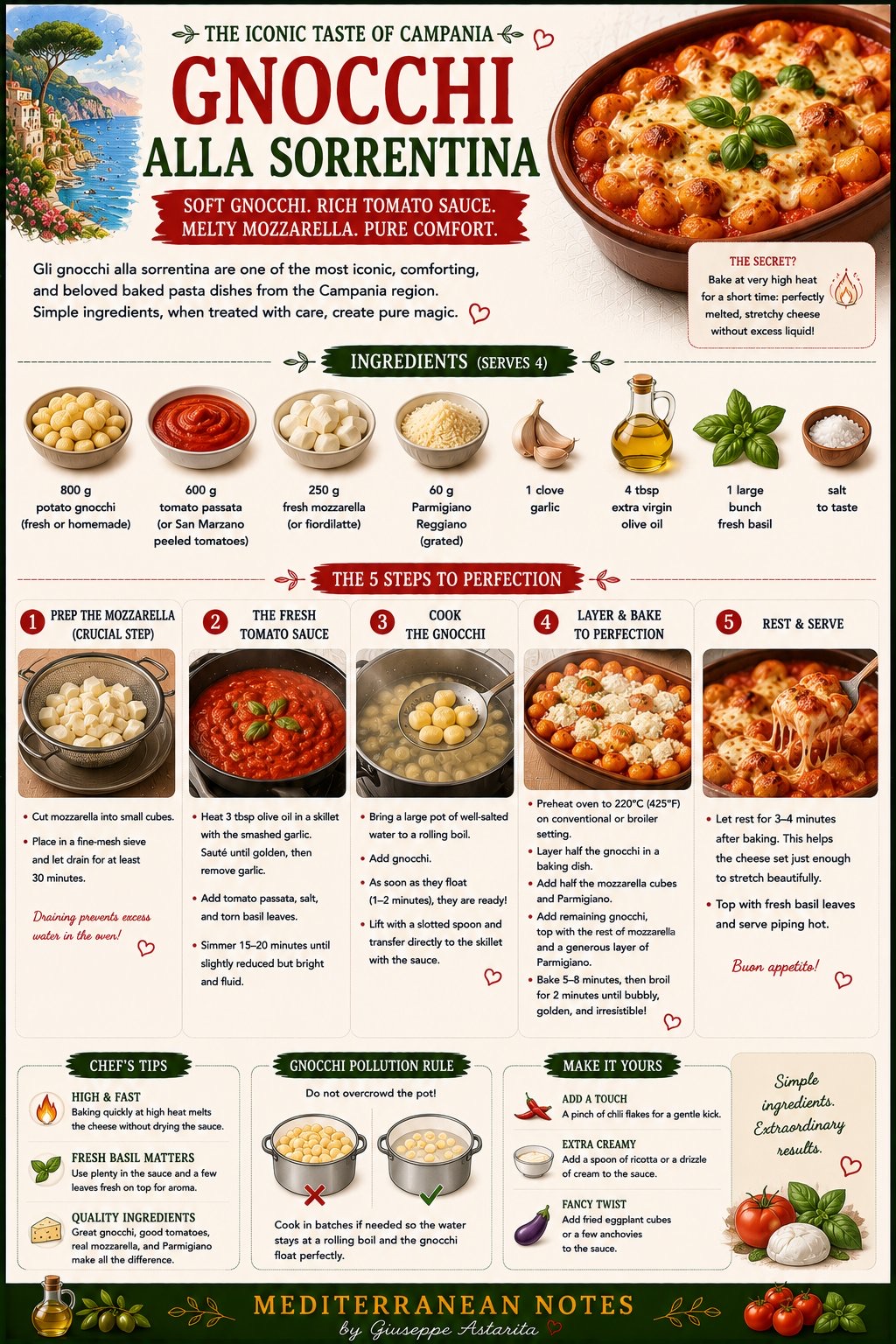
Method
Drain the mozzarella — start here. Cut into small cubes and place in a fine-mesh sieve over a bowl. Refrigerate for at least 30 minutes. This step cannot be skipped. Well-drained mozzarella melts into threads; undrained mozzarella turns the dish watery.
Make the tomato sauce. In a wide pan, heat 3 tbsp olive oil over medium heat. Add the garlic clove and sauté until golden, then remove. Add the tomato passata, a generous handful of basil leaves, and salt. Simmer for 15–20 minutes until slightly reduced, bright, and fluid — not thick. The sauce continues cooking in the oven; keep it loose.
Cook the gnocchi. Bring a large pot of well-salted water to a rolling boil. Cook the gnocchi in batches — do not overcrowd. As soon as they float (1–2 minutes), lift with a slotted spoon and transfer directly into the pan with the tomato sauce. Toss gently to coat.
Cook in small batches so the water stays at a rolling boil and the gnocchi float cleanly. Overcrowding drops the temperature and the gnocchi stick together.
Layer and bake. Preheat oven to 220°C (425°F) on conventional or broiler setting. Spoon half the gnocchi and sauce into a baking dish. Scatter half the mozzarella cubes and half the Parmigiano. Add the remaining gnocchi and sauce. Top with the rest of the mozzarella and a generous final layer of Parmigiano. Bake for 5–8 minutes, then broil for 2 minutes until the top is bubbly, golden, and irresistible.
High heat, short time: this is the secret. A longer, lower bake dries the gnocchi and makes the mozzarella release water. High heat melts the cheese instantly while keeping everything underneath moist and soft.
Rest briefly and serve. Remove from the oven and let rest for 3–4 minutes. This allows the cheese to set just enough to stretch beautifully when served rather than running off the gnocchi. Top with fresh basil leaves and serve piping hot — in the same baking dish, brought directly to the table.
The gnocchi alla Sorrentina is one of those dishes where the quality of the individual ingredients determines everything. The tomato sauce should taste of good tomatoes and basil and nothing more. The mozzarella should be fresh, milky, and well-drained. The Parmigiano should be Reggiano and freshly grated. The gnocchi should be light and well-made. When all four elements are good, the assembled dish is significantly greater than the sum of its parts — which is the specific quality that makes it one of the great comfort dishes of Campania and the reason it is so difficult to choose against it at a restaurant when the alternative is pizza.
The answer to the pizza-or-gnocchi dilemma, if the restaurant is good, is to order both and share. This is always the correct solution.
The traditional serving vessel is the pignatiello — the individual terracotta pot in which the gnocchi are assembled and baked, then brought directly to the table. In Caserta and across Campania it is the standard way: each person gets their own pot, still bubbling, the cheese still stretching. The terracotta holds the heat and keeps the gnocchi warm through the meal. Outside of Italy, a pignatiello is surprisingly difficult to find — they are not sold in most Italian-American kitchenware shops, and the few available online are rarely the right size or quality. An individual ceramic or cast-iron gratin dish works well as a substitute; the result is the same, even if something of the ritual is missing. If you ever find the real ones, buy several.
Buon appetito — e buona scelta.