Cioccolata Calda Napoletana
Thick, Silky & Intensely Chocolatey — For Special Days
The recipe for hot chocolate at breakfast — but not every day. For name days, birthdays, feast days, and the cold mornings when a small special thing is warranted. Thick, silky, intensely chocolatey. You are free to dip in your favorite biscotti. A tradition we bring forward, a small treat on special days. Slow down. Sip. Enjoy.
The Italian onomastico — name day — is a tradition with no American equivalent and no easy explanation. In the Catholic calendar, each day is associated with one or more saints, and if your name corresponds to a saint's feast day, that day is your onomastico: a secondary birthday of sorts, celebrated with smaller gestures — the telephone call from relatives, the small gift, the special breakfast. In a country where until recently most people were named after saints, the onomastico was a genuine recurring occasion and one that children took seriously as a second opportunity for recognition in the year. The hot chocolate at breakfast was one of its markers: you woke up on your name day and there was something different on the table. This specificity matters. The hot chocolate was not just hot chocolate — it was the signal that the day was already more than ordinary.
The classical version — as my mother made it
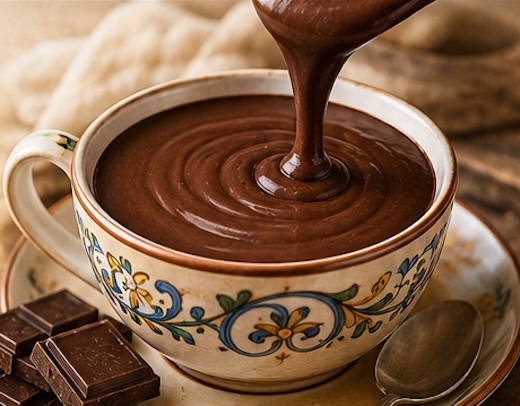
This is the version that came first — the one I grew up with in Caserta. Cocoa powder and chopped dark chocolate together, sugar, a little cornstarch for the guaranteed body, cinnamon if you wanted it, and whole milk. That is all. The cornstarch is what gives this version its characteristic velvety, almost pudding-like consistency — the thickness that requires a spoon before you can drink it, the thickness you see poured from a height in the historic cafès of Naples into those wide decorated ceramic cups. My mother made it this way, with no maple syrup, no honey, no vanilla. Just good dark chocolate, cocoa, milk, and patience over a low flame.
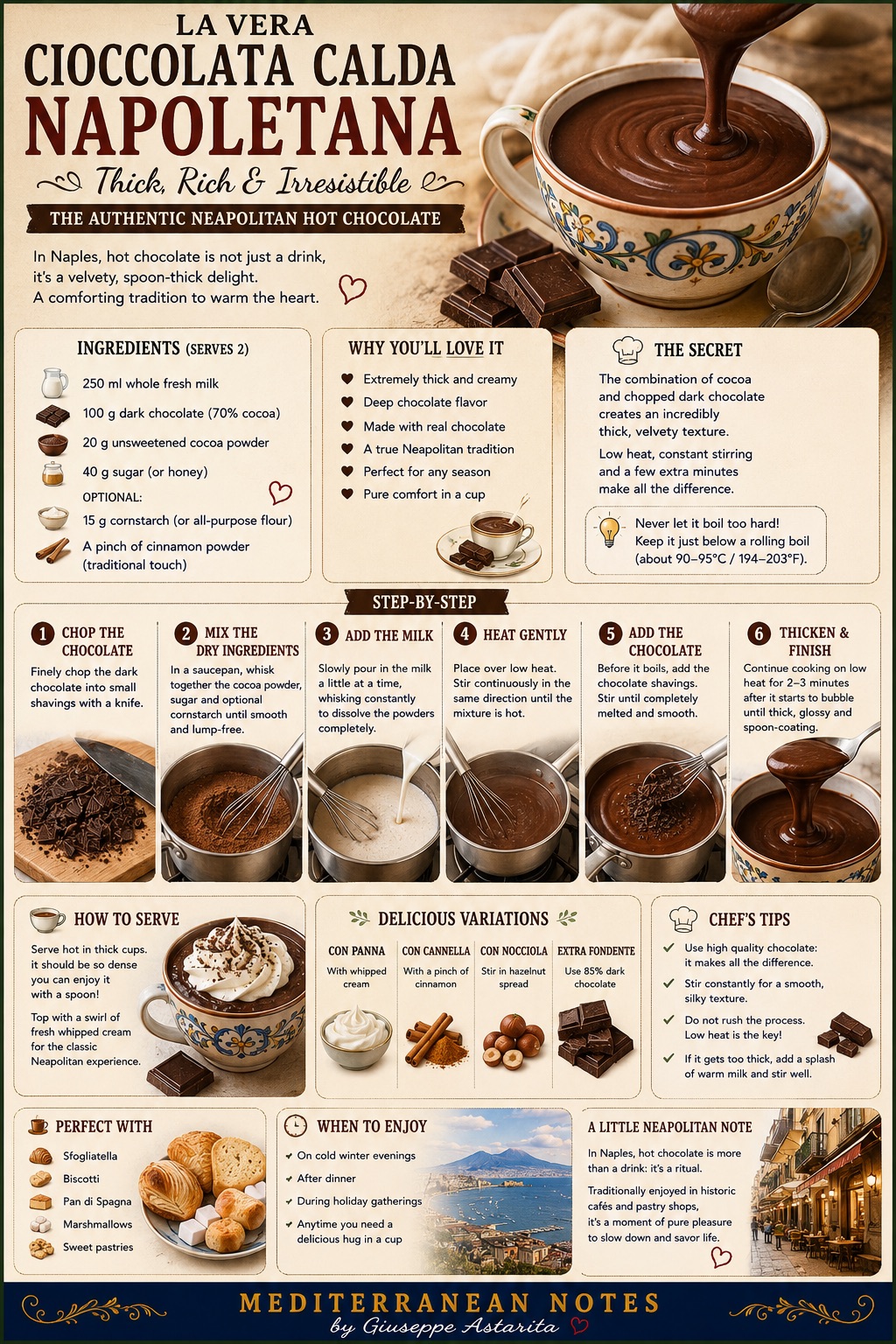
The thickness comes from three concurrent processes. Reduction: the 2–3 minute simmering evaporates water from the milk, concentrating the dissolved solids. Cocoa butter emulsification: dark chocolate contains approximately 30–35% fat (cocoa butter), which melted into hot milk and whisked continuously forms a stable emulsion — glossy, silky, and thick. Cornstarch: when heated in liquid, starch granules swell and gelatinize, increasing viscosity significantly — this is what gives the classical Neapolitan version its spoon-coating density that the chocolate-only version approaches but does not quite match.
Cinnamon contributes cinnamaldehyde, which enhances the perception of chocolate flavor at the same concentration — chocolate and cinnamon together taste more chocolatey than chocolate alone. The tradition of spicing chocolate goes back to the Mesoamerican origins of cacao and arrived in Naples through the Spanish colonial trade routes in the 16th century. My mother added it; many Neapolitan families do not. Both are correct.
In Naples, hot chocolate is more than a drink — it is a moment of comfort, a pause in the day, a small luxury we cherish.
The biscotto dipped into thick hot chocolate is the zuppa di latte logic at its richest iteration. The same 3–5 second timing applies — the biscotto absorbs the chocolate in the same way it absorbs warm milk, by capillary action into its porous starch matrix, but what it absorbs is darker and more complex. A Macine or a Pan di Stelle brought out of thick hot chocolate and eaten immediately produces a combination that is simultaneously the familiar biscotto of the daily breakfast and something considerably more special. This is the appropriate treatment for a birthday morning or a name day.
The other version
Buon compleanno, buon onomastico —
e sempre la cioccolata calda al mattino dei giorni speciali.