Biscotti e Latte
The Breakfast That Raised Generations of Neapolitans
Before cereals arrived, most of us started the day with milk and biscotti. Simple, honest, unforgettable. We used to let them swim in the warm milk and then catch them with a spoon — the zuppa di latte effect. You still can't find real Italian biscotti in the United States very easily, so we have to bring them back in suitcases when we travel to Italy. For a true Italian colazione experience with the kids. Not the healthiest breakfast, probably — but not the worst either. Eat with moderation. That's the trick.
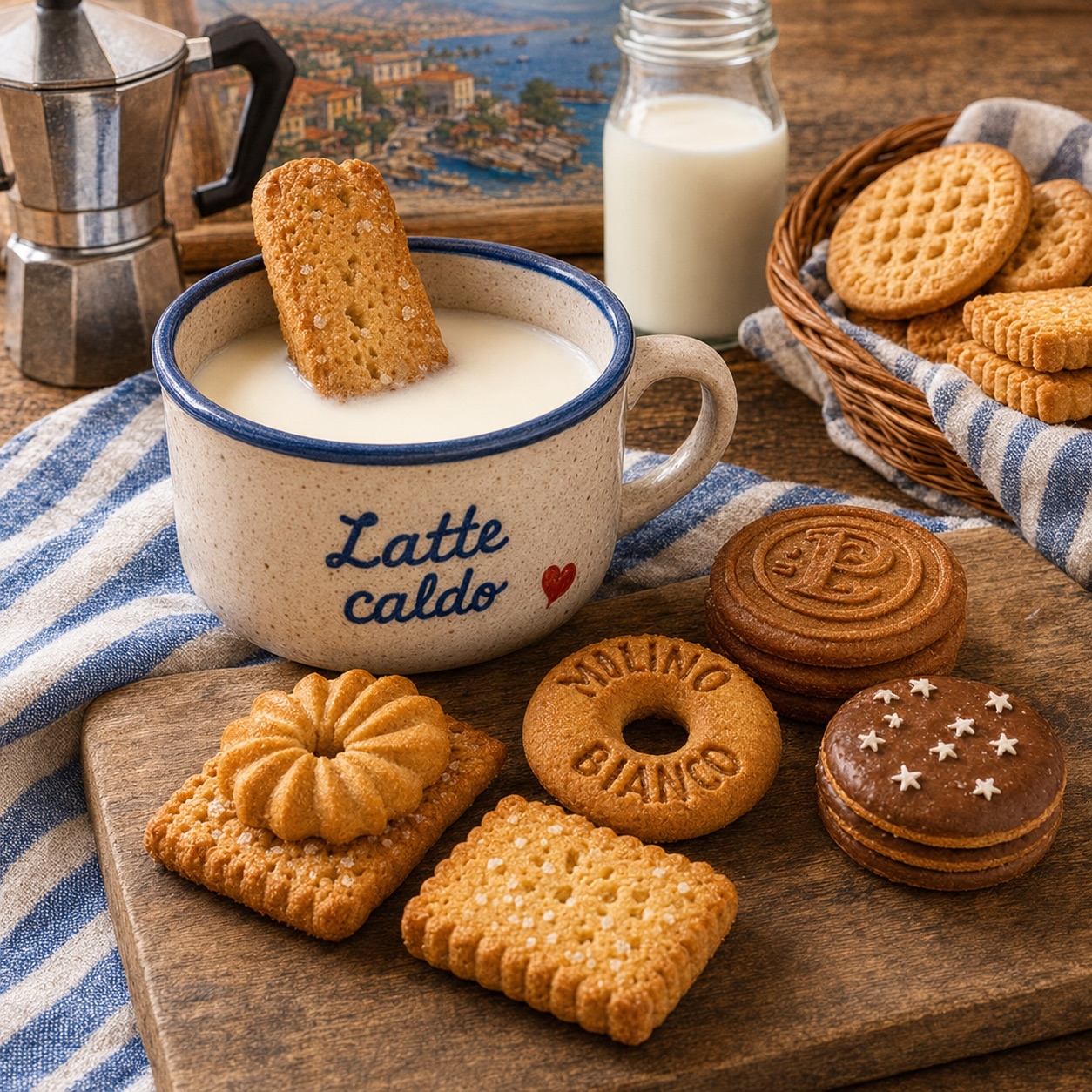
The Italian breakfast is the simplest meal of the Italian day — by design and by tradition. Where the midday meal is the elaborate one (pasta, secondo, contorno, salad, fruit) and dinner is substantial, breakfast is minimal: a coffee, sometimes a cornetto from the bar, and at home a bowl of warm milk with biscotti. This was the colazione of every Italian child from approximately the 1960s onward, when the industrial production of sweet biscuits expanded enough to make them a daily staple. Before that — the 1950s generation — bread was dipped in milk, sometimes with a little jam if the family had it, which is the most austere version of the same logic: something starchy and bland softened in warm milk, eaten quickly before school.
The biscotti of the Italian breakfast are not what Americans call biscotti — the hard twice-baked Tuscan almond logs served alongside coffee. They are the thin, crisp, slightly sweet biscuits made by Mulino Bianco, Pavesi, Galbusera, and others: Abbracci, Macine, Pan di Stelle, Tarallucci, Galletti, Rigoli, Ringo, Gocciole, Frollini. Each brand has its iconic shapes and flavors, debated across generations with the seriousness usually reserved for more consequential things. Pan di Stelle — the star-printed round chocolate biscuits — have a specific devoted following. Macine — the ring-shaped buttery ones — dissolve in milk at a slightly different rate than the rectangular ones, which affects the zuppa timing. These distinctions matter to the people for whom they were the morning ritual.
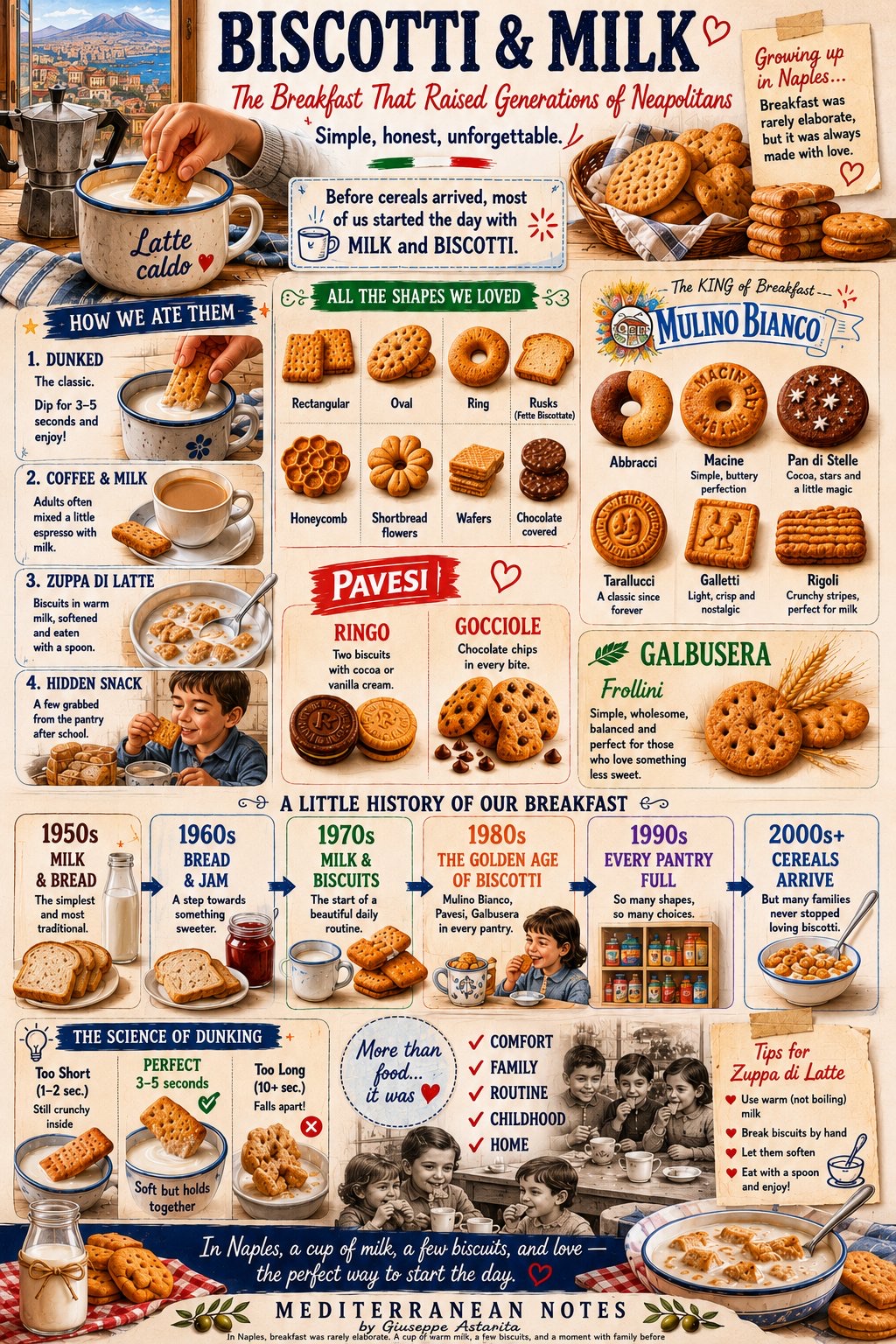
A short history of the Italian breakfast
The iconic brands — what was in our pantry
The science of dunking — three outcomes
A dry biscotto is a matrix of baked starch and sugar with approximately 3–5% moisture content. When immersed in warm milk, capillary action drives the liquid into the porous structure of the biscuit — the same mechanism that makes a sponge absorb water. The rate of absorption depends on the pore size of the biscuit (determined by the recipe and baking process), the viscosity of the liquid (warm milk is less viscous than cold milk, which is why the infographic specifies warm milk for the zuppa), and the surface area exposed. In 3–5 seconds at the correct temperature, the milk penetrates approximately 70–80% of the biscuit's thickness — enough to soften it throughout while the starch-sugar matrix at the center still provides structural integrity. Beyond 10 seconds, the matrix at the center saturates fully and the biscuit's structural proteins and starch network can no longer support the weight of the absorbed liquid — the biscuit falls apart. The 3–5 second window is not arbitrary; it is determined by the physics of capillary absorption in a baked starch matrix.
Not the healthiest breakfast, probably — the sugar content of Italian breakfast biscotti is real, typically 20–30% by weight, which is higher than many breakfast options but lower than most American breakfast cereals, which often run 30–40% sugar. The fat content is moderate, the fiber content is low, the protein content is minimal. It is a carbohydrate-forward, mildly sweet, comforting breakfast that provides energy quickly and that children have eaten for seventy years across Italy without observable catastrophe. Eat with moderation — that's the trick. Two or three biscotti in warm milk is a breakfast. Eight Ringo biscuits is a different decision.
My daughters eat biscotti e latte when we have them, which requires the suitcase import from Italy or a careful online order from an Italian specialty importer. The Macine dissolve at the same rate in Massachusetts as they did in Caserta. The zuppa di latte works exactly the same. The bowl, the spoon, the warm milk, the waiting for the right moment — this is a breakfast that is simple enough to cross an ocean and remain intact. In Naples, a cup of milk, a few biscuits, and a moment with family before the day begins. That is all it was. That is what it still is.
Buona colazione — e sempre la zuppa di latte al momento giusto.