Tiramisù: the cake that gives you strength — and my favorite for a birthday
The word means tirami su — pick me up, lift me up, give me strength. It is a nutritionally dense celebration dessert that appears at every Italian occasion that calls for one. I remember helping my mother dip the savoiardi in coffee as a child. I am not entirely sure I was allowed the coffee yet. It is one of my favorites for a birthday now.
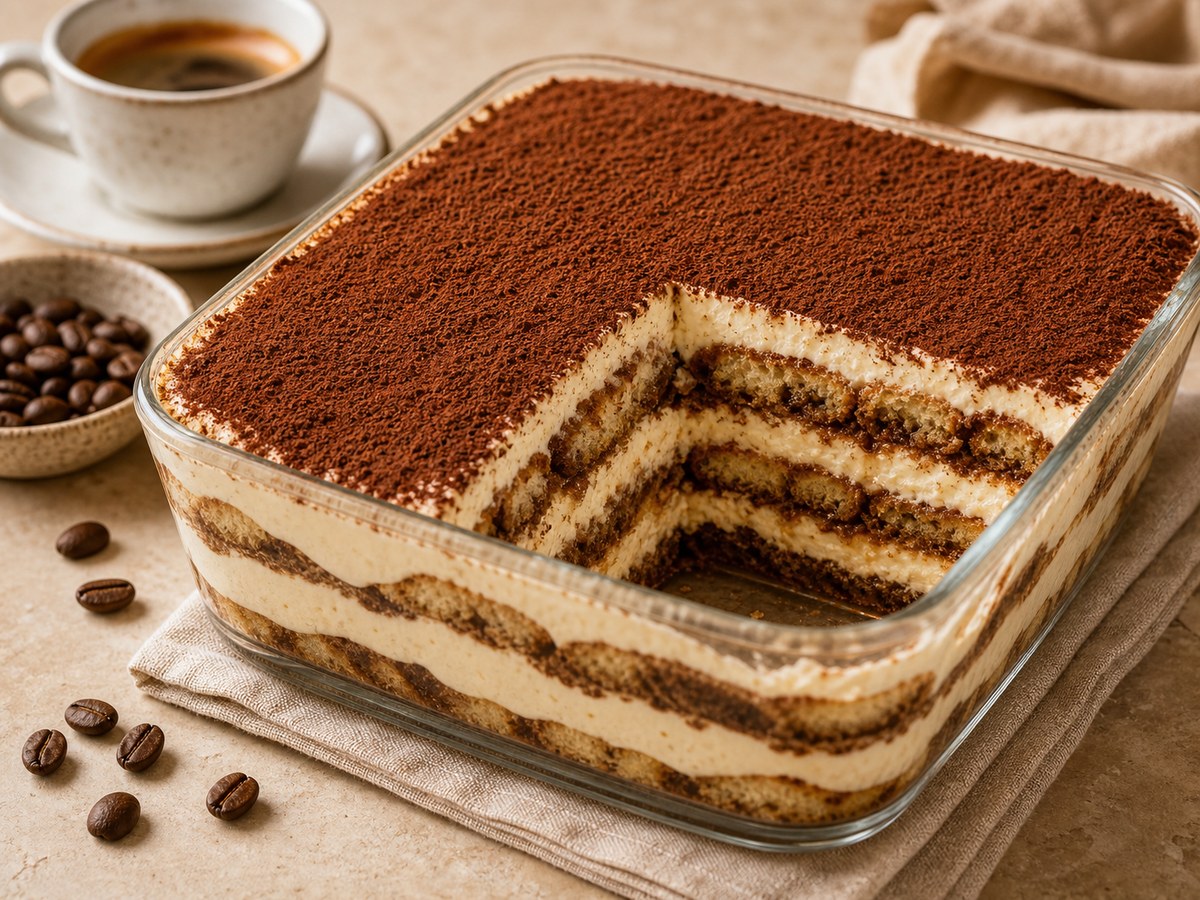
The tiramisù is one of those Italian dishes whose origin is disputed with the specific intensity reserved for things everyone wants to claim. Veneto claims it, Friuli claims it, various individual restaurants claim it, and the Venetian origin is probably the most historically documented. None of this matters in Campania, where tiramisù has been made in family kitchens for decades and where the Neapolitan version has its own specific character: the moka pot espresso instead of bar-pulled coffee, the Strega liqueur as the Campanian spirit of choice for the soak, the mascarpone cream without whipped egg whites — just yolks, sugar, and mascarpone, dense and rich and exactly as heavy as it should be.
The savoiardi were dipped in coffee quickly — a brief pass through the cooled espresso on each side, not a soak, not an immersion. This is the step I helped with as a child: holding the savoiardo by one end, passing it through the liquid twice, and arranging it in the dish. The coffee had been sweetened slightly and had Strega in it, which was why, thinking back, I may not have been supposed to be eating it. The smell of Strega is very specific — herbal, slightly medicinal, unmistakable — and it is one of those smells that recalls the specific moment immediately.
The name's literal meaning — tirami su, pick me up — reflects the energy density of the dessert. Mascarpone, eggs, sugar, ladyfingers, and coffee constitute a caloric-dense combination that in the context of its historical working-class origin was genuinely intended to be restorative. The same logic appears in other traditional Italian preparations where the name describes the effect — zabaione, for instance, was given to the ill and the recovering as a strengthening preparation. That the tiramisù became one of Italy's most celebrated desserts rather than merely a practical food is partly a function of how good it is, and partly because nutritional density and pleasure are not opposed concepts.
Every Italian family makes it slightly differently, and the disagreements are genuine and deeply held. Some people whip the egg whites and fold them into the cream for a lighter result — more airy, less dense. Some use only yolks. Some add both. Some replace the egg entirely with whipped cream. Some do yolks plus whipped cream. The Neapolitan tradition is typically yolks and mascarpone only — no whites, no cream — which produces something richer and heavier and more satisfying in a single slice than the lighter versions. Hard to say any of them are wrong. As you said: it is hard to complain of a bad way to make tiramisù.
Mascarpone fat, espresso caffeine, and why tiramisù is an accurate name
The name tirami su is not marketing — it is an accurate description of the dessert's energy profile. Mascarpone, the Italian fresh cheese made from cream rather than milk, contains approximately 40–45% fat by weight, making it one of the most calorie-dense dairy products in the Italian pantry. A single 100 g serving provides roughly 400–450 kcal, almost entirely from fat — primarily saturated and monounsaturated fatty acids, with fat-soluble vitamins A, D, E, and K2 at meaningful concentrations. Egg yolks contribute lecithin (a phosphatidylcholine that emulsifies the mascarpone cream and gives it its characteristic smooth texture), cholesterol, choline, lutein, zeaxanthin, and the complete suite of fat-soluble vitamins. The sugar provides rapid glucose energy. Savoiardi (ladyfingers) contribute carbohydrate and a small amount of egg protein. The coffee soak adds caffeine — approximately 30–40 mg per serving depending on the quantity of espresso used — which produces the mild stimulant effect consistent with the pick-me-up name. Strega liqueur, the traditional Campanian choice, contains approximately 40% alcohol and roughly 160 herbs and spices including mint, fennel, saffron, and cinnamon — the phytochemical contribution of which is nutritionally negligible in the quantities used but contributes significantly to the flavor complexity of the soak. The unsweetened cocoa powder dusted on top provides flavanols (epicatechin and catechin, the same compounds in dark chocolate with documented cardiovascular benefits) and theobromine — a methylxanthine related to caffeine with a gentler, longer-lasting stimulant effect. The tiramisù is, taken together, exactly what it claims to be: a food that lifts you up.
The recipe — Neapolitan version
Ingredients · serves 8–10
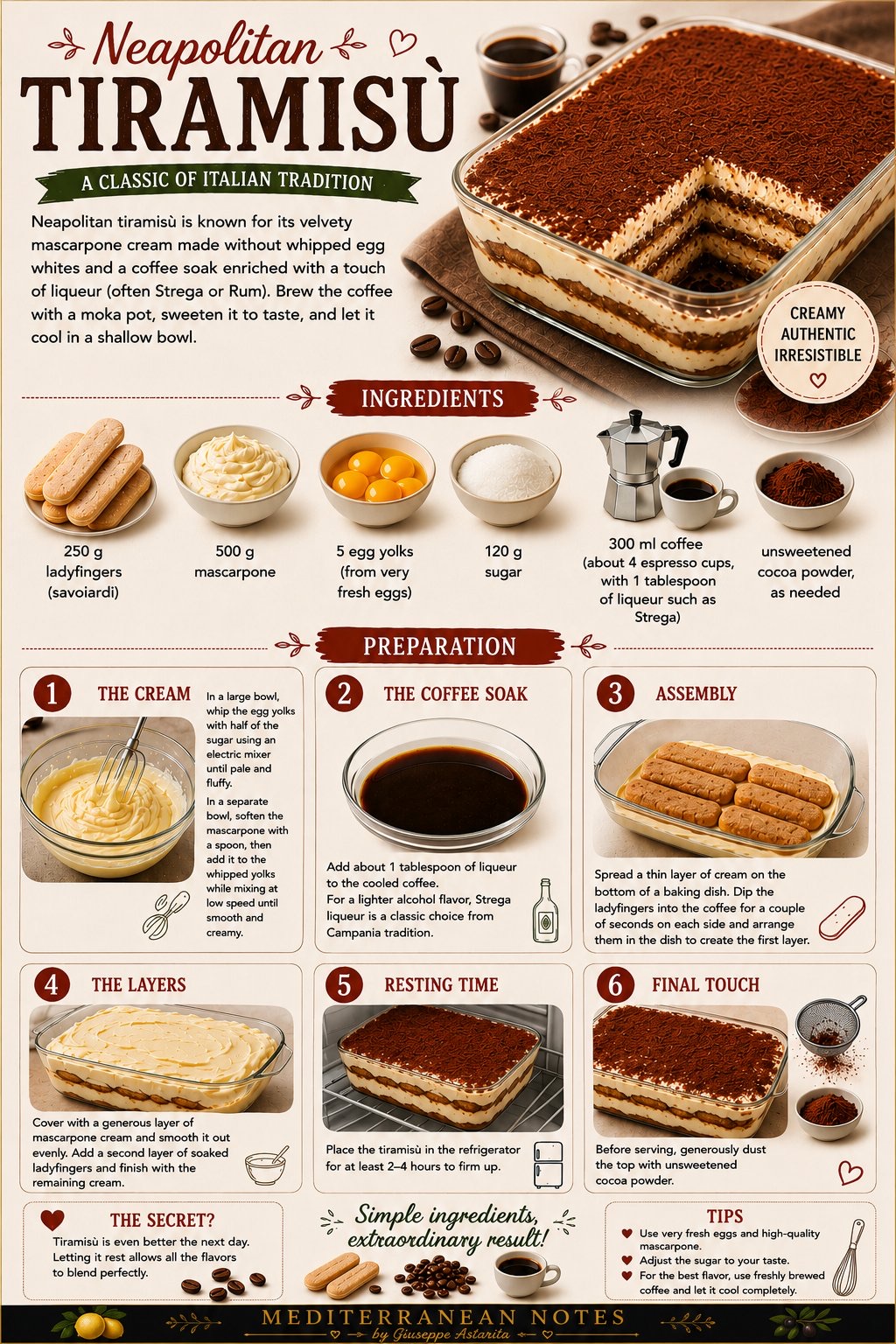
Method
Make the cream. In a large bowl, whisk the egg yolks with the sugar using an electric mixer until the mixture is pale, doubled in volume, and falls from the whisk in a thick ribbon — about 4–5 minutes. In a separate bowl, soften the mascarpone with a spoon until smooth. Add the mascarpone to the yolk mixture gradually, folding with a spatula or mixing at the lowest speed until completely incorporated and smooth. Do not overmix; the cream should be thick and velvety.
Use very fresh eggs — the yolks are not cooked in this recipe. If you are concerned about raw egg safety, use pasteurized eggs, or make a zabaione base: whisk the yolks and sugar over a bain-marie until they reach 70°C, then cool before adding the mascarpone.
Prepare the coffee soak. Brew the espresso in a moka pot (the authentic Campanian method), sweeten very lightly, and let cool completely. Add the Strega or other liqueur. Pour into a shallow bowl wide enough to dip the savoiardi.
The coffee must be completely cold — warm coffee dissolves the savoiardi rather than soaking them. Make it well in advance. For a caffeine-free version, use cooled barley coffee (caffè d'orzo) — it produces a surprisingly good tiramisù with a slightly different, nuttier flavor profile.
Assemble. Spread a thin layer of cream on the bottom of a rectangular baking dish. Dip each savoiardo briefly — 1–2 seconds each side, no more — in the coffee and arrange in a single layer over the cream. The savoiardi should be moist but not soggy; they continue to absorb during refrigeration. Cover with a generous layer of mascarpone cream, smoothed evenly. Add a second layer of soaked savoiardi. Finish with the remaining cream, smoothed flat.
Refrigerate and dust. Cover with plastic wrap and refrigerate for at least 2–4 hours. Overnight is better. Before serving, dust generously with unsweetened cocoa powder through a fine sieve. Serve in squares cut with a clean, sharp knife wiped between cuts.
The tiramisù is always better the next day — the savoiardi have fully absorbed the coffee, the cream has set completely, the flavors have unified. Make it the evening before any occasion that requires it.
The egg debate — three schools
Yolks only
The Neapolitan tradition. Dense, rich, intensely flavored. The cream is heavy and set — holds its shape when sliced. The version for those who want maximum flavor in a single portion. My preference.
Yolks + whipped whites
The classic Italian recipe. Egg whites whipped to stiff peaks, folded into the yolk-mascarpone cream. Lighter, more airy, less dense — a larger volume of cream that is easier to eat in quantity. The version most familiar outside Italy.
Yolks + whipped cream
A richer variation — whipped cream folded in instead of whites. Produces something between the yolks-only and the classical version: lighter than pure yolks, richer than the whites version. Good for those who want a stable cream that travels well.
Variations — the tiramisù as a template
Caffè d'orzo — for children
Replace the espresso with cooled barley coffee (orzo) — caffeine-free, with a slightly nuttier, more delicate flavor. The same technique, the same assembly. The tiramisù my children can eat. Perhaps the version I should have been given as a child when I was supposedly just dipping savoiardi.
Alle fragole — with strawberries
No coffee. Soak the savoiardi in a mixture of fresh strawberry juice, a little sugar, and a splash of limoncello or nothing at all. Layer with the mascarpone cream. Top with sliced fresh strawberries instead of cocoa. A completely different dessert in character — lighter, fresher, more appropriate for summer — but the same template.
Con il cioccolato
Add a layer of finely grated dark chocolate between the cream layers, or mix cocoa powder into part of the cream. More intense, more bitter — a version for those who find the classic one too gentle. The cocoa-dusted top stays, but now there is cocoa inside too.
Individual glasses
Assemble in individual glasses or ramekins — broken savoiardi in the base, cream on top, cocoa dusted. Easier to serve at a gathering, no slicing required, visually elegant. The same flavors, a different presentation. This is the birthday version when the table is large and everyone needs their own.
There is no bad tiramisù. Every Italian celebration that has involved one has been made slightly differently by whoever made it — different liqueur, different ratio of cream to savoiardi, more or less coffee in the soak, whipped whites or not. All of them were good. The one that was made with care and good mascarpone and real espresso from the moka was always better than the rest, but the rest were still excellent. It is a resilient dessert that accepts variation with generosity.
Buon appetito — e tanti auguri.