Spaghetti Estivi con Salsa Cruda
Summer Spaghetti with Raw Sauce — Fresh, Light, Irresistible
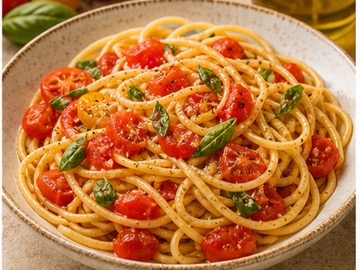
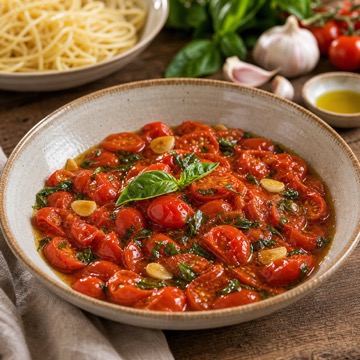
We call this spaghetti estivi con salsa cruda — summer spaghetti with raw sauce. A quick and easy way to use the abundance of ripe tomatoes and fresh basil that summer provides. The sauce is not cooked: the tomatoes are cut small, marinated with olive oil, garlic, basil, and salt for thirty to forty minutes, and that becomes the sauce. I prefer spaghettini — thinner than regular spaghetti, faster to cook, and a lighter bite that doesn't overwhelm the tomato. It is hot out. No need to leave the stove on any longer than necessary.
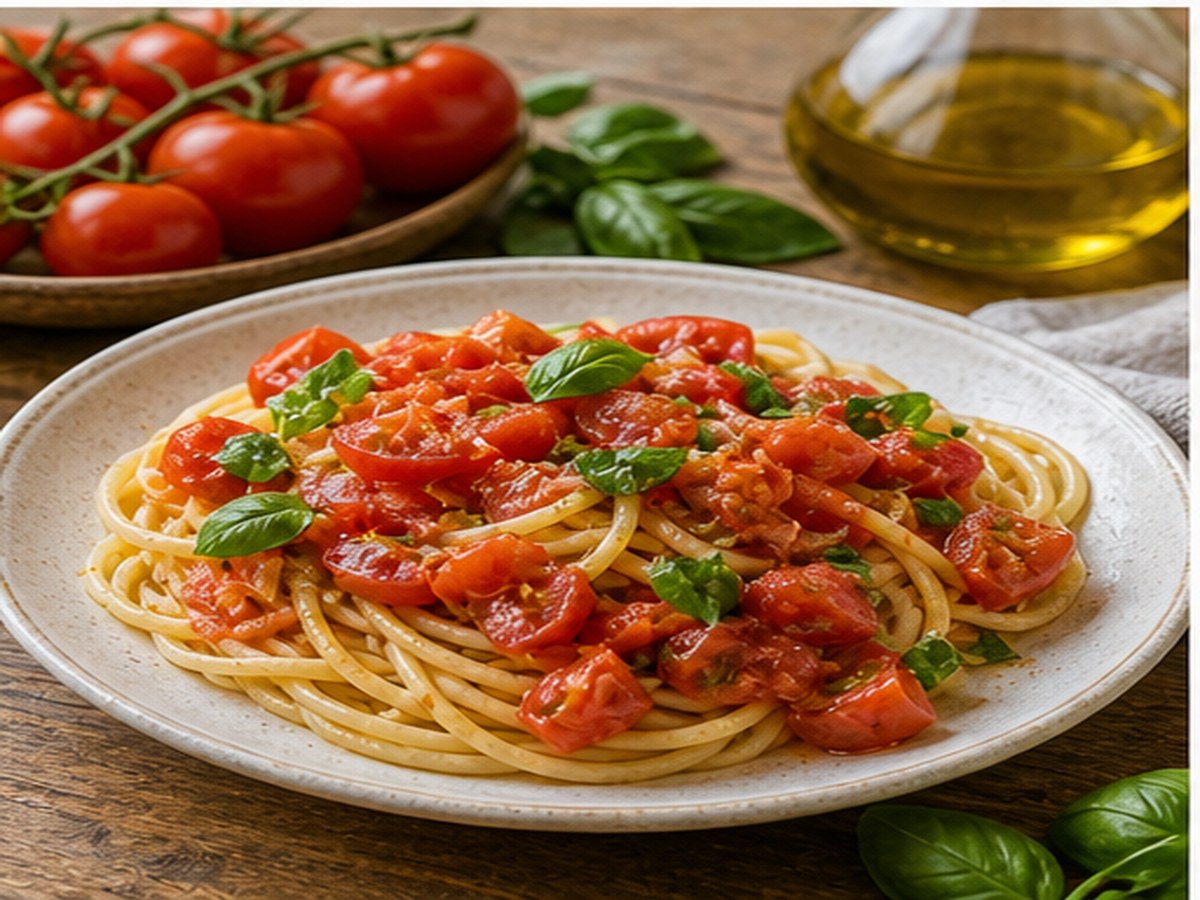
This dish exists because of a specific seasonal abundance. In Campania in summer — July through September — the tomatoes are not a year-round commodity requiring careful sauce construction. They are everywhere, ripe, cheap, sweet, full of juice. The basil is in large bunches in every market and in every garden. The logical response to this abundance is the raw sauce: cut the tomatoes, dress them with olive oil and salt and garlic, add basil, wait half an hour, add the pasta. No cooking required beyond boiling the water. The tomatoes do the work themselves, releasing their juice into the olive oil and creating a sauce that has the specific uncooked sweetness and fragrance that no heat application produces.
The pasta choice matters here more than in dishes where the sauce has more body. I prefer spaghettini — the thin spaghetti, which cooks in four to five minutes rather than the eight to ten of regular spaghetti. In summer, when it is hot and you do not want to leave the stove on longer than necessary, this is reason enough. But there is also the flavor reason: spaghettini have less structural presence than spaghetti, their bite is lighter, and they do not compete with or overwhelm the delicate raw tomato. The tomato and the raw olive oil should be what you taste. The pasta is the vehicle, not the subject.
The recipe — serves 4
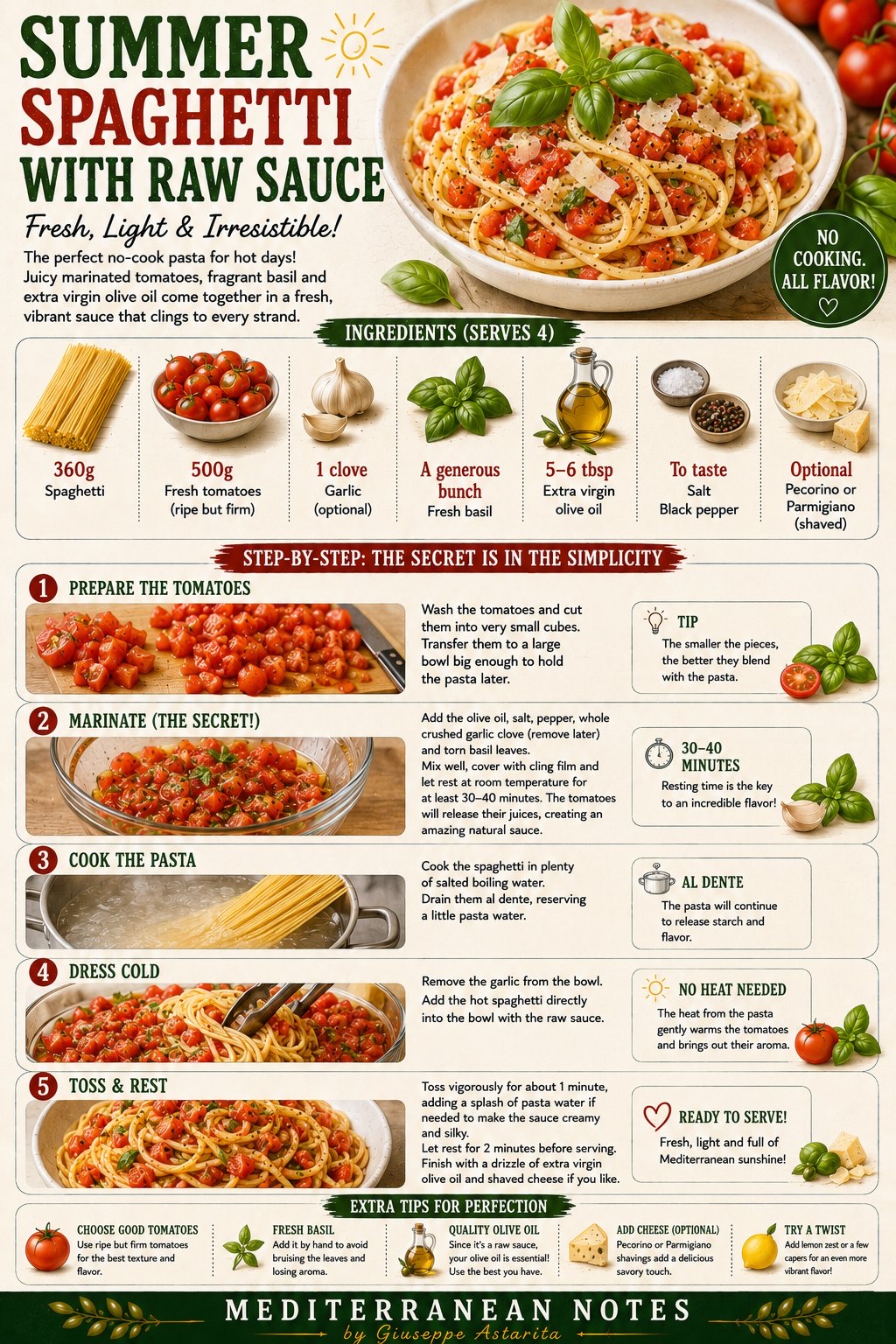
When salt is added to diced tomatoes, it creates an osmotic gradient — the concentration of dissolved solutes outside the tomato cells is higher than inside, drawing water out of the cells through the cell membrane. This released water, carrying with it tomato flavor compounds (glutamates, organic acids, volatile esters), mixes with the olive oil in the bowl. The mechanical action of mixing — and the thirty minutes of contact time — allows the hydrophilic tomato juice and the lipophilic olive oil to partially emulsify, producing a sauce with more body and better flavor distribution than either component alone. The volatile aromatic compounds responsible for fresh tomato smell — including cis-3-hexenal, which gives ripe tomatoes their characteristic grassy-fruity green note — are present at highest concentration in raw tomatoes and are largely destroyed by heat above 60°C. This is the flavor you are preserving by not cooking: the specific chemistry of a ripe summer tomato exists only in its raw state.
The garlic clove steeped whole in olive oil releases allicin and its derivatives slowly and at low concentration — producing a fragrant background note rather than the sharp garlic flavor of chopped garlic sautéed in oil. The basil's volatile compounds — linalool, eugenol, and various monoterpenes — are fat-soluble and dissolve into the olive oil during marinating, distributing their aroma through the sauce. Torn basil releases these compounds more gently than cut basil because tearing produces larger surface areas with less cellular damage; cut basil oxidizes faster and loses more volatile aromatics to the air before they can dissolve into the oil. The instruction to tear rather than cut is not aesthetic.
This is the summer version of the same principle that runs through the whole collection: use what the season gives, in the simplest form that honors it. In winter the tomato is cooked — slowly, reduced, concentrated into a sauce that compensates for the absence of summer sweetness with depth and body. In summer the tomato needs none of that. It is already at its peak. The raw sauce is the acknowledgment that at this moment the tomato does not need your intervention. Salt it, oil it, wait thirty minutes. The work is done.
Estate in Campania — in una ciotola.
No cooking. All flavor. Thirty minutes and patience.