Sfogliatella Riccia o Frolla
A Napolitan masterpiece — and why one is never enough
My mother never made sfogliatella at home. Nobody's mother made sfogliatella at home. You bought it at the pasticceria, still warm from the oven, and you ate it immediately on the way out or standing at the counter with a coffee. For years I was a devoted riccia person. It took time to understand the frolla. A Napule 'o sapore è 'na cosa seria.
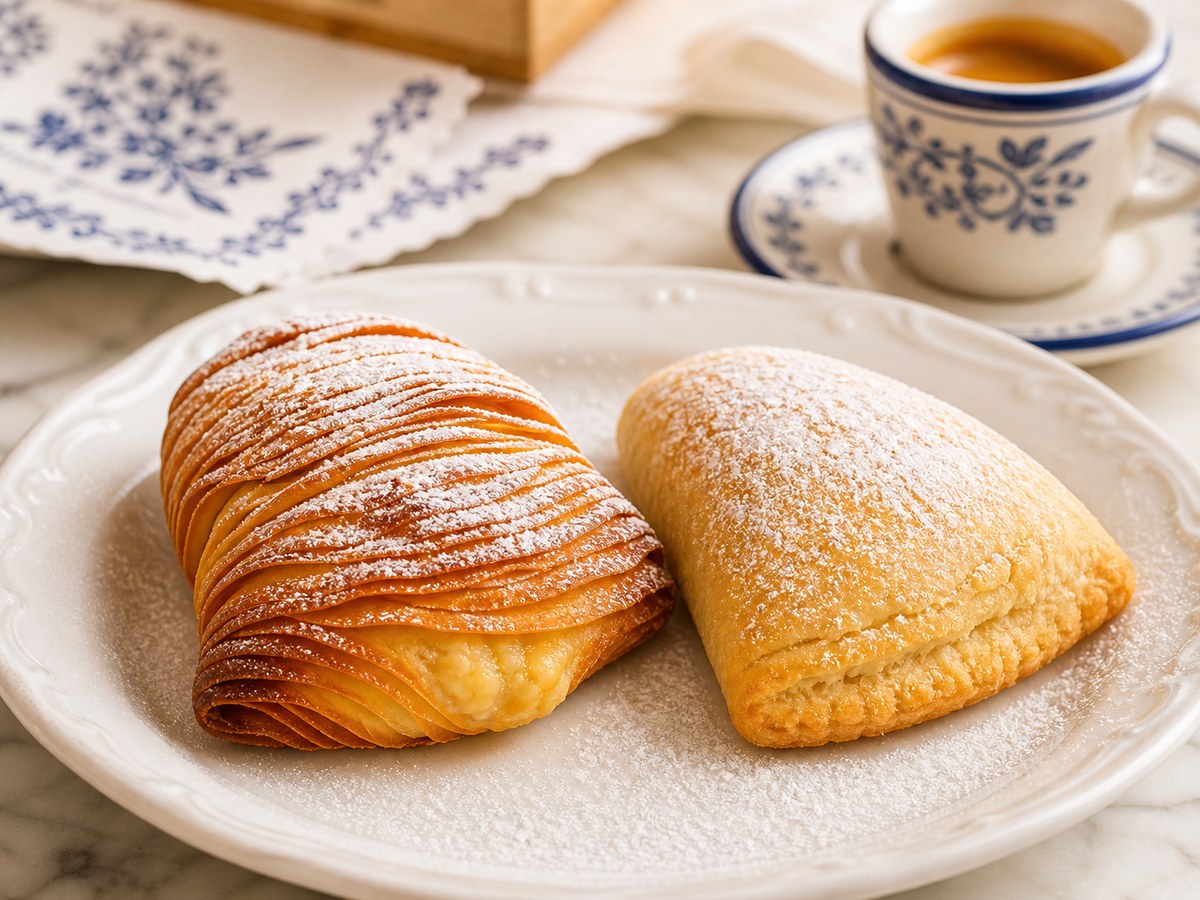
There is a specific hierarchy of purchased pastries in Neapolitan life, and the sfogliatella sits at the top of it without serious competition. Not the most elaborate, not the most expensive, but the most essentially Neapolitan — the pastry that most directly expresses what the city's baking tradition is capable of when it is focused on a single, uncompromising preparation. The name comes from sfoglia, thin leaf of dough, and the riccia version is exactly that: over a hundred paper-thin leaves of dough, rolled, folded, and shaped by hand into the characteristic shell form, filled with a mixture of semolina, ricotta, candied orange peel, candied citron, sugar, vanilla, and cinnamon, and baked until each layer crisps independently. The result is a shell that shatters when you bite it and reveals a warm, fragrant interior that tastes of the citrus and the spice. It is not subtle. It is not trying to be.
The pasticceria ritual was specific. You did not plan to buy a sfogliatella in the way you planned to buy bread. It happened on the way somewhere, or when you passed a particular shop and the smell reached the street, or on Sunday morning as a deliberate small pleasure before the day began properly. In Caserta the good pasticcerie kept them warm throughout the morning. You took one — sometimes two, which required no justification — and ate it standing up or walking, the layers releasing small showers of crumbs that required accepting rather than managing. The coffee alongside was non-negotiable. The sfogliatella and the coffee were one thing in two parts.
For years I ate only the riccia. This was not a considered position — it was simply what you ate, the original, the icon, the version that proved the technique. The frolla was there at the counter alongside it, rounder, smoother, quieter, and I passed over it in the way you pass over the thing that does not announce itself. Then at some point in my twenties I ate a frolla from a good pasticceria in Naples and understood what it was doing: the shortcrust shell, tender rather than crispy, held the same filling in a different relationship. Less texture, more filling per bite, a more delicate sweetness that let the ricotta and the candied citron come forward where the riccia's crunch had partly competed with them. It was not better than the riccia. It was a different sensory argument for the same filling, and both arguments were correct.
The origin is convent-born, as many of the great Neapolitan pastries are. The legend — and in Naples the word legend covers a range of things from complete invention to substantially true — places the sfogliatella's creation in the Santa Rosa Convent in the 17th century, where the nuns took the simple ingredients available to them and produced something that required patience and technique rather than expensive raw materials. From the convent it passed to the noble tables and the seafarers of the 18th and 19th centuries, and from there to the pastry shops of the 20th century where it became the street-level daily thing it is today. The trajectory from convent to street corner took about three hundred years and produced no fundamental change in the preparation. This is probably the strongest argument for its correctness.
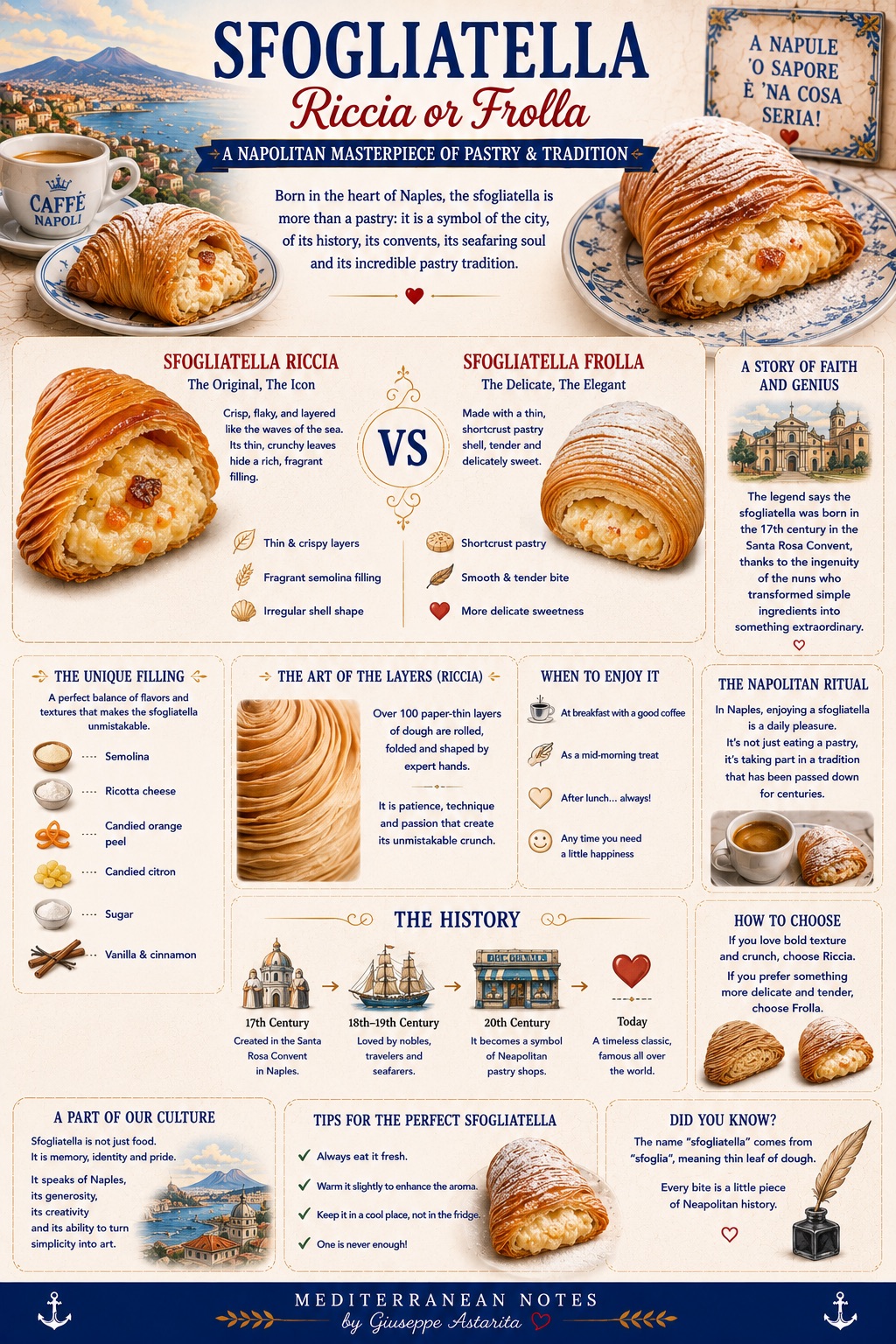
Il ripieno — the same inside both
The filling is what the sfogliatella is, underneath the pastry debate. The semolina gives it body and a slightly grainy texture that is specific to this preparation. The ricotta adds creaminess without heaviness. The candied orange peel and citron are the fragrance — the specific Neapolitan sweet-citrus note that appears in struffoli, in pastiera, in many of the great pastries of the tradition. The vanilla and cinnamon are the warmth that ties everything together. This filling, in either shell, is one of the finest things the Italian pastry tradition has produced.
The riccia's characteristic crunch comes from its laminated dough structure — the same principle as croissant or puff pastry but taken to an extreme. The dough for sfogliatella riccia is stretched to near-translucency, rolled into a cylinder, and then the cylinder is compressed and shaped: each thin sheet of dough becomes a layer separated from the next by a thin film of fat (traditionally lard). When this goes into a hot oven, the water in each dough layer converts to steam, expanding and separating the layers. The fat melts and is absorbed into the dough, which then dehydrates and crisps. The result is a structure of over one hundred independent crispy sheets — like geological strata — that shatter on bite because each layer has almost no flexibility. The frolla's shortcrust pastry is made by a fundamentally different method: fat is worked into flour before liquid is added, coating the flour particles and inhibiting gluten network formation. The resulting pastry has a crumbly, tender texture because the short gluten chains cannot stretch — they break cleanly under pressure rather than shattering like the laminated riccia. Both pastries are baked to a golden color through the same Maillard reactions, but the structural outcome is completely different: one is architectural and crispy, the other is crumbly and yielding. Neither is superior; they are different solutions to the same question of how to encase a warm, soft filling in something that holds its shape and provides textural contrast.
I cannot find a genuine sfogliatella in Massachusetts in 2026. There are Italian bakeries that sell something called sfogliatella, and some of them are not bad, but the specific quality of a fresh riccia from a Neapolitan pasticceria at eight in the morning — the warmth, the crunch, the fragrance of candied citron — does not travel. It requires the oven, the hands that made it, and the immediate consumption. It is one of the foods I think about when I think about what is genuinely missing from a life lived outside Naples. My daughters have had sfogliatella in Italy. They are young enough that they do not yet know what they will spend the rest of their lives looking for a version of.
Una non basta mai — e sempre fresca, sempre calda.