Polpettone al Forno
The Stuffed Italian Meatloaf
A classic of Italian family cooking — soft, juicy, impossible to resist. My mother made this on weekday evenings, filled differently each time: provola and spinach, provola and wurstel, prosciutto cotto and provola. I loved it as a child. I remember the juices that ran when she sliced it and how she would wet each slice with them. I never made it myself. It rests in my memory — and now in this collection.
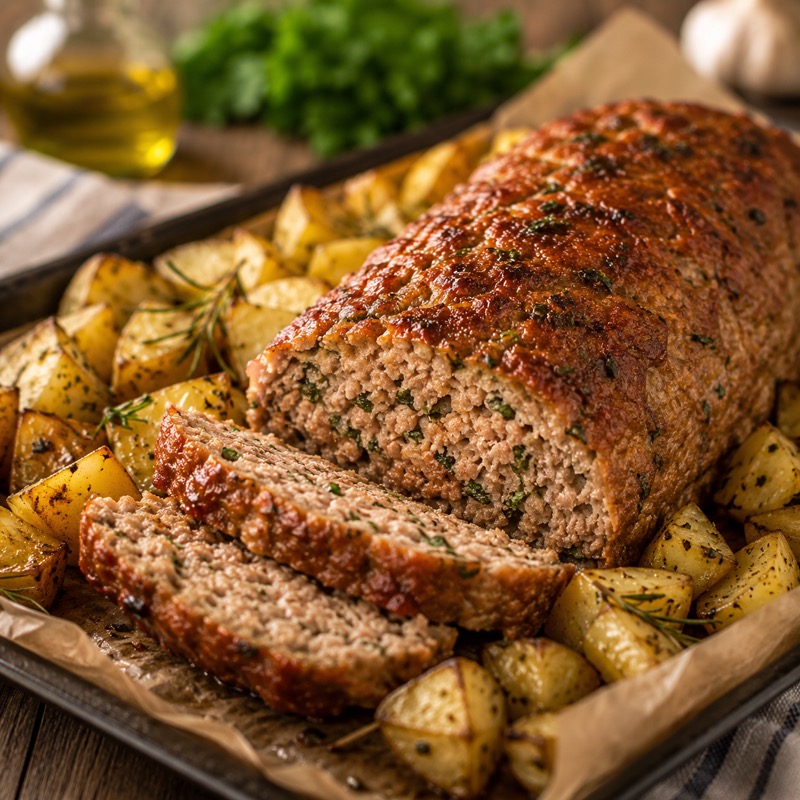
The polpettone is the Italian meatloaf — a preparation that exists in most European food cultures under various names and with various traditions, and that in the Italian kitchen is characterized by the inclusion of soaked bread and eggs in the meat mixture (which keeps it moist and tender) and, in the stuffed version, by a filling rolled into the center before the loaf is shaped. It is not a Sunday dish — it belongs to the weekday rotation, alongside the spezzatino and the scaloppine and the petto di pollo. It requires the oven but not constant attention, which made it practical for an afternoon when other things were also happening.
The wurstel filling deserves a note because it is one of those details that dates a dish very specifically. Wurstel — the German-style pork sausage in a casing — arrived in Italian home kitchens in force in the 1970s and 1980s as one of the processed food products that entered the diet through American and northern European influence in the postwar decades. For Italian children of that generation, wurstel were something modern and slightly exciting — different from the salumi of the traditional kitchen, milder, with a specific texture that worked particularly well melted inside a meatloaf alongside provola. They were a thing growing up. Putting them inside the polpettone was exactly the kind of practical fusion that Italian home cooks have always done: take whatever is at hand, put it inside something that improves it, bake until done.
Ground beef on its own, when baked at oven temperatures, tends to dry out — the muscle proteins denature and contract as the temperature rises, squeezing out moisture, and without a counteracting agent the result is dense and dry. The milk-soaked bread addresses this in two ways. First, the bread crumb structure provides a hydrated matrix throughout the meat mixture; as the surrounding meat contracts during baking, the moisture from the bread migrates into the meat rather than being expelled outward. Second, the milk proteins coat the gluten and starch of the bread and produce additional fat and moisture distribution through the mixture. The result is a meatloaf that is noticeably more tender and juicy than one made without bread and milk, even at the same internal temperature.
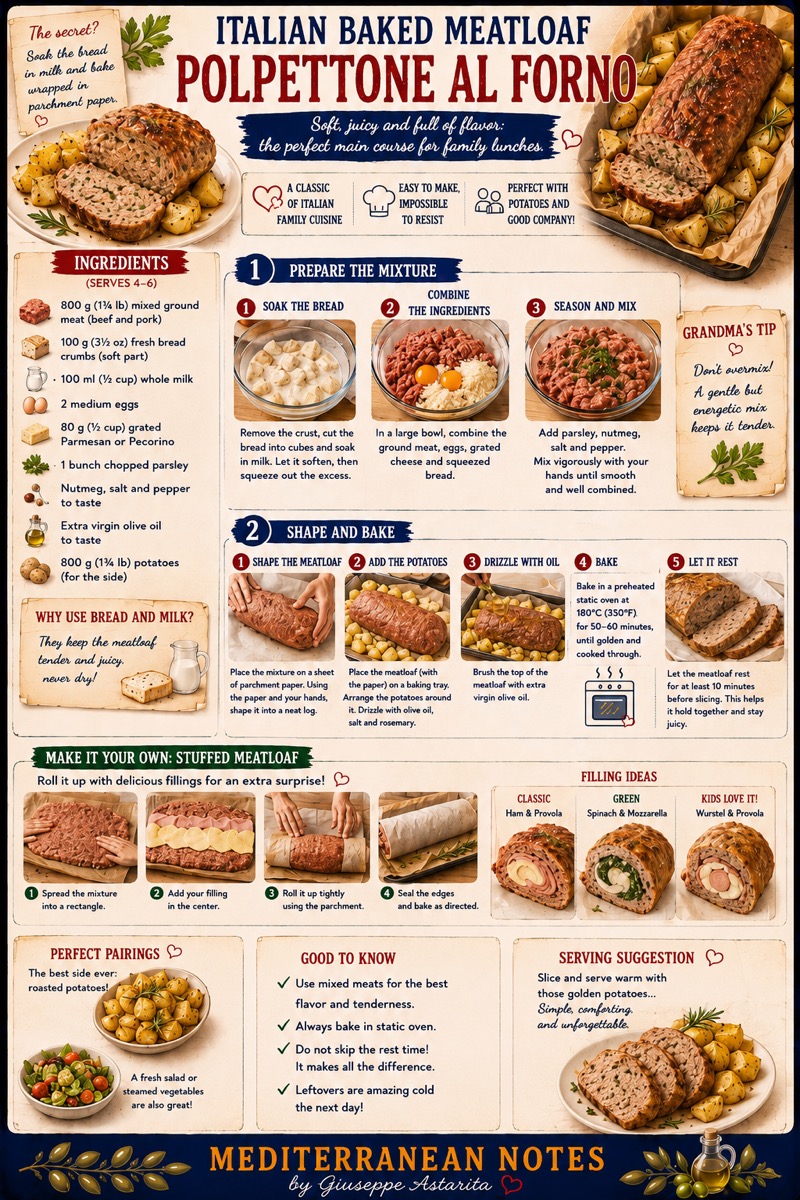
The mixed beef-and-pork mixture specified in the recipe is better than pure beef for a second reason: pork contains significantly more intramuscular fat than lean beef, and this fat melts during baking and lubricates the surrounding protein matrix from within. The fat is also a solvent for flavor compounds — the nutmeg, the parsley, the garlic — distributing them through the mixture more effectively than a lean mixture would. The 50/50 or 60/40 beef-pork ratio produces the balance the infographic describes: tender, juicy, full of flavor. The wrapping in parchment during the first part of baking (specified in the infographic) creates a steam environment around the loaf that further slows moisture loss. The parchment comes off for the last 15–20 minutes to allow browning.
The recipe — serves 4–6
I have not made this. It joins the spezzatino as one of the dishes in this collection that exists here from memory and from reconstruction rather than from repeated practice. The vegetarian years are part of why — these were the weekday meat dishes of a Caserta childhood that I ate without making, and that I am writing down now so that the making is possible later. My daughters will eat them with the knowledge of where they came from. That is what this is for.
The juices. The knife going through. My mother spooning the liquid back over the slices. The wurstel in the center, a very specific 1980s detail that made the dish feel modern and slightly exciting. The provola melted around it. Bread with dinner. The smell of the rosemary on the crust. It is all here now.
Buon appetito — e grazie ancora, mamma.