Il Piatto di Frutta
La tagliata napoletana — a refreshing ritual on hot afternoons
Eating fruit in the afternoon is perhaps universal — or close enough to universal that it requires no explanation in any language. But the way it is done in Naples is specific. It is not a bowl of mixed pieces. It is a tagliata — large slices, generous wedges, arranged on a plate with the generosity that Neapolitan food culture extends even to the simplest preparations.
The afternoon in Caserta in summer was hot in a way that made certain activities reasonable and certain others impossible. Between the end of lunch and the beginning of the late afternoon there was a period — roughly from two to five — when the heat was at its heaviest and the sensible response was to stay inside, lower the shutters, and do as little as possible. This was the time of the piatto di frutta. Not because fruit was the only thing available, but because fruit was the exactly correct response to that specific heat: cold from the refrigerator, hydrating, sweet without heaviness, something that could be eaten slowly while sitting in the shade without requiring any preparation or any particular effort from anyone.
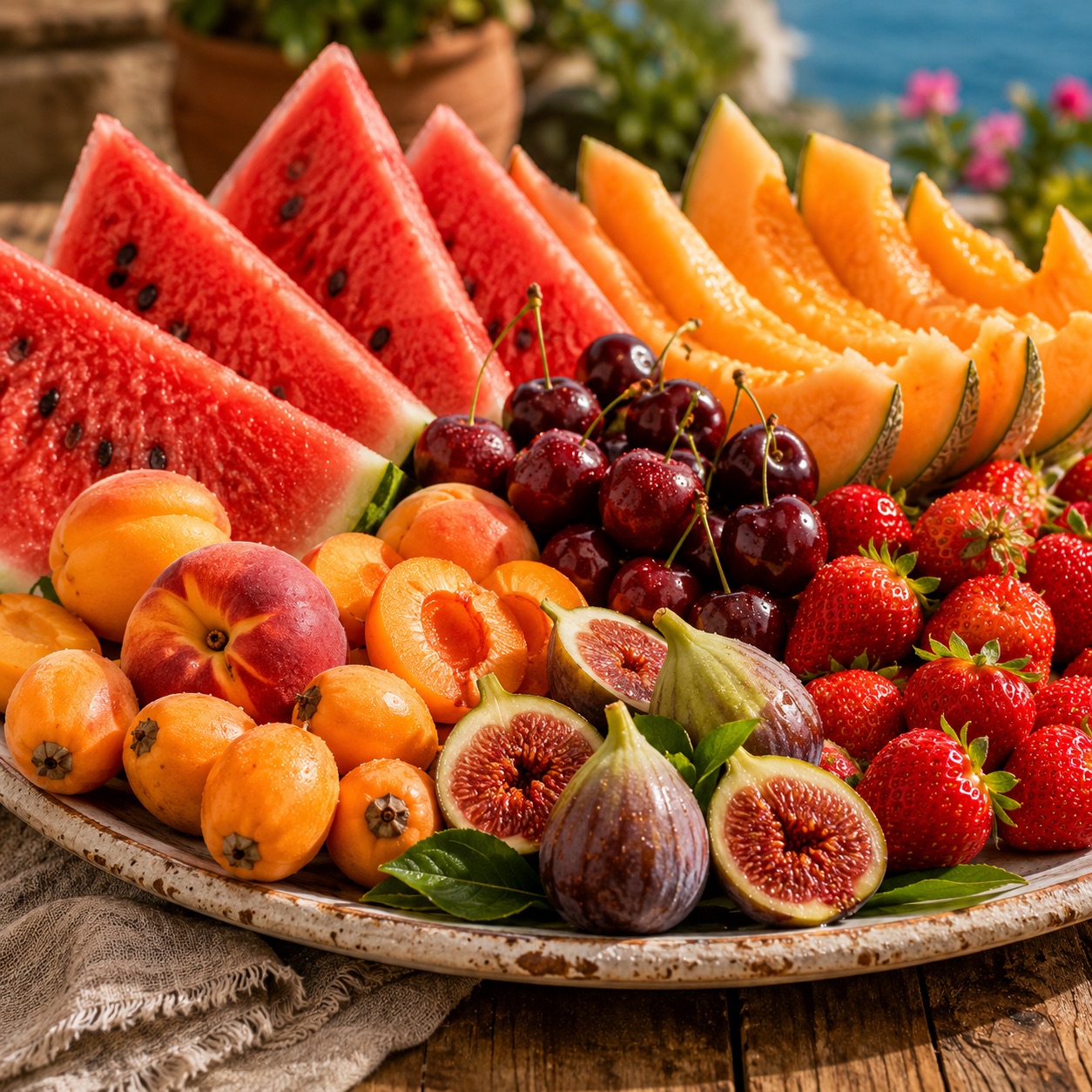
My father prepared the fruit plate. This was one of his contributions to the domestic kitchen — one of the things he did with genuine care and without prompting. He would go to the refrigerator, assess what was there, take out what was ripe and cold, wash it, and cut it into large pieces on the board. Not small pieces. Large wedges of watermelon, thick slices of cantaloupe with the rind still on, halved figs if there were figs, peaches cut into segments. He arranged everything on the large oval plate that served this purpose and brought it to whoever was in the room. This was not a complex gesture. It was a daily one in summer, offered without commentary, accepted without ceremony. The plate was always generous. The fruit was always ripe. My father had strong opinions about fruit ripeness and would not serve fruit that was not ready.
The Neapolitan term for this preparation — and the infographic uses it specifically — is tagliata. The word distinguishes the large-slice presentation from a simple fruit salad or a bowl of cut pieces. A tagliata is cut, not chopped. The pieces are large enough to be held and bitten, not speared with a fork from a bowl. They are arranged on a plate rather than piled in a container. The visual generosity of the arrangement is part of the point — from the seafront kiosks and chalets of Naples to the neighborhood fruit vendors and home kitchens, the fruit plate in Campania is always presented with a particular abundance that is a form of welcome as much as a form of eating. You offer the plate and you offer it generously. Anything less would miss the point.
I am not sure eating fruit in the afternoon is specifically Neapolitan — it seems too universal a response to hot weather to claim as a regional tradition. Children eat fruit in the afternoon in most of the world, and in most of the world's warm climates the same logic applies: between meals, when the heat is serious, cold ripe fruit is the correct and sufficient thing. What may be more specific to Campania is the variety available, the quality of that variety due to the volcanic soil and Mediterranean climate of the region, and the specific attention to seasonal correctness. You eat what is ripe now, not what is available year-round in cold storage. In July this means watermelon, cantaloupe, the percoche peaches of Campania, figs if they are ready, cherries at the beginning of the season. In spring it means nespole, strawberries, apricots. In autumn it means figs in the second crop, plums, late-season peaches. The plate changes with the month. What does not change is the size of the pieces and the generosity of the arrangement.
The same fruit plate appears at the end of meals as dessert. My father ate fruit after almost every lunch and dinner — not a large quantity, but the closing gesture of the meal, the transition from eating to being done eating. The plate that had served as afternoon merenda reappeared in a slightly different context: smaller portions, after the pasta and the secondo, as the final thing. In Italy generally, and in Campania specifically, fruit as dessert is not a compromise or a health-conscious substitution for something else. It is simply dessert — what closes the meal when no elaborate sweet has been made. It is correct on its own terms.
The infographic's note — fruit is best enjoyed between meals, away from heavy or cooked foods, for better digestion and maximum nutritional benefit — reflects a genuinely sound principle of digestive physiology. Fruit is digested primarily in the small intestine and passes through the stomach relatively quickly (gastric emptying time for most fruit is 20–40 minutes). When eaten after a protein-and-fat-heavy meal, the fruit is held in the stomach while the proteins and fats are processed, during which time the natural sugars in the fruit begin fermenting in the warm, slightly acidic gastric environment — producing gas and sometimes discomfort. Eaten between meals on an empty stomach, the fruit passes through quickly and its sugars, vitamins, and water are absorbed cleanly. This is why the afternoon fruit plate — eaten 2–3 hours after lunch when the stomach is largely empty — is physiologically as well as culturally correct. The flavor quality of Campanian fruit is linked specifically to the volcanic soil of the region — particularly the dark, basalt-derived soil of the Vesuvius slopes — which is rich in minerals, especially potassium and phosphorus, that accelerate the metabolism of fruit plants and concentrate the development of natural sugars and aromatic compounds. Campanian tomatoes grown in this soil (the Vesuvian cherry tomatoes, the San Marzano) are among the most flavorful in the world for this reason, and the same soil chemistry applies to the stone fruits, the melons, and the figs of the region. The percoca peach — the firm yellow clingstone variety used for vino e percoche — develops its specific flavor only in this volcanic environment and cannot be replicated in other soil types with the same result.
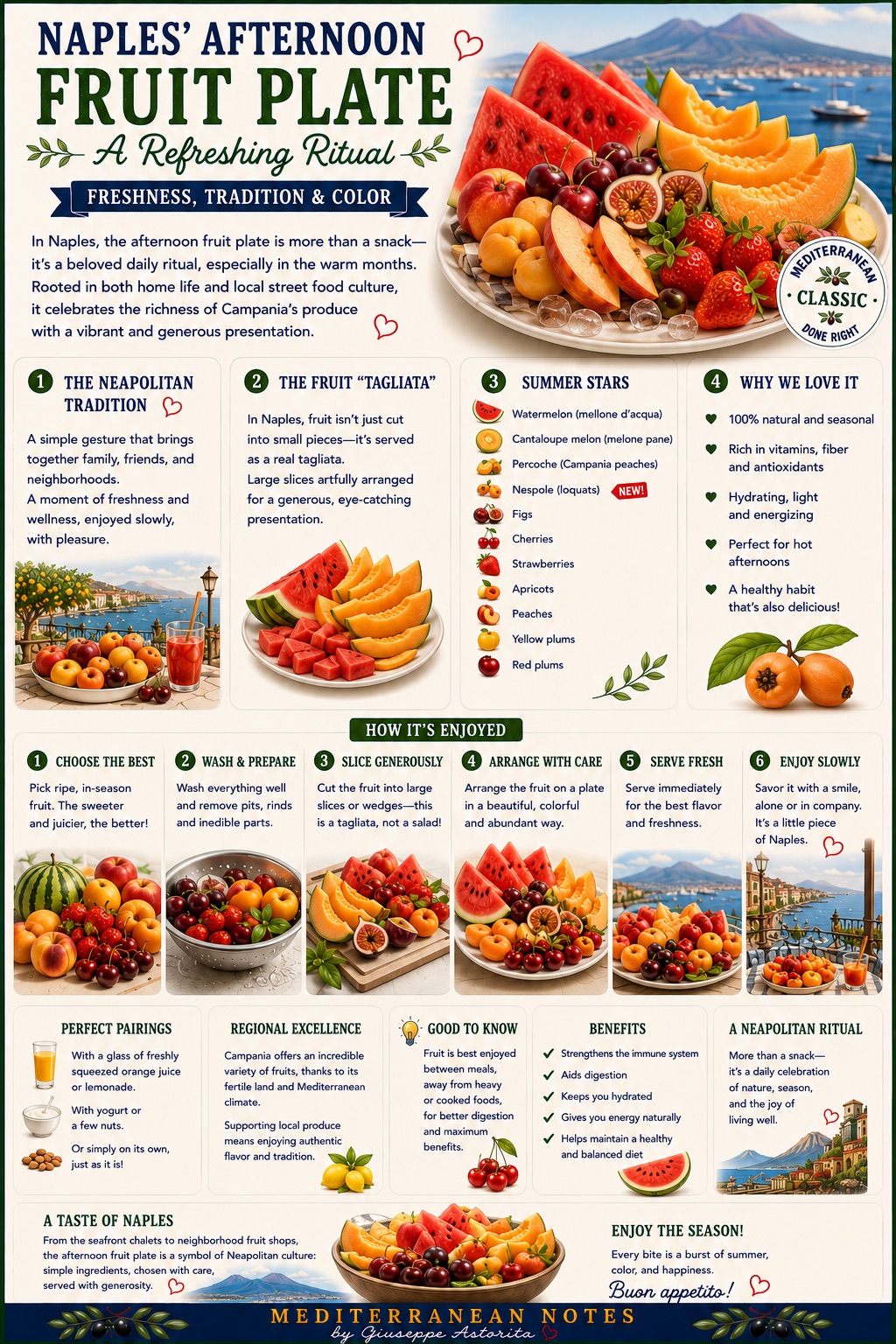
I frutti dell'estate campana
The rule my father applied — and that the infographic states explicitly — is that the fruit must be ripe. Not approximately ripe, not ripening on the counter, not bought three days ago and kept at room temperature in the hope that it will improve. Ripe, today, at the correct temperature. This requires either growing your own fruit or having a relationship with a fruit vendor who can tell you which fruit is ready today and which is not yet. In Naples this relationship existed naturally — the fruit vendor at the market or the neighborhood shop knew his product and his customers and would tell you directly whether to buy something today or wait. This kind of vendor still exists but is rarer. Supermarket fruit selected by weight and uniformity of appearance is a different product from fruit selected by a person who knows what ripe looks, feels, and smells like.
I try to maintain the standard in Massachusetts. The farmers' markets in summer have good peaches, good cherries, good strawberries. The watermelon is adequate. The cantaloupe is sometimes very good. The figs are rare and when they appear they are worth stopping for. The nespole are not there. The percoche are not there. The Campanian apricots are not there. This is the honest inventory. Anna and Carolina eat fruit in the afternoon in summer with the same ease and naturalness that I did at their age, which is the most portable of all the things I have tried to give them from that other place and time. The plate is always generous. The pieces are always large. The fruit is always as ripe as I can find.
Buona merenda — e solo frutta matura, solo di stagione.