Campanian kitchen · Fish · Secondi · Grilled · Pinzimonio · Summer
Pesce Spada alla Griglia
con Pinzimonio — aggiungi un po di pinzimonio
My mother made both versions of swordfish — with pinzimonio and alla napoletana. The pinzimonio was our favorite. She made the best one. She always said it the same way, lifting the bowl and pouring: aggiungi un po di pinzimonio. It was never a little.
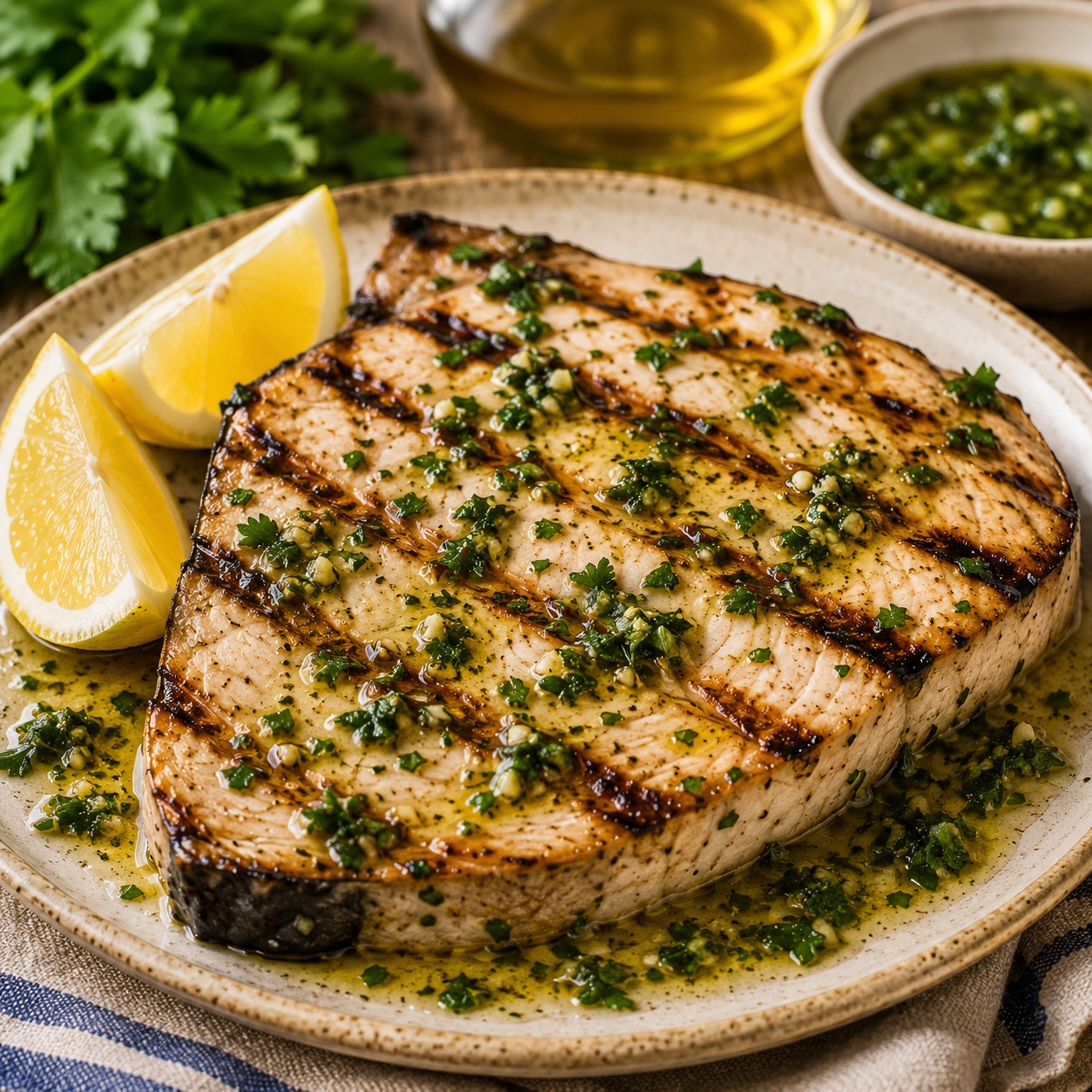
The pinzimonio for grilled fish in Naples is not what most people outside Campania might expect from the word. In other contexts pinzimonio means a simple dipping oil for raw vegetables — olive oil, salt, pepper, nothing more. For grilled fish in the Neapolitan tradition it means something else entirely: a hot, intensely fragrant emulsion of extra virgin olive oil and lemon juice with garlic, abundant fresh parsley, and oregano, mixed vigorously and poured immediately — still hot — over the fish the moment it comes off the grill. In French this preparation would be called a citronette or a salmoriglio. In Naples it is simply called pinzimonio, and my mother's version was the standard against which I have measured every other version since.
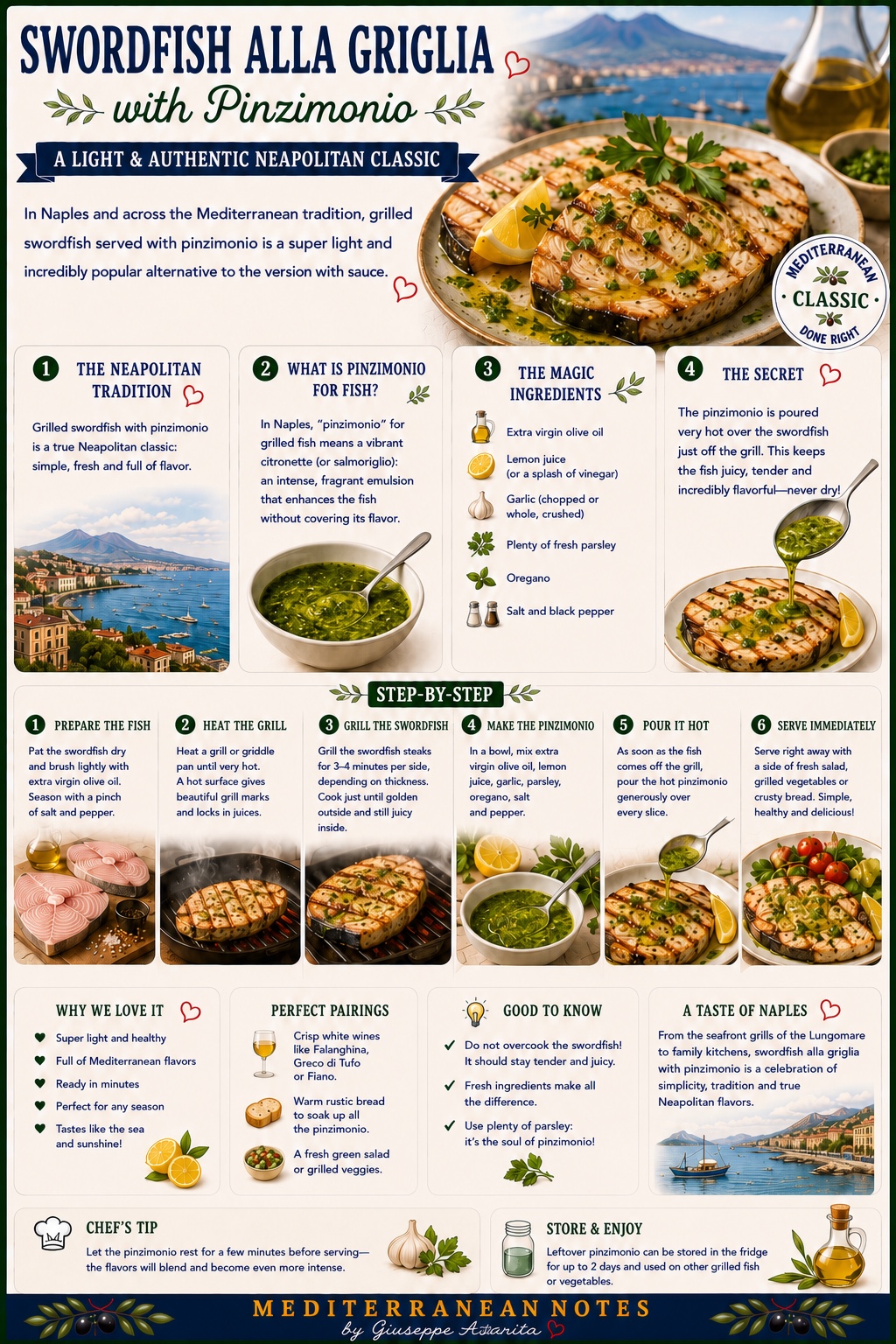
She made it quickly, without measuring, in a small bowl beside the grill. Olive oil — generously, always generously. The juice of a full lemon. A clove of garlic, chopped fine when she wanted the flavor distributed through every spoonful, left whole and crushed when she wanted something subtler that she could remove. Plenty of parsley, fresh, chopped roughly — the infographic calls parsley "the soul of pinzimonio" and this is correct: without abundant parsley the preparation loses its character and becomes oil and lemon, which is a lesser thing. Oregano, salt, black pepper. She mixed it with a fork until it came together into an emulsion — not stable, not the kind that lasts, but the kind that is cohesive for the two minutes it takes to pour it over the fish and bring the plate to the table. Then she lifted the bowl and poured it hot over the swordfish steaks just off the grill and said what she always said: aggiungi un po di pinzimonio.
The swordfish was the other half of the equation. Pesce spada — swordfish — is one of the great Mediterranean fish: firm, dense, meaty, capable of taking the heat of a very hot grill without falling apart the way a more delicate fish would. It is not the most subtle of flavors — it has a pronounced, slightly mineral taste of its own — but it is exactly this robustness that makes it suitable for the pinzimonio, which is an aggressive preparation. A delicate fish with pinzimonio would be overwhelmed. The swordfish can meet it as an equal. The two together produce something that is more than either: the grill's smoke, the fish's minerality, the lemon's acid, the olive oil's richness, the parsley's freshness, the garlic's depth. This is what my mother was building every time she assembled that bowl beside the grill.
The principle I keep returning to from both the infographic and from my mother's practice: do not overcook the swordfish. Three to four minutes per side on a very hot grill, golden and marked on the outside, still juicy within. Swordfish that has been cooked even one minute past this point becomes dry and grainy — not unpleasant, but a completely different texture from the tender, almost creamy interior that correct cooking produces. The pinzimonio poured hot immediately after has a second function beyond flavor: the hot oil enters the surface of the fish and slows the carryover cooking that continues after the fish leaves the grill, keeping the interior moist for the time it takes to reach the table.
Swordfish muscle — like all fish muscle — contains much less connective tissue than mammal meat, which is why it cooks so quickly and why overcooked fish is so much worse than overcooked beef. The myosin proteins in fish muscle begin denaturing at around 40°C and are fully coagulated by 60°C, compared to 65–70°C for red meat myosin. This narrow window of correct doneness (50–58°C internal temperature for moist, tender swordfish) means carryover cooking — the continued rise in internal temperature after the fish leaves the heat source — can push the fish past the correct point in the 2–3 minutes it takes to plate and serve. Pouring a hot liquid over the fish immediately after grilling serves two purposes: the thermal mass of the hot oil temporarily stabilizes the surface temperature and slows further heat penetration into the interior, and the oil forms a thin film over the surface that reduces moisture evaporation during the brief resting period. The lemon juice in the pinzimonio contributes citric acid, which reacts with the surface proteins of the fish in a mild acid denaturation — similar in principle to a ceviche preparation but far less extreme — producing a slight brightening of flavor on the outer surface. The emulsion itself (oil and lemon juice mixed vigorously) is a temporary oil-in-water emulsion stabilized by the small amount of pectin and mucilage compounds in the lemon juice; it breaks within minutes, which is why the pinzimonio must be used immediately — once it separates into its oil and aqueous phases, the flavor distribution over the fish is uneven. Mixed and poured immediately, it distributes as a cohesive, fragrant coating. This is the chemical reason behind the urgency of the step: not tradition for its own sake, but the physics of the preparation requiring fast action.
La ricetta
Per il pesce
Per il pinzimonio
My mother had a light hand with the grill and a heavy hand with the pinzimonio, which is the correct balance. The fish required precision — the right temperature, the right time. The pinzimonio required generosity. Aggiungi un po di pinzimonio meant: more than that. Always more than that. The bread at the end of the meal was for the pinzimonio left on the plate, and there was always pinzimonio left on the plate because she always poured more than anyone expected, and it was always exactly right.
Buon appetito — e aggiungi un po di pinzimonio.