La Melannurca Campana
La regina delle mele — one apple a day, after dinner, always
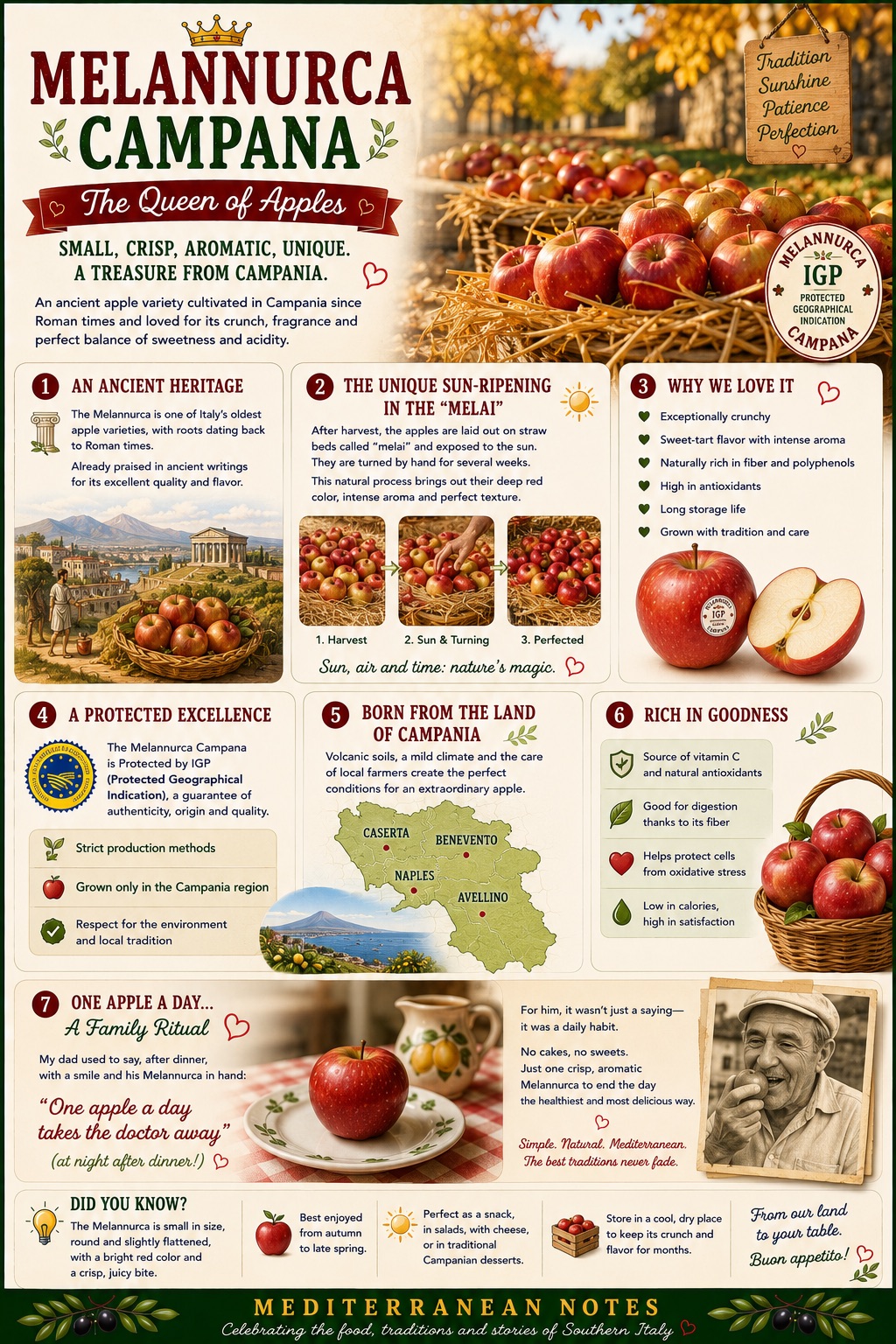
Small, round, slightly flattened, with a deep red skin and a crunch unlike any other apple. Cultivated in Campania since Roman times, finished in the sun on straw beds after harvest. My father ate one every evening after dinner. It was not a proverb. It was a habit, and the habit was correct.
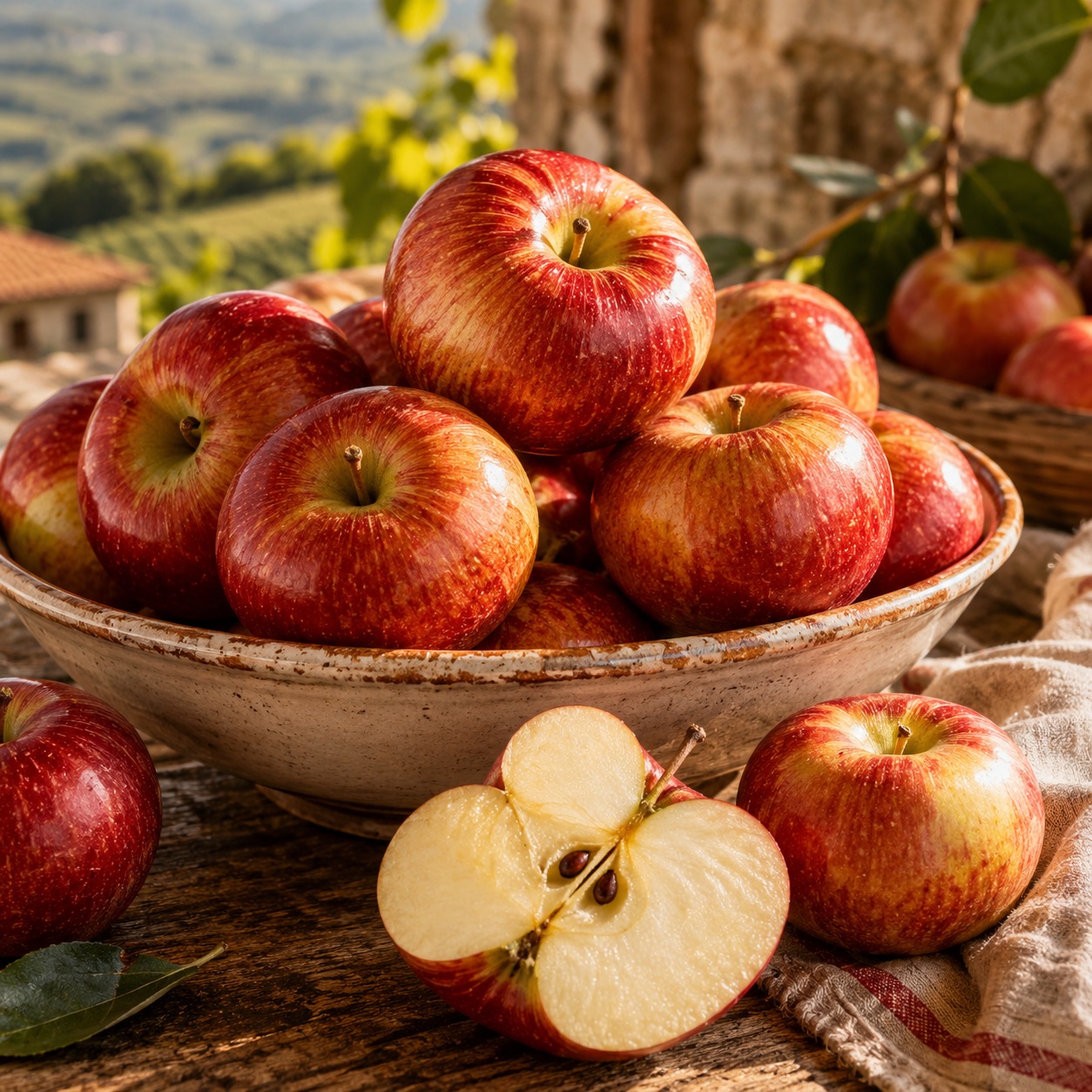
The Melannurca Campana is called the Queen of Apples in Campania, and the title is not modest boasting. It is one of Italy's oldest apple varieties, documented in ancient writings for its quality and praised specifically for what distinguishes it from every other apple available in the autumn and winter market: an exceptional crunch, a sweet-tart flavor with intense aromatic complexity, and a specific quality of freshness that comes from the combination of volcanic soil, Mediterranean climate, and the extraordinary post-harvest tradition of the melai. No other apple is finished the way the Melannurca is finished. No other apple has quite the same result.
The provinces where it is grown — Caserta, Naples, Benevento, Avellino — map almost exactly onto the territory of ancient Campania Felix, the fertile Campania that the Romans named for its agricultural abundance. The volcanic soil of the region, enriched by centuries of Vesuvian deposits, is rich in potassium and minerals that concentrate the development of sugars and aromatic compounds in the apple fruit. The IGP designation — Indicazione Geografica Protetta — confirms that the Melannurca can only be produced in this specific territory and according to specific production methods, because the soil and the climate are essential to the result. A Melannurca grown elsewhere would not be a Melannurca in any meaningful sense.
Il segreto — i melai
The most specific and unreplicable thing about the Melannurca is not its variety but what happens to it after harvest. Once picked, the apples are laid out on low beds of straw — the melai — in rows, exposed to the autumn sun. For several weeks, farmers turn each apple by hand, rotating it so that all surfaces receive equal sun exposure. This patient, labor-intensive process is what transforms the harvested apple — still green and yellowish on the shaded side — into the deep, even red that is the Melannurca's visual signature. But the color change is only the visible result. During the weeks on the melai, the apple's starch continues converting to sugars, the aromatic compounds develop and concentrate, and the texture achieves the specific crunch that distinguishes it from any other apple stored in refrigeration. Sun, air, and time — the infographic puts it well: nature's magic, though the magic requires the farmer's hands turning each apple regularly for weeks.
My father's apple routine was specific. After dinner — after the pasta and the secondo and whatever else had been on the table — he would take a Melannurca from the fruit bowl, peel it carefully in a single continuous spiral of skin if he was in the mood for the small demonstration of patience that requires, and eat it slowly, in pieces. The apple was not dessert in the elaborate sense. It was the closing of the meal, the signal that eating was done, the transition from the table to whatever came after. He ate it with the same attention he brought to the percoche he put in wine or the cantaloupe he tapped to check its ripeness — fruit for him was always something that deserved consideration, not a casual snack consumed without thought.
The Melannurca is not available in Massachusetts. I have looked. Occasionally a specialty importer brings Italian apples — sometimes Annurca, sometimes not quite the same variety — but the Melannurca Campana finished on the melai is essentially absent from the American market, for the same reasons that the nespole and the Campanian percoche are absent: the post-harvest handling is labor-intensive, the storage life, though long by apple standards, does not survive the logistics and economics of transatlantic import at scale, and the American apple market has been shaped by different varieties and different production priorities for long enough that the space for a small, imperfect-looking, labor-finished Italian apple is narrow. I bring them in my luggage from Italy when I visit in autumn. They survive the flight better than most soft fruit. My daughters eat them and declare them very crunchy, which is the correct observation and the essential point.
The weeks-long sun-finishing on the melai is a controlled post-harvest ripening process that differs fundamentally from cold storage ripening. On the straw beds at ambient autumn temperature (typically 10–18°C in Campania in October and November), several biochemical processes continue that would be slowed or stopped by refrigeration. Starch-to-sugar conversion continues through the action of amylase enzymes, raising the soluble solid content (Brix) of the flesh and increasing perceived sweetness. The synthesis of anthocyanins — the red and purple pigments in the skin — is stimulated by the ultraviolet component of sunlight, which activates the expression of chalcone synthase and other enzymes in the phenylpropanoid pathway; this is the mechanism that produces the deep, even red coloration. The turning ensures that anthocyanin synthesis is uniform across all surfaces. The Melannurca's exceptionally high polyphenol content — particularly procyanidin B2, a dimeric procyanidin also found in high concentrations in grape seeds and linked to cardiovascular benefits — appears to be a combination of the variety's genetic characteristics and the sun-finishing process, which upregulates the same phenylpropanoid pathway that produces the anthocyanins. The resulting apple has one of the highest polyphenol contents of any apple variety commercially available in Italy, which is the scientific basis for what the infographic describes as "helps protect cells from oxidative stress." The crunch — the specific texture that distinguishes the Melannurca from other varieties — comes from its high cell turgor pressure (the apple retains moisture well due to its thick cell walls) combined with the relatively high pectin content that keeps the cell walls firm even as the flesh ripens. The crunchy texture and the aromatic intensity together are what make it what it is: a dessert fruit that requires nothing else to be complete.
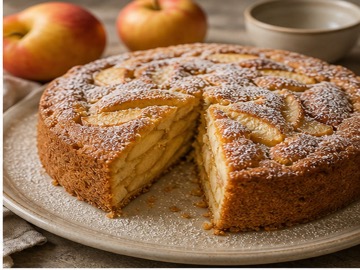
The apple also appears in Campanian cooking — in traditional desserts, in salads with cheese and walnuts, in the torta di mele that my mother made for breakfast, where the Melannurca's density and flavor hold up better than softer varieties under baking. But these uses are secondary to the primary one, which is eating it fresh, in hand, at the end of a meal. This is how it has been eaten in Campania for two thousand years. My father's evening ritual was one instance of a very long tradition, which is the best kind of tradition — the kind where the individual practice and the collective history are the same gesture, performed without thinking about either.
Buon appetito — una al giorno, dopo cena, sempre.