Lesso Rifatto
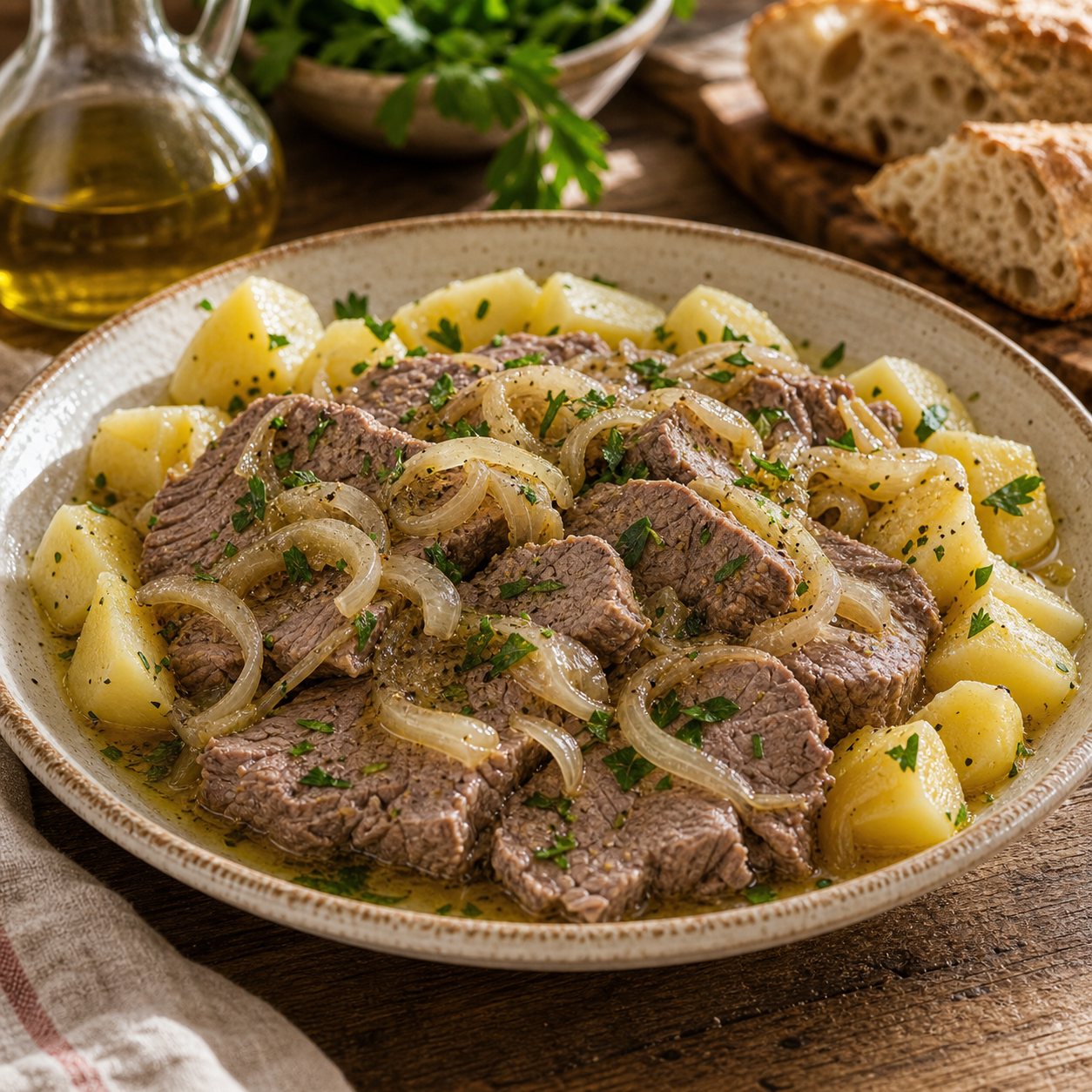
Leftover Boiled Beef with Onions and Potatoes
Saturday lunch in Caserta: pasta in broth first, then the boiled beef fried with sweet onions and potatoes as a secondo. Then basketball practice on a very full stomach. Then pizza in the evening. A particular kind of Saturday that I remember completely.
Saturday was a different day from the rest of the week. School still ended at one, but Saturday had its own structure once lunch was done — sports, going out, the pizza in the evening that was the reward for the whole week. The lunch itself was a particular construction: my mother made broth on Saturdays, a proper meat broth with beef that had been simmering since morning, and the broth served two purposes. First it became pasta — pastina or small pasta shapes cooked directly in the broth, which was the primo. Then the boiled beef that had made the broth became the secondo, transformed in a pan with onions and potatoes into something entirely different from what it was when it came out of the pot.
The idea of making broth on Saturday to keep things lighter before the Sunday big meal made a certain kind of sense. Sunday was the ragù, the long sauce, the full multi-course table — a meal that required the stomach to arrive with some capacity. The broth on Saturday was, in theory, the lighter preparation that created that capacity. In practice, by the time you had eaten a bowl of pasta in broth and then a plate of lesso rifatto with potatoes, you were not particularly light. You were full in a different way — the quieter, more sustained fullness of a meal that does not include a two-hour tomato sauce — but full nonetheless.
I have clear memories of going to basketball practice shortly after this lunch. The timing was not ideal. A full stomach of pasta in broth and fried beef and potatoes does not prepare you well for running. But that was Saturday, and Saturday had its sequence, and the sequence did not move to accommodate basketball.
The dish itself — the lesso rifatto, as it is known in various forms across Italy — is one of the more ingenious things the Italian cucina povera produced. Boiled beef, which has given up most of its flavor to the broth and can seem dry and bland when eaten plain, is completely transformed by frying it in olive oil with slowly cooked sweet onions and potatoes that have absorbed the cooking juices. The meat picks up the caramelized onion sweetness and the oil, and the potatoes provide substance and a slightly crispy edge where they touch the pan. A splash of white wine, a ladle of the warm broth back into the pan, a sprig of rosemary — the result tastes nothing like the boiled beef it started from.
Saturday evenings were pizza. This is consistent with the earlier post about Saturday pizza nights in Caserta — the pizzeria visit that was one of the few regular family restaurant meals. The full Saturday therefore had three food events: the broth lunch that was supposed to be light, the basketball practice that happened in between, and the pizza at the end that required room that the afternoon's digestion had hopefully provided. It mostly worked.
1:00 PM
Pasta in broth
Primo: small pasta or pastina cooked in the beef broth. Simple, warm, quiet.
1:30 PM
Lesso rifatto
Secondo: the boiled beef fried with onions, potatoes, wine, and rosemary. Pan scraped with bread.
evening
Pizza
Out to the pizzeria. The classic Caserta Saturday. Bruschetta first, then the pizza, then the ranking debate.
Why boiled beef needs the pan — what happens when you fry already-cooked meat
Boiling beef extracts water-soluble flavor compounds — glutamates, amino acids, collagen fragments — into the surrounding liquid, which becomes the broth. The meat itself, after this process, has lost much of its natural flavor and its protein structure is fully denatured, leaving a relatively dry, fibrous texture. This is why boiled beef eaten plain is underwhelming: it has donated most of what made it interesting to the pot.
The lesso rifatto technique recovers this by adding new flavor rather than trying to recover lost flavor. Frying in olive oil with slowly cooked sweet onions produces Maillard reaction compounds on the surface of the shredded meat that were not there before — new aromatic molecules formed from the protein residues and the sugars in the onion at temperatures above 140°C. The caramelized onions contribute fructose and glucose that further participate in this reaction. The splash of wine introduces acids and esters that penetrate the meat fibers. The broth added back to the pan re-hydrates the shredded beef and carries the onion flavor into it. The result is a dish that uses the same protein as the boiled meat but with an entirely different flavor profile — richer, more complex, with the sweet onion and the slight char from the pan doing the flavor work that the broth had originally removed.
The recipe — serves 4
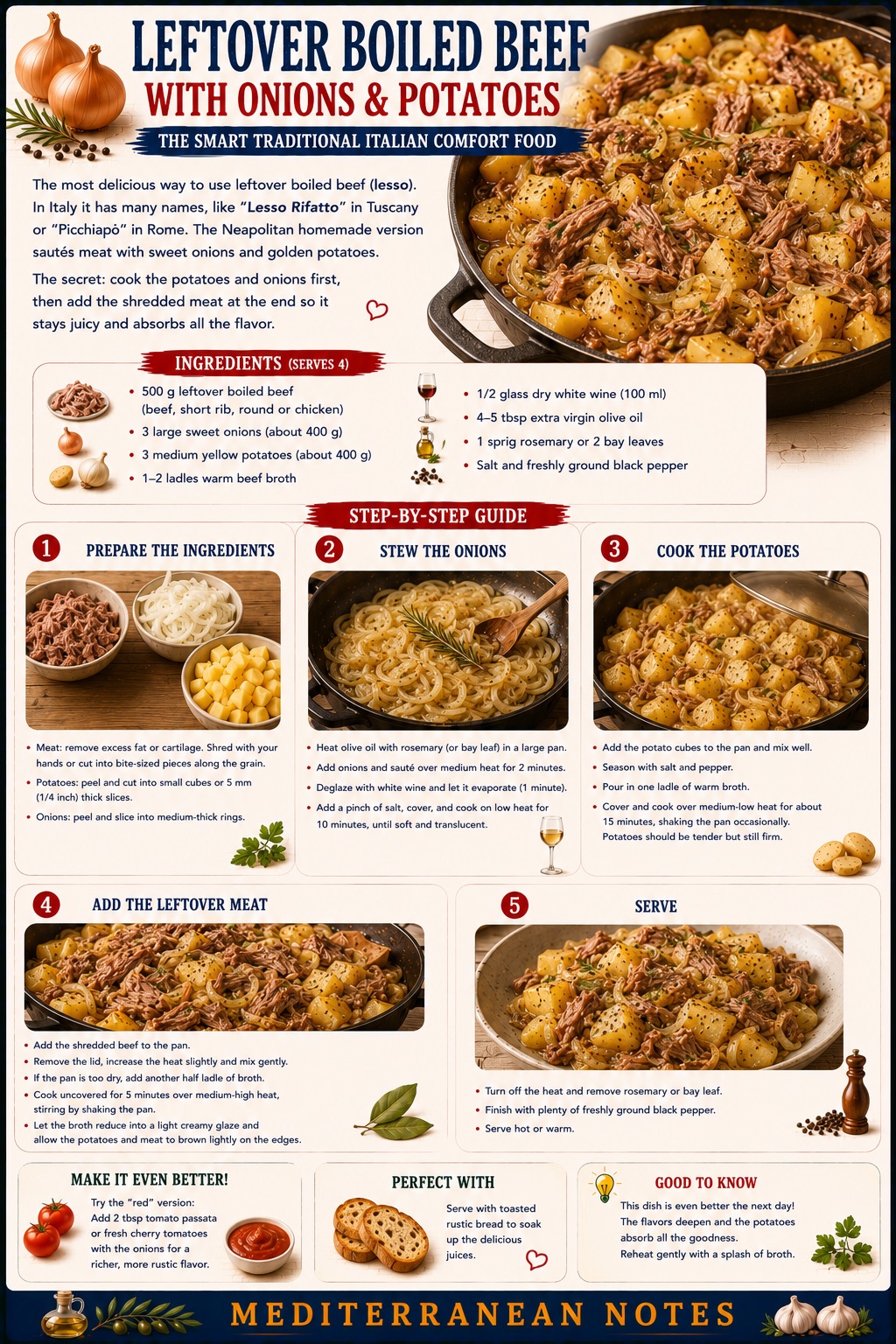
Lesso rifatto — il modo più intelligente di usare il lesso avanzato. Click to enlarge.
500 g
Leftover boiled beef — shredded by hand along the grain
3 large
Sweet onions, sliced into rings
3 medium
Yellow potatoes, peeled and cut into 1 cm cubes
1–2 ladles
Warm beef broth (the same broth from cooking the meat)
100 ml
Dry white wine
4–5 tbsp
Extra-virgin olive oil
1 sprig
Rosemary or 2 bay leaves
to taste
Salt and freshly ground black pepper
1
Shred the boiled beef by hand into bite-sized pieces, pulling along the grain. Remove any excess fat or cartilage. Slice the onions into medium-thick rings. Peel and cube the potatoes to about 1 cm — even size means they cook evenly.
2
Heat the olive oil with the rosemary (or bay leaf) in a large wide pan over medium heat. Add the onions and sauté for 2 minutes. Deglaze with the white wine and let the alcohol evaporate — about 1 minute. Add a pinch of salt, cover, and cook over low heat for 10 minutes, stirring occasionally, until the onions are completely soft and translucent.
The onions need to be fully soft before anything else goes in. They are the base of the flavor and they should be sweet and collapsed, not crunchy.
3
Add the potato cubes to the pan and mix well with the onions. Season with salt and pepper. Pour in one ladle of warm broth. Cover and cook over medium-low heat for about 15 minutes, shaking the pan occasionally, until the potatoes are tender but still hold their shape.
4
Remove the lid. Add the shredded beef and mix gently through the onions and potatoes. Raise the heat slightly and cook uncovered for 5 minutes, shaking the pan rather than stirring to avoid breaking up the potatoes. If the pan looks dry, add the second ladle of broth. Let the liquid reduce to a light glaze and allow the edges of the potatoes and meat to brown lightly.
The pan should be hot enough that you hear a sizzle when the meat goes in. That browning on the edges — where the meat and potato touch the hot oil — is the best part.
5
Turn off the heat. Remove and discard the rosemary or bay leaf. Finish with plenty of freshly ground black pepper. Serve hot with bread to soak up the pan juices — and to clean the pan.
The broth — the other half of Saturday lunch
The meat broth that the beef cooked in is the first course of the same meal. Cook small pasta — pastina, ditali, or broken spaghetti — directly in the strained broth. Season to taste and serve with a little grated Parmigiano if you like. It is as simple as cooking gets and it is very good when the broth itself is good. The broth should be made by starting the beef in cold water and bringing it slowly to a simmer — never in boiling water — with a piece of onion, a carrot, a celery stalk, and a little salt. The slower the rise, the cleaner and more flavorful the broth. Keep a ladle or two of it warm to use in the rifatto. The rest goes into a container and becomes the base for soups through the following days.
Variations
With tomato — the red version
Add 2 tablespoons of tomato passata or a handful of halved cherry tomatoes to the onions before the potatoes go in. The tomato adds acidity and color, making the dish more robust and slightly less sweet. This version is closer to a quick braise than a pan-fry. Both are correct; the white version is more traditional in the Neapolitan kitchen.
Better the next day
Like the cacciatora and the pastiera and the carne alla pizzaiola sauce, the lesso rifatto improves overnight. The potatoes absorb the onion and beef flavors and the texture becomes denser. Reheat gently in a pan with a small splash of broth or water. This is also an excellent filling for a sandwich the following day — cold, inside pane cafone, with a little mustard if you have it.
What cut of beef
The best cuts for the broth-and-rifatto combination are those with some connective tissue: short rib (costine), chuck, or eye of round. They produce richer broth and shred more generously than lean cuts. Brisket also works well. Whatever was in the broth pot is what goes in the pan — this is by definition a dish made with what you have.
The Saturday logic
The Saturday broth meal was, as noted, supposed to be the lighter option before Sunday's ragù. It was not particularly light. But the broth preparation has a real economy: one piece of beef produces two courses — the broth as primo, the meat as secondo — plus surplus broth for the week. The Sunday ragù could then focus entirely on the sauce without having to also serve as a vehicle for boiled meat. The weeks organized themselves this way, each day in relation to the next.
The lesso rifatto is a dish that exists entirely because of what came before it — the broth, the boiling, the extraction of flavor from the meat into the liquid. It is the second life of a preparation that already served its primary purpose. That it is as good as it is — arguably better than the boiled beef eaten plain would ever be — is the point the Italian cucina povera makes consistently: nothing is wasted, and the second use of an ingredient is often its best.
Buon sabato — e andate ad allenarvi dopo.