Fico d'India in Campania
The prickly pear -- wild on the hillsides, sweet in August, better ice-cold
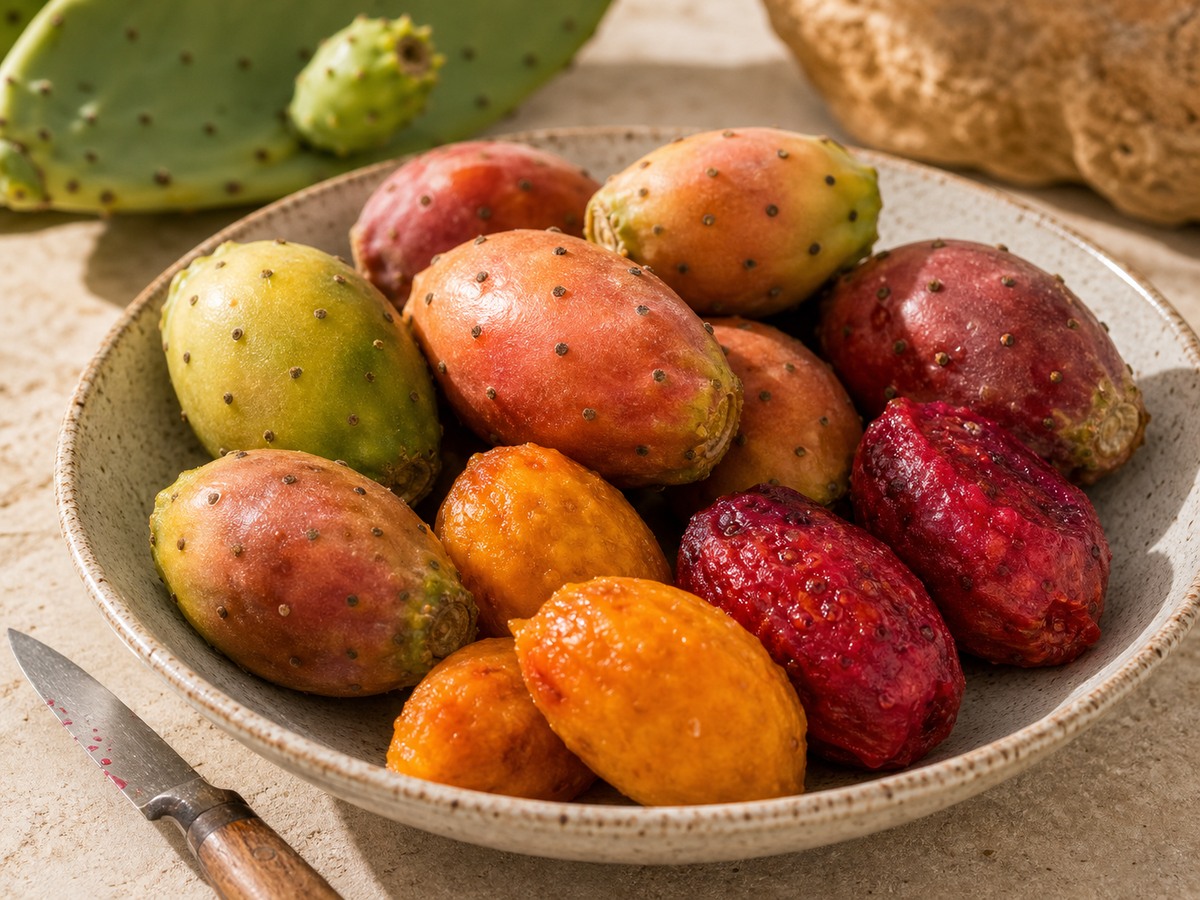
The fico d'india — the prickly pear, Opuntia ficus-indica — is one of those plants so thoroughly integrated into the Campanian landscape that it is impossible to imagine the hillsides, the roadsides, the rocky volcanic terrain of the south without it. It grows everywhere: on stone walls, on the edges of fields, on the slopes of Vesuvius, along the roads of the Caserta province, wild and abundant and completely indifferent to the summer heat. The flat, paddle-shaped cladodes with their clusters of spines, the oval fruits turning from green to yellow to red to deep purple-red as they ripen through August and September — this is part of the visual grammar of the southern Italian summer in a way that has nothing to do with its origin, which was not here at all.
The fico d'india arrived in Italy from the Americas via Spain in the sixteenth century, during the same period of Spanish rule in the Kingdom of Naples that brought tomatoes, peppers, and potatoes to the southern table. It adapted to Campania's volcanic soils and dry Mediterranean climate with remarkable success, naturalizing so thoroughly over five centuries that it is now considered a symbol of the south — not an import but a presence as old as the culture itself. My mother used to tell the stories of finding wild fico d'india growing in the countryside when she was growing up, and eating so many of them that she sometimes felt sick. The fruits are intensely sweet when ripe, with a soft, grainy flesh full of small hard seeds, and when they are freely available and it is August and you are hungry and young, the limit of how many you can eat is not immediately obvious. The lesson was learned through experience.
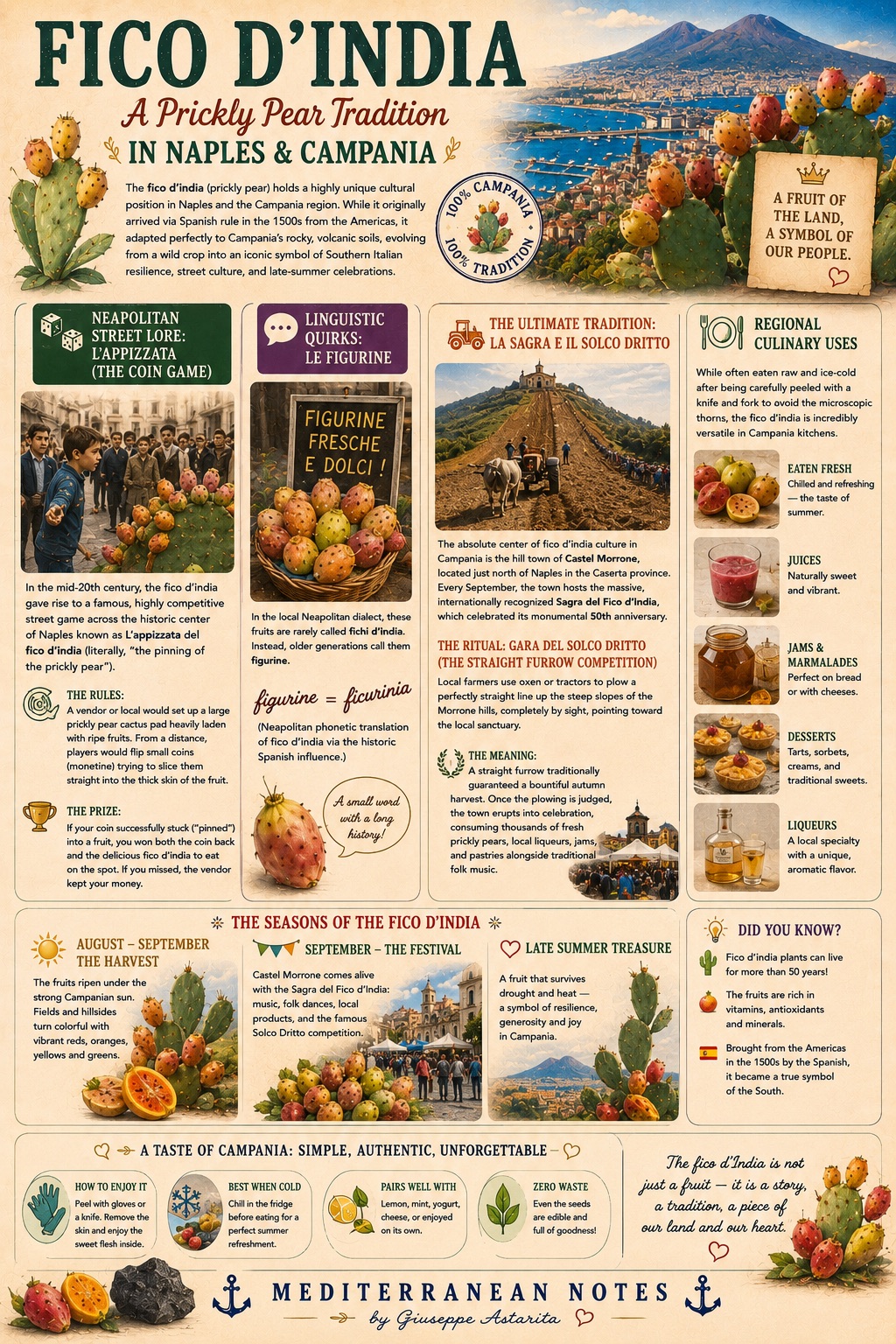
The name contains its own colonial history: fico d'India, the fig of India — meaning the Indies, the Americas as understood by the Spanish explorers who first encountered the plant and brought it east. In the local Neapolitan dialect they are called figurine or ficurinìa, a phonetic transformation of fico d'India through the peculiar modifications of the Neapolitan dialect. Street vendors still sell them in Naples, ice-cold, peeled with a knife to avoid the microscopic glochids — the tiny spine-fragments that embed invisibly in skin and are the reason you should always handle the fruit with gloves or a folded piece of paper.
The center of fico d'india culture in the province is Castel Morrone, a hill town in the Caserta province just north of Naples, which hosts the Sagra del Fico d'India every September — an event that has celebrated its fiftieth anniversary and that includes the famous Gara del Solco Dritto, the straight furrow competition, where local farmers plow a perfectly straight line up the steep slopes of the Morrone hills by sight alone, aiming at the local sanctuary at the summit. The quality of the furrow was historically a guarantee of the autumn harvest. The festival consumes thousands of fresh prickly pears alongside local liqueurs, jams, and pastries, and it is one of the most specifically Campanian of all autumn celebrations.
The Opuntia genus evolved in the semi-arid Americas for conditions of high solar radiation, low rainfall, and nutrient-poor soils -- conditions that volcanic soils around Vesuvius and the Campanian interior approximate closely. The plant stores water in its succulent cladodes (the flat paddles), allows it to survive prolonged drought, and the calcium-rich volcanic soil provides the mineral content the cactus requires for rapid growth. The glochids -- the microscopic barbed spines that cover the fruit and the pads in addition to the larger visible spines -- are a defense mechanism against herbivores and are the practical hazard of the fruit. They are too small to see clearly with the naked eye but embed immediately and painfully in skin, lips, and tongue, which is why the traditional method of peeling the fico d'india with two forks (or with gloves) removes the fruit from all contact with bare hands before it is eaten.
Eaten fresh, the fico d'india is best ice-cold from the refrigerator on a hot August afternoon -- peeled carefully, the sweet grainy flesh eaten slowly, the seeds unavoidable and part of the experience. It makes excellent juice, jams, and sorbets. The seeds, the skin, and even the pads are edible and nutritious. Nothing is wasted from this plant. My mother knew this and so did everyone who grew up with these fruits growing wild on the hillsides around Caserta.
Buon appetito —
e attenzione alle spine.