Carne alla Brace
The Real Taste of Our Land, Cooked Over Fire
In very rare occasions we went out to find spots in the countryside and typical trattorie — maybe on Easter day, for lamb alla brace. And sometimes we grilled at home on the balcony, on a tiny small charcoal grill next to the kitchen. I helped build the fire and turn the charcoal to warm ash. It only happened on Sundays and holidays.
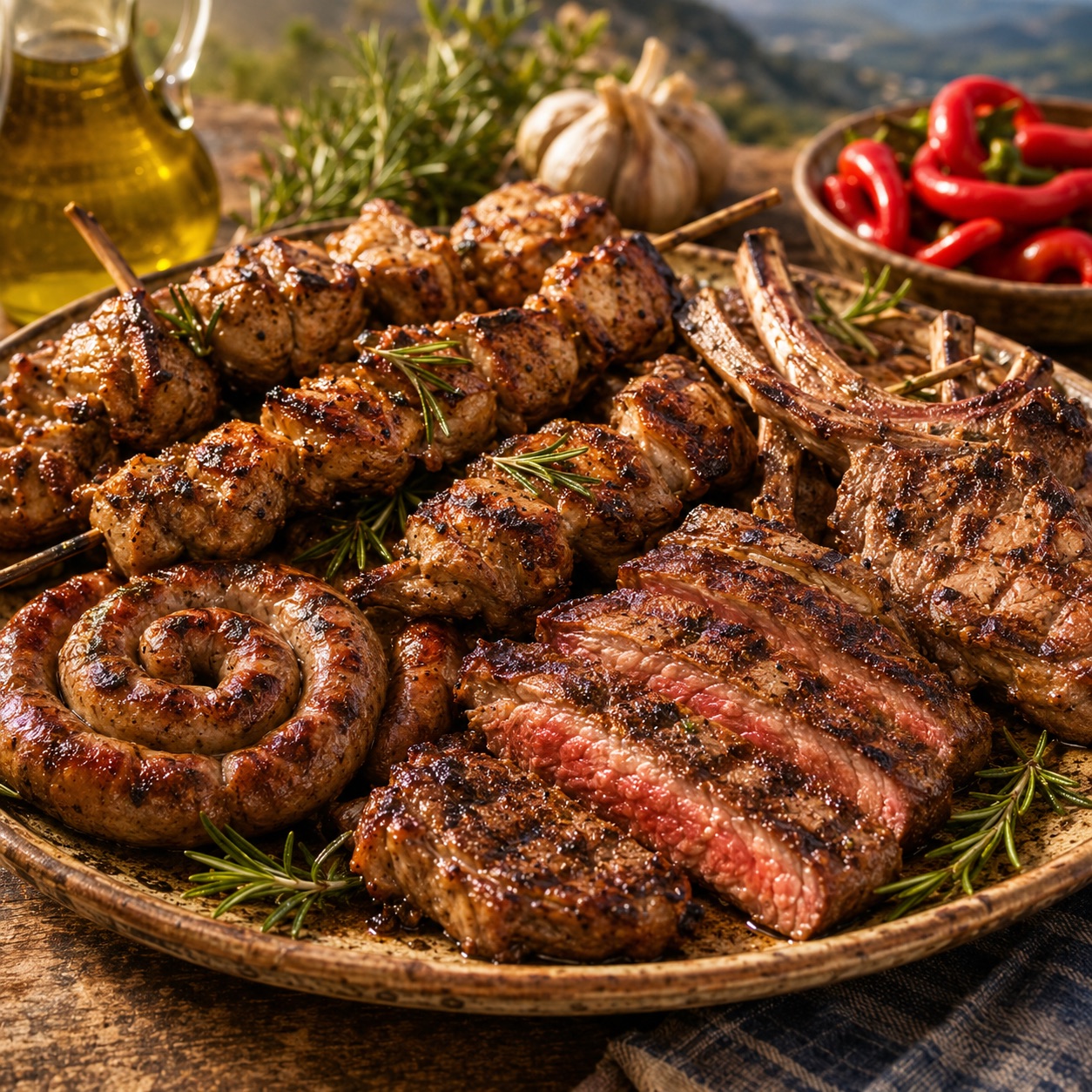
This only happened on Sundays and on holidays. The balcony grill was not a weekday appliance. It was an occasion — the smell of charcoal, the smoke drifting toward the street, the awareness that what was being cooked required different attention from the kitchen preparations. The artichokes grilled on the charcoal on that same balcony are described elsewhere in this collection. The meat grilled there belongs here.
The two occasions for the brace were different in character and in scale. The trattoria in the countryside — rare, reserved for Easter and specific holidays, requiring a drive out of the city — was an event: lamb especially, capretto or young lamb grilled over wood embers in the way that the hill restaurants around Caserta had been doing for generations. The lamb of the Campanian hinterland, cooked over live fire in a place with tables outside and a view of the hills, is one of the specific tastes of Easter in the south that is impossible to replicate at home and that you understand the value of only when you are far from it.
The home grill on the balcony was more modest in its ambitions and more frequently satisfying in its results. Sausages — the salsiccia with fennel seeds — were the most common choice because they cooked reliably and were forgiving of charcoal that was slightly too hot or slightly too cool. Pork ribs, which need patience and lower heat and reward the waiting. Sometimes a bistecca. The simplicity of the seasoning was absolute: the meat was salted and that was all. Olive oil, garlic, rosemary if there was any to hand. No marinade, no complicated preparation. The fire did the work. Good meat, fire, salt, and time. That is all you need.
There was a third context for the brace that belongs here alongside the countryside trattoria and the balcony: the mountain picnic. Day trips into the hills around Caserta — the Apennine foothills, the parks above the city, places reachable by car on a Sunday morning — where a group of friends or the extended family would find a spot, set up the small portable charcoal grill someone had carried in the boot, and light a fire. My mother prepared the food for the trip: frittata di pasta — the cold pasta cake eaten at room temperature — or a timballo di pasta con melanzane, or whatever else traveled well. And then there was the grill, lit on arrival, worked down to the right ash stage, and used to cook meat in the open air in a way that neither the balcony nor the trattoria quite reproduced. The smell of charcoal in a forest or on a hillside is different from the smell on a balcony. The appetite that comes from an hour of walking to find the spot is different from the appetite that comes from a Sunday at home.
These picnics were communal in a way that the home grill was not — friends came, families combined, someone brought the meat, someone brought the wine, someone brought the grill itself. Nobody I knew owned a gas grill. This is worth noting: the gas barbecue, the large backyard Weber, the permanent outdoor kitchen — these were not part of the Caserta domestic landscape in the 1980s. Everyone used small portable charcoal grills. The size of the grill was part of the culture: it implied a specific scale of cooking, a specific kind of occasion, and the work of building and tending the fire rather than turning a knob. The fire was part of what you were doing, not an inconvenience to be managed away. On the mountain, this was even more true — the wood gathered from the surrounding ground, the fire started from scratch, the patience of waiting for it to become what it needed to be.
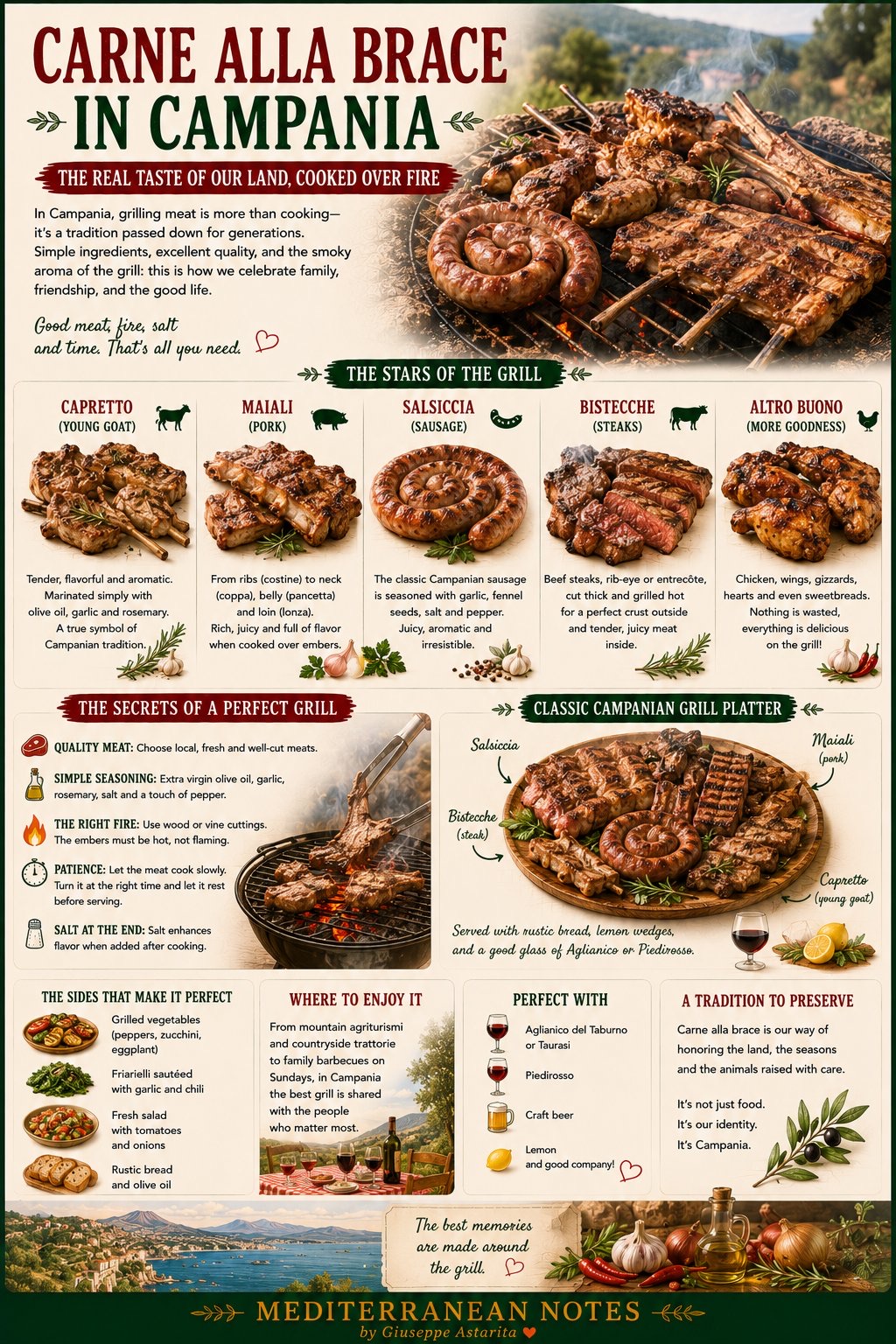
The meats — what goes on the Campanian grill
2. Simple seasoning. Extra-virgin olive oil, garlic, rosemary, salt. Nothing else. The fire provides the flavor; the seasoning supports it.
3. The right fire. Wood or vine cuttings for the countryside version. Charcoal for the balcony grill. The embers must be hot, covered in grey ash, not flaming. This takes patience and cannot be rushed.
4. Patience. Let the meat cook slowly. Turn it at the right time — when it releases from the grill without sticking, it is ready to turn. Let it rest before serving.
5. Salt at the end. Salt enhances flavor when added after cooking, not before. Salt before grilling draws out moisture and produces a dry exterior. Salt immediately after removing from the heat, while the meat is still hot.
Flame-grilling (direct contact of meat with active fire) produces a different result from ember-grilling. Active flames contain water vapor and volatile combustion compounds that condense on the cold surface of the meat, adding bitterness and preventing the dry-heat Maillard crust that is the goal. The embers — grey-ash-covered charcoal at 250–350°C — produce radiant heat without the water vapor of active flames, allowing the outer surface of the meat to dehydrate rapidly and undergo Maillard browning: the reaction between amino acids and sugars that produces the hundreds of aromatic compounds responsible for the flavor of grilled meat. The specific compounds produced over wood or vine cuttings differ from those produced over commercial charcoal — wood smoke contributes additional aromatic esters and phenols (including guaiacol and syringol) that give the countryside brace its specific character.
The salt-at-the-end rule has a simple osmotic explanation. When salt is applied to raw meat surface before cooking, it dissolves in the surface moisture and draws water out of the meat cells by osmosis — the same process by which salt preserves food. This extracted water must then evaporate before browning can begin, which both delays the Maillard reaction and contributes to moisture loss from the interior. Salt applied immediately after cooking — when the internal structure is set and the surface is hot enough to dissolve the salt quickly — provides the same flavor enhancement without the moisture-drawing effect.
The best memories are made around the grill. The infographic's closing line is correct — and it is one of those observations that is true for everyone who grew up in a food culture where grilling was an occasion rather than a convenience. The Campanian grill is not a quick weekday dinner solution. It requires the fire to be built properly, the coals to reach the right stage, the meat to be cooked with patience and attention. These requirements are why it happened only on Sundays and holidays, and why the anticipation of it — starting from when the charcoal was being prepared — was part of the experience. The food that requires something from you before you can eat it tastes different from the food that does not.
Buona brace — e buona compagnia.