Carciofi e patate: the artichoke that could have been a flower
One of my favorites — though I always found artichokes difficult to prepare, and the discarding of so many outer leaves felt like too much waste. Once you learn the preparation, their flavor is unlike anything else. And if you leave an artichoke unpicked on the plant, it opens into a beautiful purple flower. The artichoke is a thistle.
The artichoke is not obviously a food. It is a heavily armored flower bud of a large thistle plant — Cynara scolymus — and the part that is eaten is the fleshy base of the immature bud, before it has had the chance to open. If you leave it on the plant, it does open: the outer leaves spread, a dense explosion of silvery-purple filaments extends upward, and what was a closed green bud becomes one of the most spectacular flowers in any garden. This transformation is not commonly seen by people who eat artichokes because the artichoke is harvested before it can complete it. But anyone who has grown them or seen a neglected plant in spring knows the flower, and it is difficult to look at an artichoke the same way afterward.
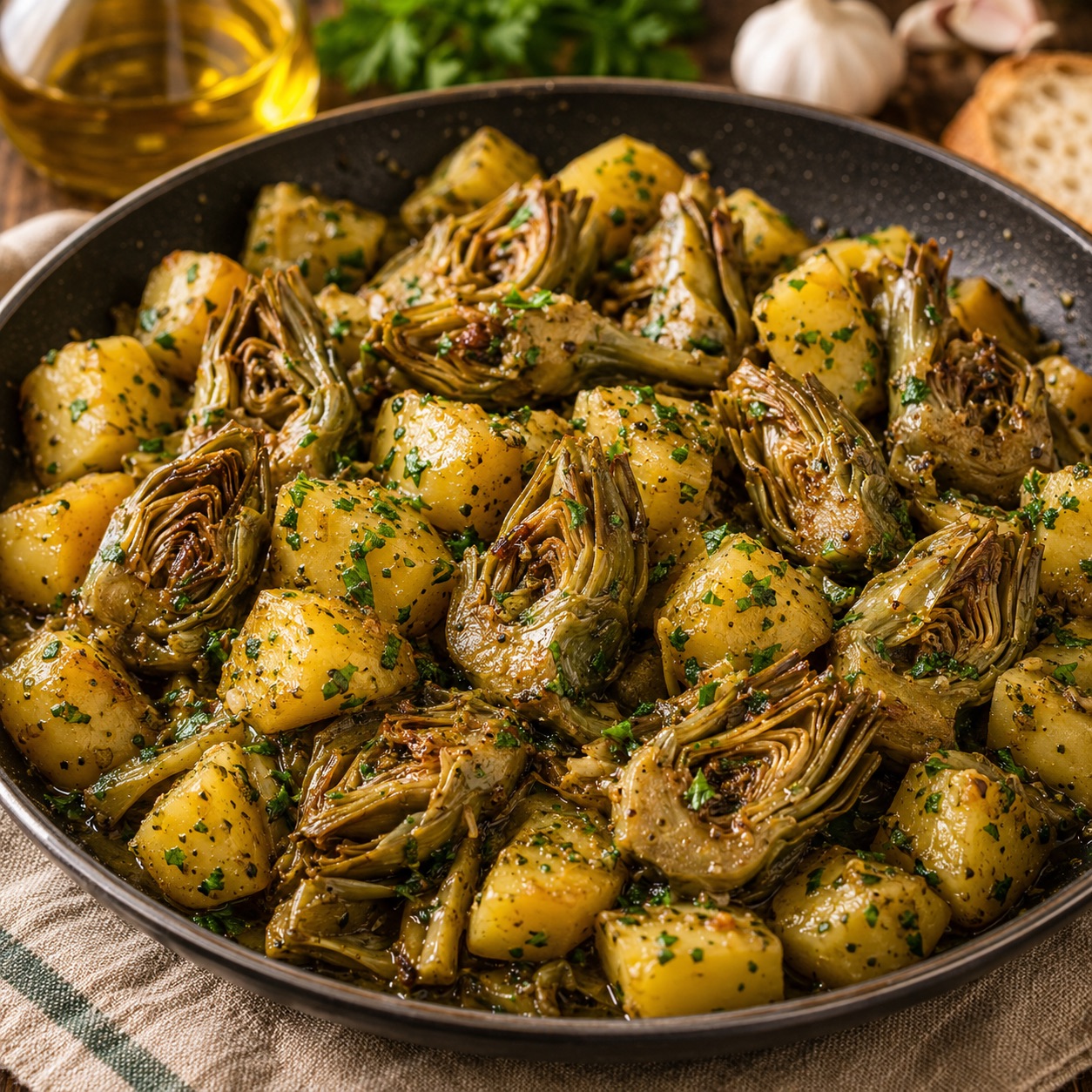
In the Neapolitan kitchen, the preparation is called carciofola affogata — the drowned artichoke — or simply carciofi e patate: artichokes and potatoes, slow-stewed together in olive oil, garlic, parsley, and a little broth or water, in a covered pan over low heat until everything is tender and the cooking liquid has reduced to a rich sauce. The potatoes absorb the artichoke flavor as they cook — this mutual absorption is the point of cooking them together rather than separately. The sauce at the bottom of the pan, infused with both, is specifically for bread.
The artichoke preparation is the obstacle that keeps this dish from being made more often. It requires patience and some experience — knowing how far to go with the outer leaves, where the tough ends, which part of the stem is worth keeping. The lemon water is essential: artichoke flesh oxidizes rapidly when cut, turning brown within minutes of exposure to air. Every piece must go immediately into a bowl of cold water with lemon juice. This is not fastidiousness — it is the difference between pale, clean artichoke hearts and grey, bitter-tasting ones.
The varieties matter too. In Campania the most appreciated are the Romanesco (large, round, violet-green, almost spineless) and the smaller Violetti (purple-tinged, slightly more bitter, with thorny tips). The best artichokes are firm and heavy, with tightly closed leaves — an open, spreading artichoke is past its prime and will have a less tender heart. Spring is the season. The artichoke at its peak is very different from the one available out of season.
Artichokes, cynarin, and why the liver reputation is actually supported
The artichoke is one of the most nutritionally interesting vegetables in the Italian kitchen, and the reputation for being good for you — especially good for the liver — is better-supported by evidence than similar claims for most vegetables. The primary bioactive compounds are cynarin (1,3-dicaffeoylquinic acid) and chlorogenic acid, both phenolic acids found at concentrations in artichoke leaves that are among the highest of any food plant. Cynarin is specifically named after the artichoke's genus (Cynara) and has been shown in multiple clinical studies to stimulate bile production and flow — a choleretic effect that supports fat digestion and the hepatic clearance of lipid-soluble compounds. Artichoke leaf extract is one of the few herbal preparations with a credible evidence base for LDL cholesterol reduction and liver enzyme normalization in non-alcoholic fatty liver disease. The hearts and the inner leaves (the parts actually eaten in this dish) contain lower concentrations of cynarin than the outer leaves, but still meaningful amounts. Artichokes are also a rich source of inulin — a prebiotic fructan that is one of the most effective substrates for Bifidobacterium and other beneficial gut bacteria, producing short-chain fatty acids including butyrate, the primary fuel of colonocytes. Inulin is not digested in the small intestine and reaches the colon intact, which is also why artichokes can cause flatulence in people unaccustomed to high prebiotic intake — the bacterial fermentation is working as intended. Iron content is genuinely notable: approximately 1.3–1.6 mg per 100 g of edible portion, making artichokes one of the better plant sources of iron in the Italian kitchen, though the non-heme iron form requires vitamin C for optimal absorption — which the lemon juice used in the preparation provides. The potatoes in this dish contribute potassium, vitamin C, and resistant starch (especially when cooled and reheated). The olive oil used generously for the stewing provides the fat medium necessary for absorption of the fat-soluble compounds in the artichoke, including fat-soluble carotenoids (lutein, beta-carotene) found in the inner leaves.
The recipe
Ingredients · serves 4
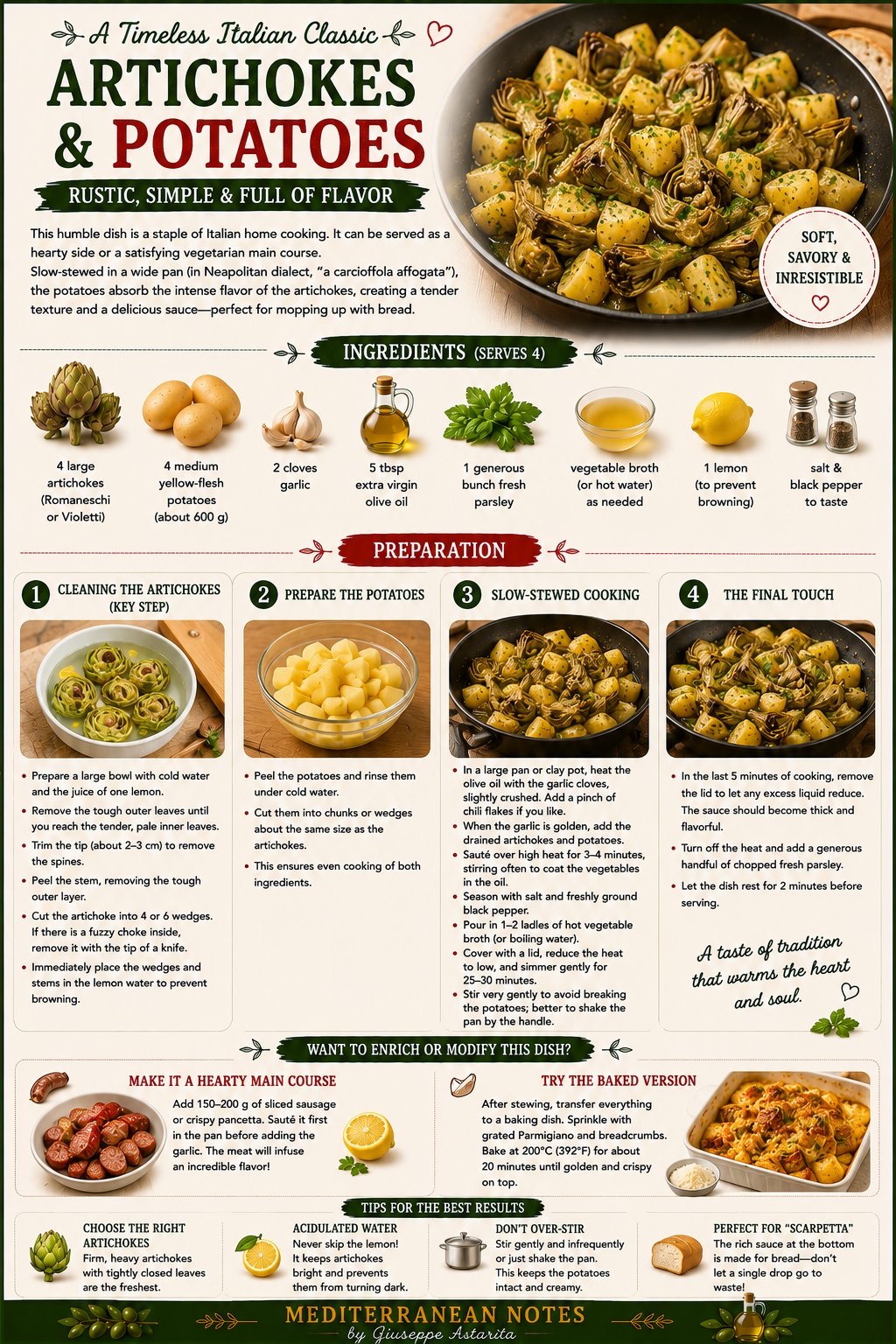
Method
Prepare the lemon water first. Fill a large bowl with cold water and squeeze in the juice of one lemon. Drop the lemon halves in as well. Every cut artichoke piece must go directly into this water — the moment an artichoke is cut, the exposed flesh begins oxidizing brown. Have the bowl ready before you pick up the first artichoke.
Clean the artichokes. Working one at a time: snap off the tough outer leaves — pull them downward and away until you reach leaves that are pale yellow-green at the base and tender. Trim the top 2–3 cm of remaining leaves to remove the thorny tips. Peel the stem by removing the tough outer layer with a knife or peeler — the inner stem is tender and flavorful and worth keeping. Cut the artichoke into 4 or 6 wedges. If there is a fuzzy choke inside the base, scoop it out with a knife tip. Place each wedge immediately in the lemon water.
The "too much discarded" feeling is real and normal. You will remove perhaps half the artichoke. This is not wasteful — the outer leaves are genuinely too tough and fibrous to eat in this preparation. What remains is the best part, and it is enough.
Prepare the potatoes. Peel and cut into chunks roughly the same size as the artichoke wedges — this ensures both vegetables reach tenderness at the same time. Keep in cold water until needed.
Stew everything together. In a large, wide pan or clay pot, heat the olive oil over medium heat. Add the garlic cloves and a pinch of chili flakes if you like. When the garlic is golden, add the drained artichokes and potatoes. Sauté over high heat for 3–4 minutes, stirring to coat both vegetables in the oil and garlic. Season with salt and pepper. Add half the parsley. Pour in 1–2 ladles of vegetable broth or hot water. Cover, reduce the heat to low, and simmer gently for 25–30 minutes.
Shake the pan by the handle rather than stirring with a spoon — stirring breaks the potato pieces. Shake gently to redistribute the vegetables without breaking them.
Finish and serve. In the last 5 minutes, remove the lid to let excess liquid reduce — the sauce should be thick and glossy, not watery. Turn off the heat. Add the remaining fresh parsley, a final drizzle of raw extra-virgin olive oil, and let the dish rest for 2 minutes before serving. The sauce at the bottom of the pan is for bread. Have bread at the table.
The dish can be enriched for a more substantial meal: 150–200 g of sliced sausage or pancetta, browned in the pan before the vegetables go in, transforms it from a vegetable side into a full main course. Or it can be finished in the oven — transferred to a baking dish, sprinkled with Parmigiano and breadcrumbs, baked at 200°C for 20 minutes until golden on top. Both work. The pure vegetable version, finished with good olive oil and parsley and eaten with bread, is the one that made it a favorite.
The artichoke requires work. It rewards patience with a flavor that no less laborious vegetable produces — slightly bitter, earthy, with a sweetness that develops during the slow stewing that is unlike anything else in this collection. If you want to understand why Italians have been preparing artichokes for centuries despite the difficulty of the preparation, make this dish once and taste the sauce at the bottom of the pan. That will answer the question.
And if, next spring, you let one plant go to flower and watch it open — the purple thistle-bloom on a tall stem, one of the more dramatic things a kitchen garden can produce — you will understand something else about what you are eating when you eat an artichoke. You are eating the potential for a flower. It is a reasonable trade.
Buon appetito.