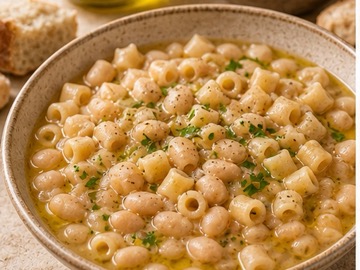
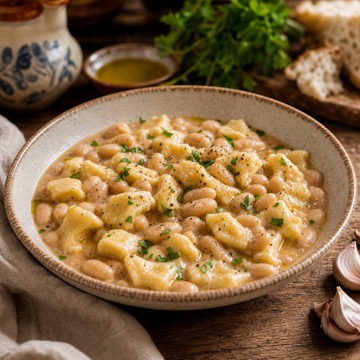
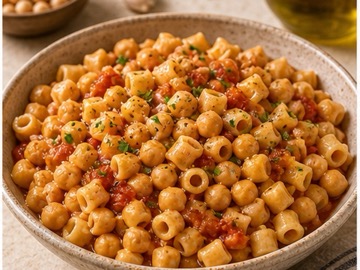
Pasta e fagioli in rosso
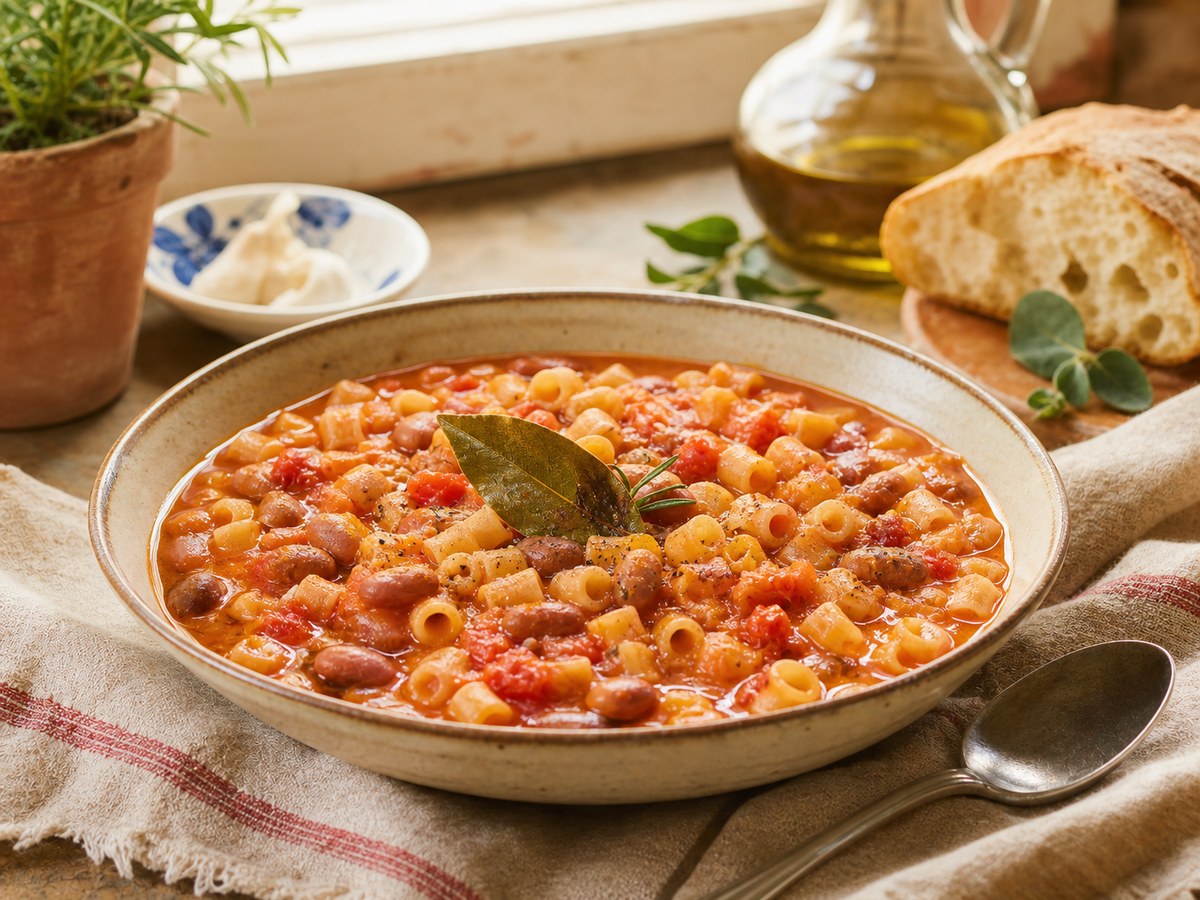
Borlotti beans cooked with tomato passata, bay leaves, garlic, and a thread of chili. Denser and more assertive than the white cannellini version — the broth darker, the beans earthier, the whole thing more rustic. Both belong on the Tuesday table.
My mother made pasta e fagioli on Tuesdays. This was not a rigid rule but a habit so consistent that Tuesday became, in my memory, the day that smelled of beans and garlic. The Catholic calendar gave legumes to Tuesdays and Fridays — cheap, filling, kept well in the pantry — and even after the calendar stopped being followed strictly, the rhythm survived in the kitchen. The science has since validated this rhythm entirely: legumes twice a week is now well-documented as beneficial for gut health, glycemic response, and cardiovascular function. My mother arrived at the same conclusion by a different route.
The version she made alternated between the two. Some weeks, the white version: cannellini, no tomato, the broth almost cream-colored, clean and direct. Other weeks, this one: borlotti with passata, bay leaves, a little chili. The red version has a different character — earthier, more substantial, the broth colored deep orange-brown by the tomato that has cooked into the beans. Borlotti hold their shape slightly better than cannellini and have a distinctive chestnut note that cannellini don't have. Some of the beans dissolve into the broth anyway; some remain whole. This variation in texture within the bowl is correct, not a mistake.
The tubettini or ditalini shape is still required — the small tubes fill with the thick bean broth as they cook directly in it, and every bite contains both the pasta and the liquid that has become part of it. Long pasta cannot do this. The dish should be slightly thicker than a soup and thinner than a stew — somewhere in between, which Neapolitans call né troppo asciutta né troppo brodosa. Not too dry and not too brothy. You eat it with a spoon but it does not pour.
Borlotti vs. cannellini — different beans, different biochemistry
Borlotti beans (cranberry beans) and cannellini (white kidney beans) are both Phaseolus vulgaris varieties but differ in their starch and protein composition. Borlotti have a higher proportion of amylose to amylopectin than cannellini, which contributes to their firmer texture and slightly higher resistant starch content when cooked. The tomato passata in this version adds lycopene — a carotenoid that is substantially more bioavailable when cooked in oil than when consumed raw — and organic acids that lower the pH of the cooking liquid slightly, which affects the color of the borlotti's anthocyanins (the pigments responsible for their mottled purple-red skin). As the pH drops, the anthocyanins shift from blue-purple toward red-orange, contributing to the distinctive dark broth color that distinguishes this version from the white one. The chili provides capsaicin, which stimulates thermoreceptors and marginally increases metabolic rate in the short term, and the olive oil drizzled at the end — always added raw and cold, never cooked in — delivers polyphenols and oleic acid in their most bioavailable form. This Tuesday dish is nutritionally complete: protein, complex carbohydrate, resistant starch, fiber, and bioactive lipids in a single bowl.
Recipe — serves 4
Ingredients
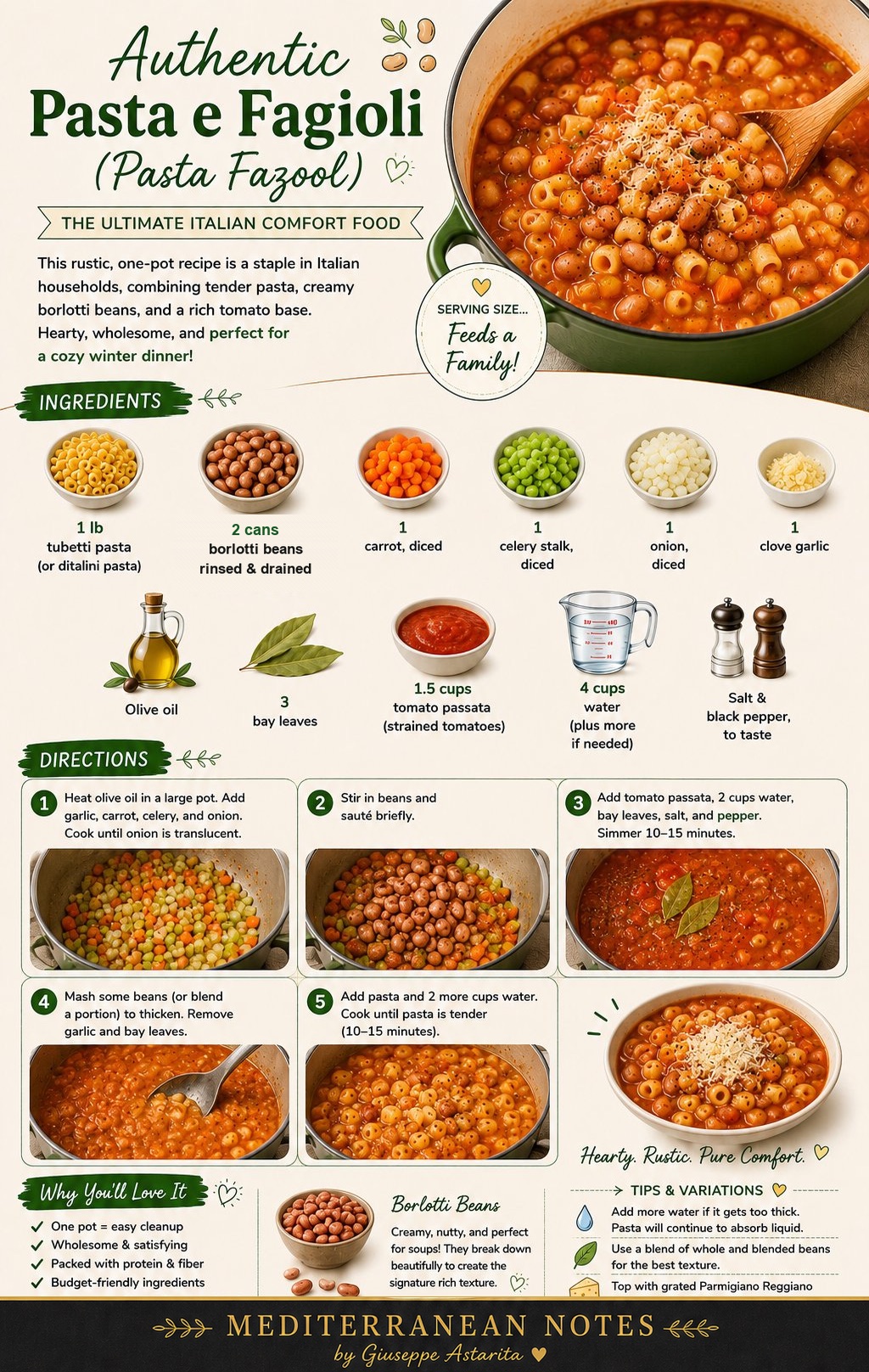
Method
Soften the aromatics. In a heavy-bottomed pot, warm 2 tbsp olive oil over medium heat. Add the crushed garlic, bay leaves, and chili. Cook gently for 2 minutes until fragrant. Do not let the garlic brown.
Add tomato and beans. Add the passata and stir to coat the aromatics. Cook for 3 minutes over medium heat, stirring, until the passata darkens slightly. Add the rinsed borlotti beans and enough water to cover generously — about 700–800 ml. Bring to a simmer.
Simmer and partially mash. Simmer over low heat for 20 minutes (canned beans) or 40 minutes (pre-cooked dried). Remove the bay leaves. Use a wooden spoon or a ladle to crush roughly a quarter of the beans against the side of the pot — this thickens the broth without blending everything. The result should be half whole beans, half creamy liquid. Season with salt now.
Salt after the beans are soft — salting dried or canned beans early can toughen the skins and slow absorption.
Cook the pasta directly in the beans. Check that the liquid level is high enough for the pasta to cook submerged — add water if needed. Bring back to a boil. Add the tubettini directly into the bean broth. Cook, stirring frequently, until the pasta is al dente and has absorbed most of the liquid. The final dish should be dense, not soupy.
The pasta absorbs liquid fast in this environment. Stay nearby and stir regularly. If it becomes too thick before the pasta is cooked, add a ladleful of hot water.
Rest and serve. Remove from heat. Let it rest 3–5 minutes — the pasta and broth continue to integrate. Drizzle 3 tbsp cold extra-virgin olive oil over the top. Serve in deep bowls. No cheese — this is a legume dish, not a pasta dish, and Parmigiano would overwhelm it.
The cold raw olive oil at the end is not optional. It changes the texture and flavor of the whole bowl. Use your best oil here.
The white version
For the white cannellini version — the classic Campanian preparation, in bianco, no tomato — see the companion page. Both belong on the Tuesday table; which one depends on what the week calls for.
Martedì, sempre — con l'olio crudo sopra.