Il Caffè della Moka
Always on the stove, always ready — the ritual of the open door
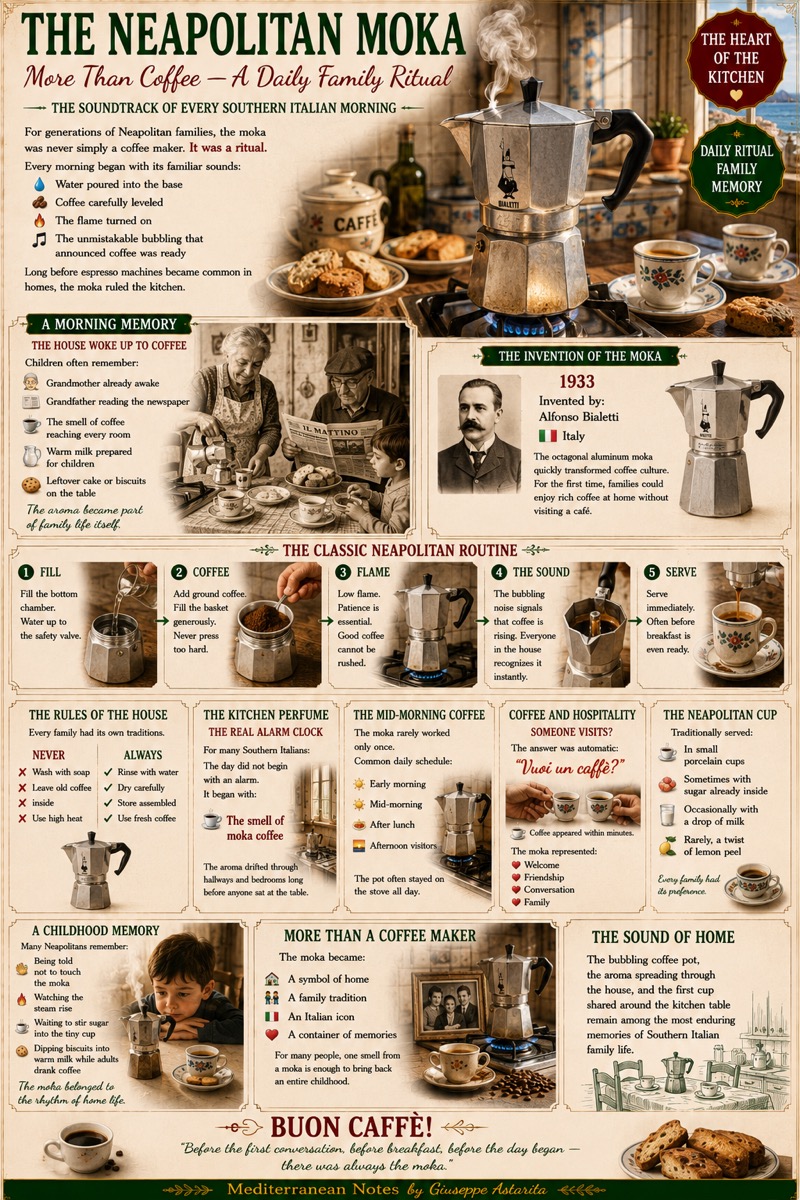
Ti faccio un caffè? It is not really a question. It is an opening. The door is open, the stove is nearby, and before anything else is decided the moka is already filling with cold water. Five minutes. Sit down. Let's talk.
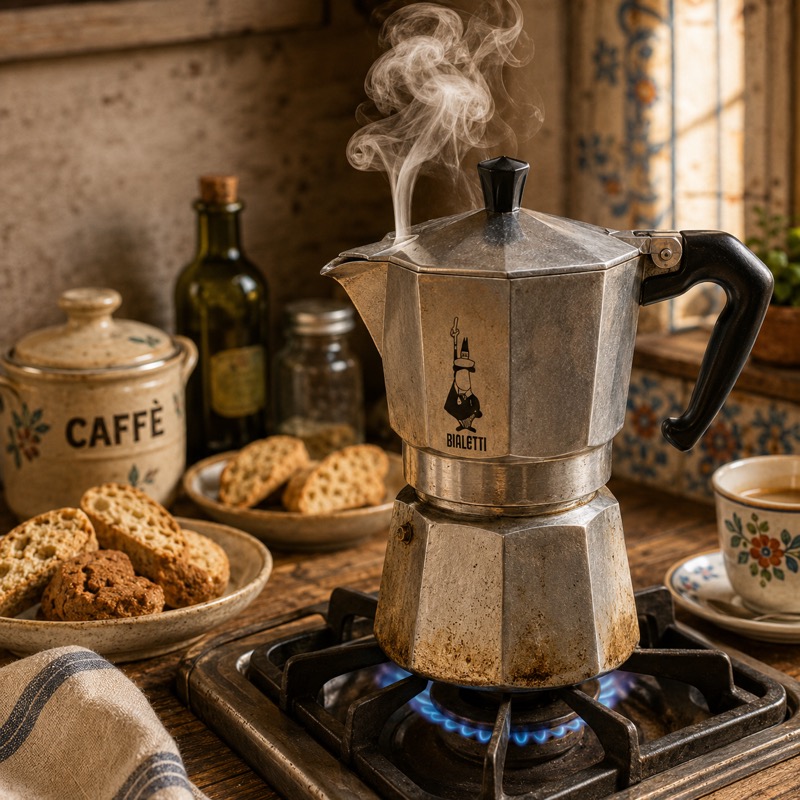
In the house where I grew up, the moka was never put away. It lived on the stove, or just beside it, always. After each use it was disassembled, rinsed, and left open to dry — the top lid propped up, the filter basket out, the two halves of the pot resting face-up on the counter. This was not carelessness. It was readiness. You never knew when someone would arrive — an aunt, an uncle, the neighbor from downstairs, the man who fixed the shutters, a friend of a friend passing through — and the first thing that happened, before coats were hung or seats taken, was the moka going on the stove. It was the signal that you were welcome and that there was no hurry.
The question — ti faccio un caffè? — was asked but never really waited on. The answer was always yes, even when it was no. Even people who did not drink coffee sat down while it was made, because the coffee was not the point. The five minutes it took were the point. The small interruption in the day, the brief ceremony of filling and screwing and waiting for the gurgle — that was what was being offered. A pause. A conversation. A moment that was not going anywhere.
This is not the finest way to make coffee. Espresso from a bar machine extracts differently — higher pressure, finer grind, more controlled temperature — and delivers a different result. The fancy machines I now keep on the counter extract better still. But the moka has something the others do not, which is fifty years of unbroken practice. My grandmothers made it this way. My parents made it this way. I learned to make it this way before I learned to make much else in the kitchen. There is a muscle memory to it — the sound of the water filling the bottom chamber to just below the valve, the way the grounds go into the basket without packing, the half-turn that seals it, the low flame, the moment the first coffee appears and you lower the heat so it rises slowly and doesn't scorch.
I still keep a moka next to the espresso machine. I use both. The espresso machine is for when I want the best possible cup alone in the morning. The moka is for when someone comes through the door. I don't think I could switch them around. The ritual belongs to the object.
The moka works by steam pressure: as the bottom chamber heats, water turns to steam and pushes the remaining hot water up through the coffee grounds in the filter basket and into the upper chamber. The pressure inside reaches roughly 1–2 bar — significantly lower than the 9 bar of a professional espresso machine. This lower pressure means a different extraction profile: moka coffee is bold and concentrated but chemically distinct from true espresso. It tends to extract more of certain bitter compounds (chlorogenic acids and their degradation products) and less of the emulsified oils that give espresso its characteristic crema. The result is a denser, slightly more bitter brew with lower crema. It is not an inferior version of espresso — it is a different drink with its own qualities, made for the stovetop and the home, and optimised not for a 30-second extraction but for a five-minute conversation.
The single most important variable in moka quality is heat. Too high and the coffee scorches as it rises, producing a burnt, metallic taste. A low, steady flame that lets the coffee climb slowly — 3 to 4 minutes for a full pot — preserves the aromatic compounds that make good moka coffee round rather than harsh. Removing the pot from heat the moment the gurgling sound changes (from a steady pour to a sputtering bubble) stops the extraction before the last bitter drops enter the upper chamber.
How to make it — the method
For a 3-cup or 6-cup moka. The ratio and method scale exactly.
After the coffee
When the coffee is finished, unscrew the pot while it is still warm, rinse the two chambers and the basket in water only — no soap, which leaves a residue — and leave everything open to dry. The basket goes on the counter face-up. The bottom sits beside it. The top stands open. Ready for the next person who walks in.
The moka builds up a thin layer of coffee oil on the inside walls over time, what Italian home cooks call la patina del caffè. This is not dirt. It is seasoning. A new moka makes slightly inferior coffee for the first few uses — harsh and metallic — until the patina forms and tempers the extraction. Washing the inside with soap removes it and sets you back to the beginning. Rinse with water only, dry, leave open. This is all the maintenance it needs.
The moka I make coffee with now is not the one from my parents' kitchen. That one is gone somewhere in the way that kitchen objects go — loaned, broken, replaced without ceremony. But the one I have now is the same brand, the same size, the same design. Alfonso Bialetti patented the original in 1933 and the shape has barely changed since. The octagonal aluminum body, the rubber gasket, the steel filter — unchanged for ninety years. There is something in that continuity that I find reassuring. The object has not needed to improve because the ritual has not needed to change.
Un caffè? Siediti — ci vuole solo cinque minuti.